Last reviewed: 18 July 2026
Bahariya Oasis is the most practical Western Desert base for travellers who want to combine an inhabited Egyptian oasis with the Black Desert, Crystal Mountain, Agabat Valley and the White Desert. It lies roughly 370 kilometres southwest of Cairo, and the usual road journey takes about five hours before stops, checkpoints and traffic are added. Bawiti is the main town and the point where most organised trips change from the Cairo transfer vehicle to a locally operated four-wheel drive.
A worthwhile visit normally needs at least two days. Choose two days and one night if the White Desert is your priority. Choose three days and two nights if you want a more balanced journey that includes time in Bahariya, springs or local sights, and a less compressed desert route. Longer itineraries can add Djara Cave or a wider oasis circuit, subject to permits and current access.
Bahariya should not be treated as an unsupervised driving destination. Desert routes cross protected, remote and sometimes regulated areas with limited mobile reception and medical support. Arrange the route with a licensed operator, provide passport details by the requested deadline and confirm permits, vehicle, camp, meals and exact inclusions shortly before departure.
Quick answer: Bahariya Oasis is best for travellers who want oasis life, natural springs, Late Period and Greco-Roman archaeology, and a starting point for the Black Desert–White Desert circuit. For a first visit from Cairo, three days and two nights gives the strongest balance of driving time, oasis context and desert scenery.
Bahariya Oasis quick facts
What and where is Bahariya Oasis?
Bahariya is not one resort, one village or one desert attraction. It is a broad natural depression containing towns, villages, farms, springs, archaeological remains, low mountains and access tracks leading into much larger desert landscapes. Visitors usually stay in or near Bawiti, the administrative and service centre, while local drivers and guides connect the settled oasis to off-road areas.
NASA Earth Observatory describes Bahariya as one of the Western Desert depressions deep enough to reach underground water. From space, the date and olive groves appear as dark patches against the surrounding desert. A recent open-access study in Scientific Reports also describes the oasis as a natural depression approximately 370 kilometres southwest of Cairo and part of the wider Nubian Sandstone Aquifer System.
That geology explains the central idea of an oasis: groundwater makes permanent settlement and agriculture possible in a hyper-arid landscape. It does not mean the water supply is unlimited. Scientific research has raised concerns about intensive groundwater extraction and limited renewable recharge. Visitors should therefore treat water as a valuable local resource rather than assuming that springs, hotel showers or camp supplies are inexhaustible.
The name appears in several English spellings, including Bahariya, Bahariyya, Al-Bahariyya and El-Bahariya. Search engines and maps may use different versions for the same oasis. Bawiti may also appear as Al-Bawiti or El-Bawiti. This guide uses Bahariya and Bawiti for consistency.
Why visit Bahariya instead of going directly to the White Desert?
A hurried itinerary can make Bahariya feel like a transfer station: arrive from Cairo, eat lunch, change vehicles and leave for the desert. That misses the reason the route works.
Bahariya adds four dimensions to the journey:
- A living oasis. Farms, date palms, olive groves, homes, workshops and local cafés show how people live with desert geography rather than merely travelling through it.
- Water in an arid landscape. Natural hot and cold springs reveal the hydrological system that supports settlement.
- Archaeological depth. Tombs, chapels, settlements and discoveries connect the oasis to pharaonic, Greco-Roman and early Christian periods.
- A practical expedition base. Local guides, drivers, four-wheel drives, water, food and camping equipment are organised here before remote travel.
The White Desert remains the visual headline for many visitors, but Bahariya provides the human and environmental context. A good itinerary does not need to visit every named attraction. It should allocate enough time for a few meaningful oasis stops without reducing the desert section to a rushed photo circuit.
Is Bahariya Oasis worth visiting?
Bahariya is worth visiting if you enjoy one or more of the following:
- Remote landscapes reached by overland travel
- A combination of nature, culture and archaeology
- Camping under dark desert skies
- Small towns and agricultural life
- Geological contrasts between black hills, golden sand and white chalk
- Travel with a local guide rather than a self-guided city break
- Slow photography, walking and landscape observation
It may be a poor fit if you need resort-level facilities, guaranteed mobile service, short transfer times, step-free access throughout or a fixed urban schedule. The attraction is precisely the transition from Cairo infrastructure to an oasis and then to remote desert.
If you are unsure, compare the full things to do in Bahariya Oasis guide with the ultimate White Desert guide. The first helps decide whether to reserve time for the oasis; the second explains the landscape most people add after Bahariya.
How many days should you spend in Bahariya?
One day
A day trip from Cairo involves around ten hours of road travel before delays and sightseeing. It can work for a specific business, family or archaeological purpose, but it is not the best first visit. You are likely to reach Bawiti, take a short local circuit and immediately begin the return journey.
If you have only one day, define one objective. Do not try to combine several archaeological sites, springs, the Black Desert and the White Desert.
Two days and one night
Two days is the classic minimum for a Cairo–Bahariya–White Desert loop. The first day normally includes the Cairo transfer, lunch or vehicle change in Bahariya, then selected desert stops and a camp. The second day continues through the landscape and returns via Bahariya to Cairo.
This format prioritises the desert over the oasis. It is suitable when time is limited, but it does not support a comprehensive Bahariya visit. See the White Desert two-day itinerary and the active 2-day, 1-night White Desert adventure for the practical route.
Three days and two nights
Three days is the strongest first-visit format. It can include a quieter arrival, selected oasis attractions, a spring or viewpoint, Black Desert and White Desert sectors, and two nights divided between an oasis hotel and a desert camp or between two camps, depending on the programme.
Elzaghandi Travel publishes a 3-day, 2-night Bahariya Oasis and White Desert adventure for travellers who want both parts of the destination. A separate 3-day, 2-night White Desert adventure may place more emphasis on the remote landscape. Compare the current inclusions rather than choosing by title alone.
Three days with Djara Cave
Djara is not a short detour beside Bawiti. It requires a long off-road sector, additional planning and two desert nights. Read the White Desert and Djara three-day itinerary before selecting it. Travellers whose priority is oasis archaeology or relaxed springs should choose a Bahariya-focused programme instead.
Four days or longer
Extra time can support hiking, photography, a deeper archaeology schedule, an additional camp or a wider oasis circuit. Longer routes toward Farafra, Dakhla, Kharga or Siwa involve separate road, permit and safety considerations. Do not assume that every historic desert track is currently open.
How to get to Bahariya Oasis from Cairo
Most international visitors use a prearranged road transfer. The official Egyptian tourism portal describes Bahariya as the closest Western Desert oasis to Cairo and advises travellers to confirm permits, transportation and logistics with an authorised travel agency or operator.
A typical journey works like this:
- Pickup from an agreed Cairo or Giza address.
- Drive southwest on the paved oasis road.
- Checkpoint and rest stops as required.
- Arrival in Bawiti or the operator’s base.
- Lunch, briefing and baggage reorganisation.
- Change to a local four-wheel drive for off-road travel.
- Return to Bahariya after the desert sector.
- Transfer back to Cairo.
The Cairo transfer vehicle and the desert vehicle may be different. This is normal. A minivan or road vehicle is efficient for the paved transfer; a locally prepared four-wheel drive is needed for sand, tracks, equipment and recovery.
Do not book a flight, train or evening event immediately after the estimated Cairo return. Desert driving, checkpoints, traffic, mechanical checks and group timing can change the arrival window. Ask for a realistic range rather than a guaranteed minute.
For pickup choices, public-transport limitations and the vehicle-change process, use the detailed Cairo to Bahariya Oasis transport guide.
Can you reach Bahariya by public transport?
Local buses or shared transport may operate between Greater Cairo and Bawiti, but schedules, departure points, luggage rules and foreign-visitor procedures can change. Public transport only addresses the paved-road segment. It does not provide a legal, navigated or equipped White Desert expedition.
A public-transport plan may suit an experienced independent traveller staying inside the oasis, provided the current service is verified locally. It is not a substitute for an authorised desert guide, four-wheel drive, permits, water, recovery equipment or camp logistics.
If your main purpose is the Black and White Desert, a door-to-door organised transfer is usually simpler. If you intend to arrive independently, ask the operator exactly where and when to meet in Bawiti and what identification is required.
Bawiti: the practical centre of the oasis
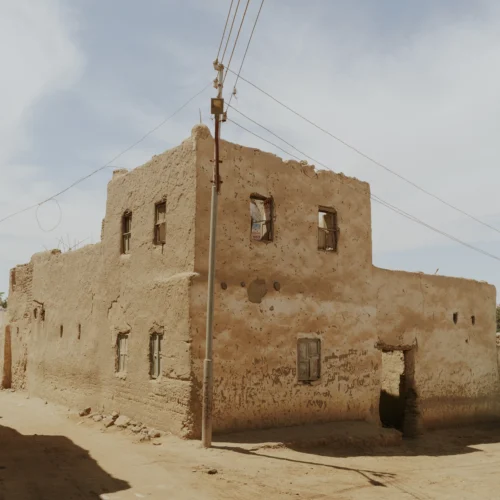
Bawiti is where the abstract idea of “Bahariya Oasis” becomes a working town. It contains accommodation, food shops, cafés, local services and many of the operators who prepare desert journeys.
A useful Bawiti stop is not necessarily a formal sightseeing tour. Walking with a guide through a settled area, seeing date palms and irrigation channels, buying supplies or eating a local lunch can be more informative than racing between landmarks.
Observe normal town etiquette:
- Ask before photographing people.
- Dress comfortably and respectfully.
- Do not enter farms or pick fruit without permission.
- Keep voices moderate near homes and places of worship.
- Use local businesses when practical.
- Expect daily life, not a staged “oasis village” performance.
Bawiti and nearby settlements also make the trip more resilient. Meals can be prepared, fuel checked, water loaded and vehicle problems addressed before entering remote terrain.
Date palms, olive groves and oasis agriculture
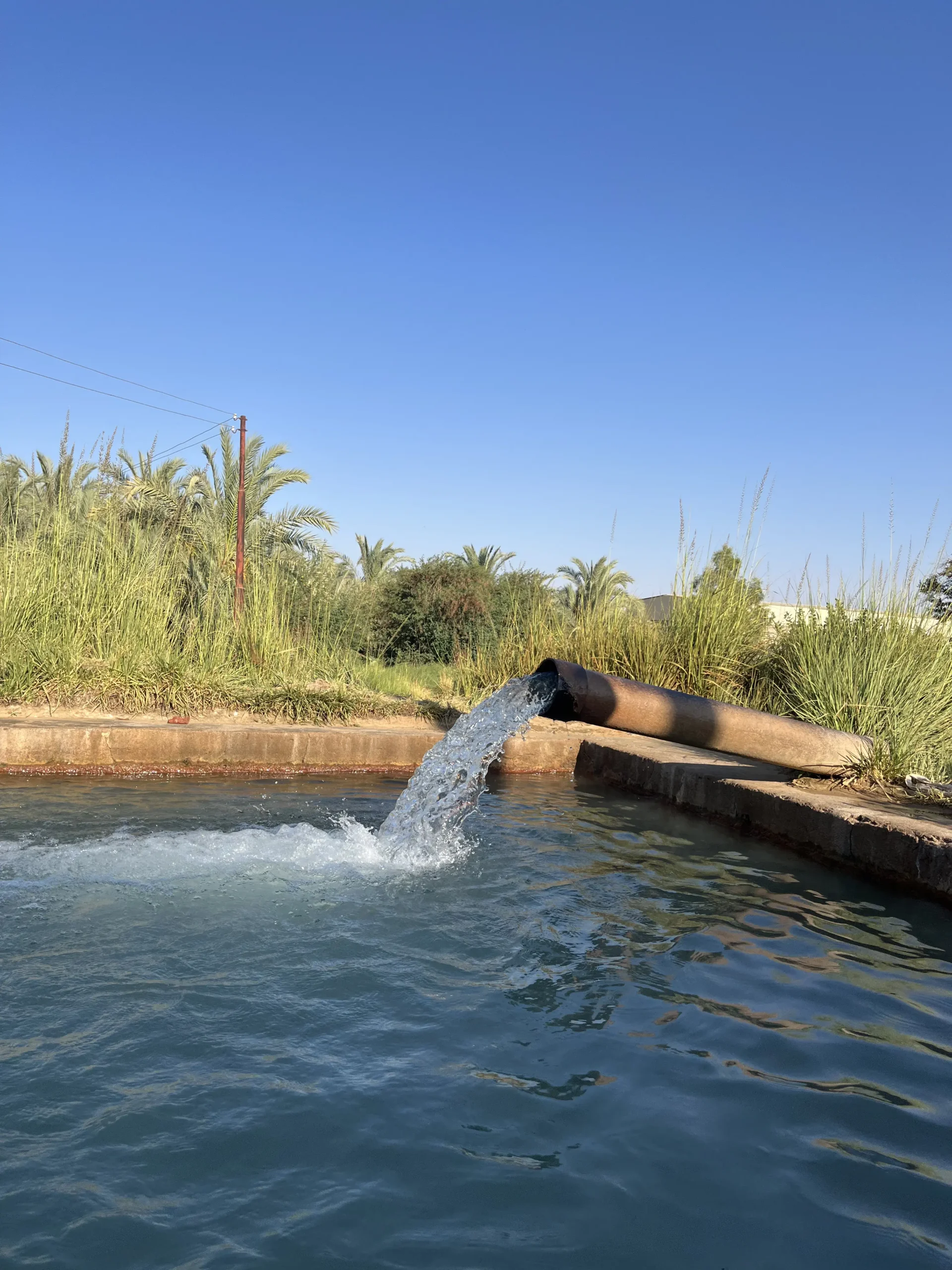
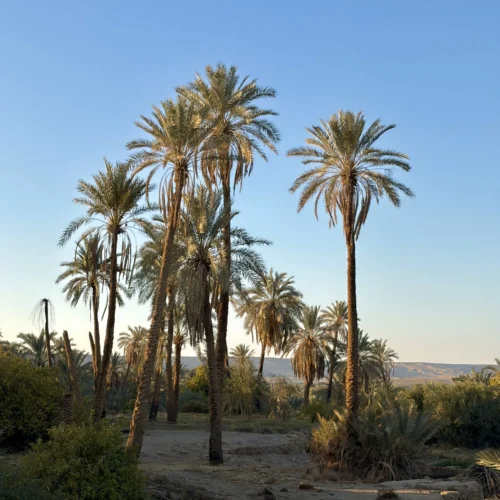
NASA imagery identifies date and olive groves as the dark cultivated patches within Bahariya. These crops are not decorative landscaping; they are part of the oasis economy and cultural identity.
Agriculture depends on groundwater, soil conditions, drainage, labour and long-term management. Some low areas contain saline or waterlogged ponds where irrigation and evaporation interact. A body of water that looks like a natural lake in a photograph may be influenced by agricultural drainage and season.
Visitors should avoid simplistic claims that every green area is “fed by an eternal spring.” The modern oasis is a managed landscape. Water extraction, irrigation, salinity and conservation are connected.
When buying dates or olive products, ask whether they are locally produced and what season you are visiting. Harvest activity changes through the year. Do not expect farms to function as open tourist attractions without an arrangement.
Natural hot and cold springs
The official Experience Egypt page names Ain Gomma, Al-Jaffara, Bir Al-Mattar and Bir Ramla among the better-known natural hot and cold springs in and around Bahariya. Spellings vary across maps and tour programmes.
A spring visit may be a short wash, a warm soak, a photography stop or a local social experience. Facilities range from very basic to developed pools. Temperature, water clarity, privacy, access and maintenance can differ between sites and over time.
Before entering, ask:
- Is bathing currently allowed?
- What is the water temperature today?
- Is there a private changing area?
- Is the pool shared with local residents?
- Is the surface slippery?
- Are children allowed?
- Is there a strong mineral smell?
- Is there a separate pool for different users?
- How long is a sensible visit?
- Should cuts or medical conditions prevent entry?
Do not drink spring water unless a competent local authority confirms that the specific source is potable. Do not describe the water as a treatment for skin, joint or other conditions without medical evidence. Warm water can feel relaxing, but comfort is not the same as a proven health benefit.
A dedicated Bahariya Oasis hot springs guide explains what to bring, privacy questions and how to choose a stop without making medical claims.
Salt lakes and water views
Photos of Bahariya often show blue or green water surrounded by palms and desert. These scenes are attractive, especially near sunrise or late afternoon, but “salt lake” can refer to different ponds or low basins.
Access can change with farm tracks, water level and local conditions. Some edges are muddy or unstable. Do not walk onto a bright salt crust unless the guide confirms it is safe. Keep vehicles on established tracks and avoid disturbing cultivated land.
A salt-lake stop is best treated as a landscape and photography experience rather than a swimming promise. Ask whether the current itinerary includes one and whether entry is permitted.
Mountains and sunset viewpoints
Low dark mountains and mesas rise around the depression. Travellers often visit a local viewpoint for sunset, sometimes described as English Mountain or Black Mountain depending on the programme and translation.
Names are not always used consistently. Ask the guide which hill is being visited, how much climbing is involved and whether the vehicle reaches the viewpoint. Loose stone, steep short slopes and declining light can affect access.
A good viewpoint stop reveals the shape of the oasis: cultivated green areas sit below cliffs and hills, while the desert extends beyond the depression. Bring closed shoes and a light layer. Descend before full darkness unless the guide has lighting and a clear route.
Archaeological sites in Bahariya
Bahariya’s history extends far beyond the modern safari route. Archaeological evidence represents multiple periods, including pharaonic, Greco-Roman and early Christian occupation. The Ministry of Tourism and Antiquities has reported discoveries at Qasr Al-Agouz involving rock-cut spaces, mud-brick structures, churches and Greek inscriptions that help scholars understand early monastic communities.
For travellers, the important rule is that an archaeological name in a guidebook does not guarantee public access today. Excavation, conservation, staffing, ticketing and permit conditions can change. Plan sites with an authorised guide and confirm opening on the day.
Qarat Qasr Salim tombs
Qarat Qasr Salim in Bawiti is associated with decorated Late Period tombs, including those commonly identified with Zed-Amun-ef-ankh and his son Bannentiu. They are valued for painted religious scenes and the insight they offer into elite life in the oasis.
If open, visit slowly. Flash, touching and leaning against painted surfaces may be restricted. Narrow stairs, shafts or low passages can be difficult for people with knee, balance or claustrophobia concerns. Ask about current access before buying a schedule around the tombs.
Ain El-Muftella chapels
Ain El-Muftella is a complex of chapels associated with the 26th Dynasty and the religious landscape near ancient El-Qasr. The surviving reliefs and architecture are important even though the site is smaller and less monumental than temples in Luxor.
This is a context-rich stop. A knowledgeable guide can explain why an oasis temple mattered, who commissioned its chapels and how local administration related to the wider Egyptian state. Without interpretation, visitors may see only low walls and weathered stone.
Temple associated with Alexander the Great
Ruins west of Bawiti are associated with a temple built in the period of Alexander the Great and dedicated within the local religious landscape. Popular retellings often convert archaeological association into certainty that Alexander personally stood at every named location. A careful guide should distinguish inscriptional or architectural evidence from later travel stories.
Access and the visible remains should be confirmed locally. This is best included for travellers with a strong archaeology interest, not promised as a large intact temple.
Valley of the Golden Mummies
The Valley of the Golden Mummies brought international attention to Greco-Roman burials discovered near Bahariya. Public descriptions sometimes repeat a dramatic estimate of thousands of burials. Treat those figures as excavation-era estimates, not as the number of mummies a visitor can see.
The archaeological zone, displays and visitor access are not interchangeable. Ask whether the museum or relevant site is currently open, which objects are on display and whether photography is allowed. Do not plan the entire journey around an unverified opening.
For the history, evidence and practical caveats, read the dedicated Valley of the Golden Mummies guide.
How much archaeology can fit in one itinerary?
Two well-explained sites are more valuable than six rushed names. Archaeological stops often operate during daytime hours, while desert camps depend on reaching the landscape before sunset. Trying to do both on the same arrival afternoon creates conflict.
For a three-day trip, consider one of these patterns:
- Oasis archaeology on Day 1, desert on Days 2 and 3.
- Desert on Days 1 and 2, oasis sights on the return morning.
- One archaeological site plus a spring before or after the desert.
Send your priority list before the quotation. “See Bahariya” is too broad for precise scheduling.
The Black Desert
The Black Desert is normally the first major landscape contrast after leaving Bahariya toward Farafra. Dark volcanic-looking stones and weathered material cover pale hills, giving them a black or rust-coloured appearance.
“Volcanic-looking” should not be simplified into a claim that every hill is a volcano. The landscape reflects geological layers, erosion and iron-rich material. The dedicated why the Black Desert is black article explains the geology in accessible terms.
Typical activities include:
- Viewpoint walks
- Short hill climbs
- Photography
- Geological interpretation
- Sunrise or sunset stops
- Route breaks between Bahariya and the White Desert
The Black Desert is a region, not a single fenced photo point. Conditions and the operator’s route determine what you see. Use the Black Desert Egypt travel guide to compare stops, timing and suitability.
El-Heiz and the transition south
El-Heiz lies south of the main Bahariya settlements and often appears in itineraries as a rest, spring, lunch or cultural stop between the Black Desert and the central desert route.
Its role depends on the programme. Some tours include a spring or local meal; others pass through without a long stop. Confirm what “El-Heiz” means in the quotation, especially if bathing or a specific facility matters to you.
This transition is useful geographically. The route moves from inhabited oasis zones into increasingly remote landscapes. It is the last point to check personal water, medication, warm layers and batteries before camp.
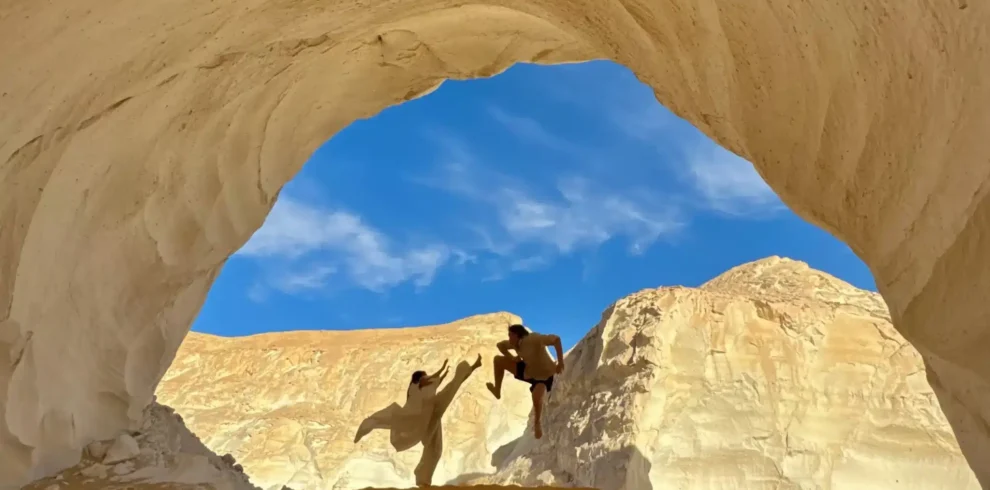
Crystal Mountain
Crystal Mountain is a small geological landmark beside the route toward Farafra. The official Egyptian tourism portal describes it as an ancient underground cave pushed to the surface, with a recognisable arch and crystals that reflect sunlight.
The word “mountain” creates false expectations. It is not a major climbing destination. A typical visit is a short walk around a fragile outcrop.
Do not remove crystals, strike the rock or climb on delicate formations. Repeated visitor pressure can damage the exact features people travel to see. The Crystal Mountain Egypt guide explains geology, visit length, photography and conservation.
Agabat Valley
Agabat, Aqabat or Al-Aqabat is known for golden sand, white cliffs and sculpted forms. Experience Egypt describes it as a dried ancient riverbed landscape where seashells may occasionally be found.
The valley is especially effective as a visual transition. Dark hills give way to pale cliffs and sweeping sand before the White Desert’s isolated chalk formations. Depending on route and conditions, the experience may include viewpoints, walking, lunch or controlled sand driving.
Do not collect shells, fossils or stones. Their scientific and landscape value depends on remaining in context. Read the full Agabat Valley travel guide for timing and responsible access.
The White Desert
The White Desert is the most famous extension from Bahariya, but it is not inside Bawiti. It lies farther south within a protected landscape associated with the Farafra region.
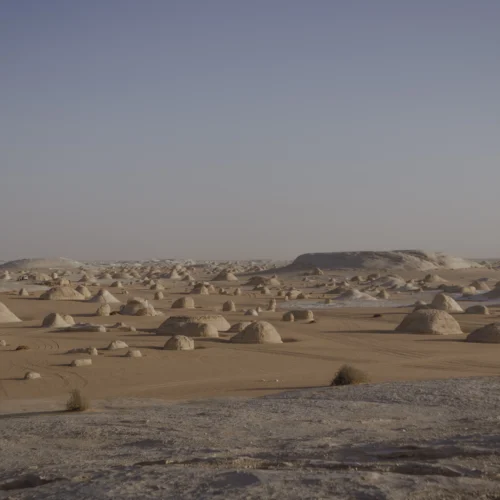
Wind and sand have shaped pale limestone and chalk into towers, mushrooms, animals and abstract forms. The Egyptian Environmental Affairs Agency’s management plan identifies the White Desert as a protected area established under Egyptian law and emphasises conservation, visitor management and local-community participation.
A White Desert programme may include:
- The “Old White Desert” and larger formations
- Newer chalk fields
- Sunset and sunrise stops
- A remote camp
- Short guided walks
- Agabat and Crystal Mountain on the approach
- Black Desert stops on the return or outbound route
Exact camps and tracks can change because of permits, conservation rules, wind, road conditions and group capability. A route description should be a framework, not a promise that the vehicle will stop at every named rock.
For a complete overview, use the White Desert Egypt guide. For the overnight experience, read the White Desert camping guide.
Black Desert versus White Desert
The two areas are complementary, not competing versions of one place.
Most first-time travellers should see both on one route. The Black Desert versus White Desert comparison helps if your time or mobility requires choosing.
Suggested two-day Bahariya and White Desert itinerary
Day 1: Cairo, Bahariya, Black Desert and camp
- Early pickup in Cairo or Giza
- Paved-road transfer to Bawiti
- Lunch and briefing
- Change to local four-wheel drive
- Black Desert viewpoint
- El-Heiz or an agreed rest stop
- Crystal Mountain
- Agabat Valley
- Sunset in the White Desert
- Dinner and camp
Day 2: White Desert sunrise and Cairo return
- Sunrise and breakfast
- White Desert formations
- Additional stops allowed by the current route
- Drive back toward Bahariya
- Lunch or vehicle change in Bawiti
- Return to Cairo
This is efficient but leaves little time for oasis archaeology, farms or springs. It is a desert itinerary using Bahariya as the base.
Suggested three-day Bahariya Oasis itinerary
Day 1: Cairo to Bawiti and oasis orientation
- Morning transfer from Cairo
- Lunch and check-in
- Guided Bawiti or farm-area orientation
- One archaeological site if open
- Spring or sunset viewpoint
- Hotel or eco-lodge night
Day 2: Black Desert to White Desert
- Breakfast
- Four-wheel-drive departure
- Black Desert
- El-Heiz
- Crystal Mountain
- Agabat Valley
- White Desert sunset
- Camp dinner and overnight
Day 3: Sunrise, formations and return
- Sunrise walk
- Breakfast
- White Desert stops
- Return through the desert corridor
- Bawiti lunch or vehicle change
- Cairo transfer
This structure separates oasis and desert days, reducing pressure. It also provides a hotel night before camping, which suits travellers concerned about two consecutive nights outdoors.
Alternative three-day itinerary with more archaeology
Day 1
Travel from Cairo, check in and visit Qarat Qasr Salim or Ain El-Muftella if confirmed open. Finish at a viewpoint.
Day 2
Visit a second archaeological location or spring in the morning, then enter the Black Desert and continue to a desert camp.
Day 3
Explore the White Desert at sunrise and return to Cairo.
This version may reduce Agabat or other remote stops. Tell the operator whether archaeology or desert distance has priority.
Where to stay in Bahariya Oasis
Accommodation generally falls into four useful categories.
Simple local hotel
Best for a clean bed, shower and practical overnight before or after the desert. Ask about room heating or cooling, hot water, stairs, meal times and early breakfast.
Eco-lodge or garden lodge
Usually chosen for atmosphere, palm setting or traditional design. The term “eco” is not a guarantee of environmental certification. Ask what it means in practice: local employment, water management, waste reduction, food sourcing or building method.
Spring-focused accommodation
Some properties promote access to warm water or a pool. Verify whether the water is natural, private, maintained and available at the time of stay.
Desert camp
A camp is an experience, not a substitute for a hotel. Expect tents, mattresses and simple toilet arrangements rather than permanent bathrooms. Ask about bedding, wind protection, group size, privacy and waste management.
The right choice depends on the itinerary. A traveller joining a two-day desert route may not use an oasis hotel at all. A three-day Bahariya programme often benefits from one hotel night and one desert night. See where to stay in Bahariya Oasis for a decision checklist rather than an unverified ranking.
Best time to visit
October through April is the main practical season for many visitors because daytime exploration is more comfortable than in peak summer. December, January and February can bring cold nights, especially in exposed camps. March and April may be warmer but can have wind or dust. Weather varies each year.
October and November
Good for a balance of warm days and cooler evenings. Carry sun protection and a proper night layer.
December to February
Comfortable walking conditions during many days, but camps can become very cold after sunset. Confirm sleeping bags and blankets; pack thermal layers, an insulated jacket, hat and warm socks.
March and April
Often suitable for travel, with increasing daytime warmth. Wind and blowing dust can affect visibility and comfort.
May to September
Travel may still operate, but heat changes the risk profile. Long off-road days, camp setup and limited shade become more demanding. Discuss itinerary timing, water, vehicle air conditioning and heat suitability before booking.
Do not use Cairo weather as a direct forecast for Bahariya or the White Desert. Check the oasis and route separately. The best time to visit the White Desert guide explains seasonal trade-offs in greater detail.
What to eat and drink
Meals vary by operator and accommodation, but a practical desert programme commonly uses simple Egyptian food that can be prepared reliably: bread, cheese, eggs, beans, rice, pasta, vegetables, chicken, fruit, tea and coffee.
Do not assume that “full board” includes unlimited snacks, bottled soft drinks, special coffee or alcohol. Ask what each day includes.
Send dietary information in writing:
- Severe allergies
- Vegetarian or vegan requirement
- Religious dietary requirement
- Gluten or other medical restriction
- Food intolerance
- Child-specific food
- Medication that requires timed meals
Remote meals are loaded before departure. A guide cannot solve a serious allergy after the vehicle has entered the desert. Bring safe personal snacks if missing a meal would create a medical problem.
Drink water supplied by the operator or sealed water from a reliable source. Do not drink directly from a spring based on appearance.
What does a Bahariya trip cost?
A responsible guide should not invent a permanent price. Costs change with fuel, permits, accommodation, group size, season and the Egyptian pound.
A quotation should identify:
- Private or shared departure
- Number of travellers
- Cairo pickup and return areas
- Road transfer vehicle
- Four-wheel-drive arrangement
- Guide and driver
- Number of nights
- Hotel category
- Tent and bedding
- Meals and drinking water
- Permits and protected-area fees
- Archaeological tickets
- Spring or activity charges
- Single-room or private-tent supplement
- Djara or other remote extension
- Children’s policy
- Cancellation terms
- What is explicitly excluded
A low headline price may exclude Cairo transfer, permits, hotel, sleeping bags or site tickets. Compare complete programmes, not only the final number.
Because Elzaghandi Travel uses a request-a-quote model, send dates, nationality, group size, ages, pickup location, preferred duration, accommodation style and main priorities on WhatsApp. That produces a meaningful quotation.
What to pack
For a normal two- or three-day Bahariya and White Desert trip, pack lightly in a soft bag.
Essential day items
- Passport or requested identification
- Water bottle
- Prescribed medication and delay reserve
- Sunglasses
- Sun hat
- Broad-spectrum sunscreen
- Lip balm
- Dust scarf or buff
- Phone and power bank
- Closed walking shoes
- Warm layer
- Small amount of Egyptian cash
- Offline booking details
Camp items
- Thermal or warm sleepwear
- Fleece or insulated mid-layer
- Windproof jacket
- Warm hat in winter
- Dry sleeping socks
- Toiletries
- Unscented wipes
- Toilet paper
- Hand sanitiser
- Small towel
- Sleeping-bag liner
- Headlamp
- Sealable waste bags
Useful extras
- Motion-sickness plan
- Spare glasses for contact-lens users
- Camera batteries
- Earplugs
- Eye mask
- Compact pillow
- Personal menstrual products
- Child comfort item
- Copies of insurance and emergency contacts
Avoid a large rigid suitcase in the four-wheel drive. Leave it at your Cairo hotel when possible. The detailed White Desert packing list explains seasonal layers and camp equipment.
Safety, permits and current travel advice
Safety advice must be specific, current and honest. The U.S. Department of State currently advises increased caution in Egypt and states that Western Desert travel should only be undertaken with a professionally licensed tour company. The UK Foreign, Commonwealth & Development Office currently exempts Bahariya, Farafra, the White Desert and Black Desert from its broader “all but essential” warning for much of the Western Desert, but says tourists in these areas must arrange permits in advance and use an official guide. It also notes limited phone reception and poor medical facilities.
These governments use different risk frameworks. Travellers should read the advice issued for their own nationality, check insurance conditions and review it again shortly before departure.
Practical precautions include:
- Use a licensed company and official guide.
- Submit accurate passport details early.
- Do not change the route independently.
- Respect checkpoints and photography restrictions.
- Keep water and medication accessible.
- Ask about first aid, recovery equipment and emergency communication.
- Inform the operator about chronic illness, pregnancy, severe allergy or mobility limitations.
- Carry insurance that covers the planned activity and medical evacuation.
- Avoid border areas and closed tracks.
- Do not separate from the vehicle or guide.
- Keep a realistic Cairo return window.
- Confirm whether permits are included in writing.
Read the dedicated is the White Desert safe article for a fuller decision framework. No article can guarantee safety; it can only help you identify competent planning and avoid preventable risks.
Vehicle and driving safety
Off-road driving is part of the attraction, but it should not become a performance. A professional driver selects speed and route for the surface, passenger comfort, vehicle load and conservation rules.
Before departure, confirm:
- Seat count and passenger arrangement
- Seat belts
- Child-restraint availability
- Luggage securing
- Recovery equipment
- Spare tyre
- Water reserve
- Communication method
- Driver rest
- Planned fuel range
Tell the driver early if you feel motion sick or need a rest. Do not stand through an open roof or sit unsecured during movement. Sand driving changes abruptly; a loose passenger, bottle or camera can cause injury.
Medical limitations and remote care
Bahariya has local services, but remote desert sectors are far from advanced medical care. Mobile reception may disappear. A minor problem in Cairo can become a serious logistics issue at camp.
Discuss suitability before paying if you have:
- Recent surgery
- Unstable heart or lung disease
- Severe mobility limitation
- Insulin or medicine requiring refrigeration
- Serious allergy
- Pregnancy
- History of heat illness
- Severe sleep apnoea requiring powered equipment
- Claustrophobia relevant to tombs or Djara Cave
- A condition requiring frequent urgent bathroom access
This does not automatically exclude travel. It changes the vehicle, camp, accommodation and emergency questions that must be answered.
Families with children
Bahariya can be memorable for children who tolerate long drives, simple food, basic toilets and temperature changes. It is not automatically suitable for every age.
Confirm:
- Minimum age policy
- Child seat or booster
- Private vehicle availability
- Camp supervision
- Sleeping warmth
- Dietary needs
- Shorter walking alternatives
- Toilet arrangements
- Distance from advanced medical care
- Whether the child can skip a climb or cave
- Screen-free activities for the road transfer
A private three-day itinerary is often easier than a shared two-day rush. Parents can add rest, oasis time and one hotel night.
Older travellers and mobility access
The road transfer is long, four-wheel drives are high, sand is unstable and camps are not step-free facilities. Archaeological sites may include stairs, shafts or uneven floors.
Ask for functional detail:
- Height of the vehicle step
- Availability of a portable step
- Seat location
- Maximum walking distance
- Surface type
- Toilet distance at night
- Mattress height
- Private room or tent
- Which attractions can be viewed without climbing
- Whether the itinerary can include an oasis hotel instead of a second camp
Do not rely on the labels “easy” or “suitable for seniors.” Describe the traveller’s abilities and request a route designed around them.
Solo travellers
A solo traveller can join a shared departure or request a private trip. Shared travel lowers cost but requires flexibility about pickup, pace, camp and photography. Private travel allows more control but costs more.
Ask:
- Is the departure guaranteed?
- Who shares the vehicle?
- Is the tent private?
- Is there a single supplement?
- What happens if another guest cancels?
- How are room and tent assignments handled?
- Can dietary and photography priorities be accommodated?
- What is the guide’s language?
Women travelling alone should also ask about private changing and toilet arrangements, room locks, guide contact and pickup identification.
Photography and drones
Bahariya offers strong contrasts: palms against cliffs, dark hills, white formations, orange sunrise and night skies.
Good practice:
- Ask permission before photographing people.
- Do not photograph checkpoints, military sites or sensitive infrastructure.
- Keep tripods away from fragile formations and paths.
- Do not climb for a photograph if the guide says the surface is unstable.
- Protect equipment from dust.
- Bring spare batteries; cold nights reduce performance.
- Avoid strong lights near wildlife or other camps.
- Label archaeological interpretations carefully.
Do not fly a drone without written confirmation that every required Egyptian permission has been obtained. Desert remoteness does not remove aviation, security or protected-area rules.
Responsible desert travel
The White Desert management plan emphasises balancing visitor use, conservation and community benefit. A traveller contributes through small decisions.
Leave geological material where it is
Do not take crystals, fossils, shells, chalk or black stones. A common-looking object may have scientific value, and repeated collection changes the site.
Protect formations and archaeology
Do not climb, carve, trace, wet or touch fragile surfaces. Never lean bags against painted tomb walls or rock art.
Control waste
Carry out tissues, wipes, batteries, food packaging and sanitary products. “Biodegradable” wipes still do not belong in the desert.
Use established tracks and camps
Uncontrolled driving scars fragile surfaces and vegetation. Follow the guide’s route.
Conserve water
Use camp water for essential drinking and hygiene. Do not demand hotel-style consumption in a water-stressed oasis.
Support local skill
Local drivers and guides hold route, weather, mechanical and cultural knowledge. Fairly organised tourism keeps more value within the oasis.
Respect wildlife
Do not feed foxes or leave food scraps. Feeding changes animal behaviour and attracts wildlife to vehicles and camps.
How to choose a Bahariya tour
A credible programme should answer practical questions without relying on phrases such as “all inclusive” or “best safari.”
Ask for:
- Exact pickup area and time window
- Road and desert vehicle types
- Group size
- Guide language
- Seat-belt arrangement
- Number and type of nights
- Hotel name or category
- Tent, mattress, sleeping bag and blanket details
- Toilet setup
- Complete meal and water schedule
- Permit responsibility
- Archaeological tickets and current openings
- Springs or salt-lake stops
- Desert landmarks included
- Route-change policy
- Dietary arrangements
- Child or mobility accommodations
- Emergency communication
- Cancellation terms
- Realistic Cairo return range
Send one priority sentence: “We care most about oasis archaeology,” “We want the longest White Desert photography time,” or “We need a comfortable family itinerary.” It helps the operator choose between routes that share the same duration.
Common planning mistakes
Treating Bahariya and the White Desert as the same place
Bahariya is the inhabited oasis and operational base. The White Desert is a protected landscape farther south. Travel time between them matters.
Booking a same-day Cairo return
The road journey consumes most of the day. Add at least one night for a meaningful desert experience.
Assuming every attraction is included
A page may list springs, tombs, lakes and viewpoints as possibilities. Only the written itinerary and quote define your booking.
Choosing by price alone
Vehicle load, guide quality, bedding, food, permits and group size change the experience.
Packing for Cairo weather
Desert nights can be much colder and windier. Use layers.
Expecting permanent bathrooms at camp
Ask about a toilet tent and waste method. A desert camp is basic.
Believing hot springs have guaranteed medical benefits
Treat them as a cultural and recreational experience unless a qualified medical source supports a specific claim.
Depending on mobile service
Download documents and tell family the route before leaving Bawiti.
Collecting a “small souvenir” from the desert
Crystals, fossils and rocks belong in the landscape.
Scheduling a flight after the return
Use a buffer night in Cairo when possible.
Explore Bahariya in more detail: See the 12 essential things to do in Bahariya Oasis, plan the journey with Cairo-to-Bahariya transport advice, and explore the Valley of the Golden Mummies, Bahariya hot springs and Salt Lake sunset guide.
Explore the oasis: Visit the Bahariya Oasis destination page to compare the current trips connected to this guide.
Frequently asked questions
What is Bahariya Oasis famous for?
Bahariya is known for its date and olive groves, natural hot and cold springs, archaeological sites, Bawiti town, the Black Desert and its role as a gateway to the White Desert route.
How far is Bahariya Oasis from Cairo?
Scientific and tourism references place it at roughly 370 to 380 kilometres southwest of Cairo. The practical road journey is commonly around five hours before traffic, stops and checkpoints.
Is Bahariya in Giza Governorate?
The oasis is administratively associated with Giza Governorate, despite being far southwest of the urban Giza pyramid area. Do not confuse a “Giza” address with proximity to the pyramids.
What is the main town in Bahariya?
Bawiti is the principal town and the usual arrival, accommodation and vehicle-change point.
Can I visit Bahariya in one day?
You can drive there and return, but it is not recommended for a first leisure visit. The round trip leaves little time for the oasis and does not support a meaningful White Desert journey.
How long should I stay?
Choose two days for a fast White Desert loop, three days for a balanced Bahariya-and-desert trip, and longer for Djara Cave, archaeology or a wider oasis circuit.
Is Bahariya the closest oasis to Cairo?
The official Egyptian tourism portal describes Al-Bahariyya as the closest Western Desert oasis to Cairo and a good starting point for desert exploration.
Do I need a guide?
Use an official guide and licensed operator for desert excursions. Current UK guidance says Bahariya, Farafra, Black Desert and White Desert tourists must apply for permits in advance and use an official guide.
Do I need permits?
Permits and route approvals may be required. The operator should arrange them after receiving accurate traveller details. Confirm inclusion and deadlines in writing.
Can I drive my own rental car into the White Desert?
Do not treat a rental car as an expedition vehicle. Off-road sectors require local navigation, permits, recovery equipment, supplies and an authorised guide. Rental agreements may also prohibit off-road use.
Is Bahariya safe?
No destination is risk-free. Government advice differs by nationality. Use a licensed company, check current official travel advice and insurance, follow checkpoint rules and recognise that remote medical and phone support are limited.
Is the road from Cairo paved?
The main Cairo–Bahariya connection is a paved road. The desert attractions use separate tracks and off-road routes.
Is there an airport?
Bahariya is normally reached by road from Cairo. Do not plan around a scheduled commercial flight unless a current official service is independently verified.
Is there Wi-Fi or phone signal?
Expect service in parts of Bawiti and some accommodation, but weak or no reception in remote desert. Wi-Fi quality varies.
Are there ATMs?
Do not depend on a specific ATM or international-card acceptance. Bring a reasonable amount of Egyptian cash from Cairo and keep it secure.
Can I use credit cards?
Some accommodation or operators may accept electronic payment, but local purchases and tips may require cash. Confirm payment method before departure.
Are the hot springs safe to swim in?
Conditions vary. Ask the guide about current temperature, access, cleanliness, depth, surface and privacy. People with medical conditions should seek appropriate advice. Never assume therapeutic benefit.
Which springs are well known?
Experience Egypt names Ain Gomma, Al-Jaffara, Bir Al-Mattar and Bir Ramla among the better-known hot and cold springs in and around Bahariya.
Are there salt lakes?
There are saline and waterlogged ponds or lake-like basins within the oasis landscape. Access and water level vary, and not every itinerary includes a safe swimming location.
What archaeological sites can I see?
Possible sites include the decorated Qarat Qasr Salim tombs, Ain El-Muftella chapels, ruins associated with Alexander’s period and displays connected to the Golden Mummies discoveries. Verify opening and access on the travel date.
Can I see thousands of Golden Mummies?
No. Large numbers quoted in media refer to estimates for a wider archaeological area, not a public display containing thousands of visible mummies.
What is the Black Desert?
It is a landscape of pale hills and ground covered by dark, iron-rich and volcanic-looking material. It is normally visited on the road south from Bahariya.
What is Crystal Mountain?
It is a small crystal-bearing geological outcrop and arch, not a high mountain. Visits are usually short and collection is prohibited.
What is Agabat Valley?
Agabat is a dramatic area of golden sand and white cliffs on the route toward the White Desert. It is associated with an ancient riverbed landscape.
Can I camp in the White Desert?
Yes, when the current regulations, route and operator arrangements allow it. Use an authorised company, established camp practices and complete leave-no-trace procedures.
What are the toilets like?
Remote camps have no permanent bathrooms. Operators may provide a toilet tent and portable system. Confirm details before booking.
Is there a shower at camp?
Normally no. Use simple hygiene supplies and conserve water. An oasis hotel night provides a better option for travellers who require a shower.
How cold does it get?
Winter nights can feel very cold, especially with wind. Exact temperatures vary. Confirm bedding and bring thermal layers, a warm jacket, hat and dry socks.
Is summer too hot?
Summer can make long transfers, off-road driving and camp setup demanding. Ask about vehicle cooling, water, shade, departure timing and whether a shorter oasis-focused programme is more suitable.
What clothes should women wear?
Loose, breathable clothing covering shoulders and knees works well for sun protection and town respect. Bring layers, a scarf or buff and private changing supplies for camp.
Is Bahariya good for children?
It can be, if the child handles long drives, basic toilets and camping. Confirm restraints, private vehicle, food, warmth, medical access and a flexible schedule.
Is it suitable for older travellers?
Suitability depends on vehicle entry, sand walking, stairs, toilet distance and sleeping setup. A private itinerary with a hotel night can reduce difficulty.
Can a solo woman travel?
A solo woman can book a private or shared trip, but should confirm guide identity, pickup, room or tent privacy, changing and toilet arrangements, and emergency contact.
Can I visit Djara Cave from Bahariya?
Djara is reached through a separate long off-road expedition, usually within a three-day, two-night plan. It is not a quick add-on to a standard two-day White Desert tour.
Can I continue from Bahariya to Siwa?
Historic routes exist, but road and security conditions can restrict travel. Current UK advice states that the road between Al-Bawiti and Siwa is closed and advises against all but essential travel in that sector. Verify current rules; do not plan it as an automatic transfer.
What should I send for a quote?
Send travel dates, nationality, number of adults and children, ages, Cairo pickup area, preferred duration, private or shared preference, hotel or camping needs, dietary restrictions, medical or mobility considerations and the attractions that matter most.
Plan your Bahariya trip
Start with duration and priority:
- Choose the active 2-day White Desert adventure when time is limited and the desert is the main goal.
- Choose the 3-day Bahariya Oasis and White Desert adventure when you want oasis context and a less compressed route.
- Choose the 3-day White Desert adventure when the landscape and camping experience take priority.
- Review the Djara Cave three-day itinerary for a more remote expedition.
- Use the custom trip page when archaeology, accessibility, photography or family pacing requires a tailored programme.
The right itinerary is not the one with the longest attraction list. It is the one that allows realistic road time, safe desert operations, meaningful stops and enough rest.
Sources and further reading
- Egyptian Tourism Authority, Natural Wonders of Al-Bahariyya. Official overview of proximity to Cairo, Black and White Desert excursions, named springs and the need to confirm permits and logistics.
- Egyptian Tourism Authority, Desert Excursions. Official descriptions of the White Desert, Black Desert, Crystal Mountain, Agabat Valley and permit guidance.
- NASA Earth Observatory, Bahariya Oasis. Satellite context for the depression, groundwater, Bawiti, date groves and olive groves.
- El-Badrawy, H. T. et al. (2026), Mapping and predicting groundwater accumulations in Bahariya Oasis, Scientific Reports. Geography, geology and water-resource context.
- Egyptian Environmental Affairs Agency, White Desert Protected Area Management Plan. Protected-area purpose, landscapes, visitor management and community participation.
- Ministry of Tourism and Antiquities, Archaeological discoveries at Qasr Al-Agouz in Bahariya Oasis. Official early Christian and monastic archaeology context.
- U.S. Department of State, Egypt Travel Advisory. Current U.S. risk guidance for Egypt and licensed-company requirement for Western Desert travel.
- UK Foreign, Commonwealth & Development Office, Egypt regional risks. Current permit, official-guide, communications and medical-facility guidance for Bahariya and the Black and White Desert.
- Elzaghandi Travel, 3 Days / 2 Nights Bahariya Oasis and White Desert Adventure. Active first-party itinerary and quotation framework.
Request a current Bahariya and White Desert quote
Message Elzaghandi Travel on WhatsApp with your dates, nationality, group size, ages, Cairo pickup area and preferred number of nights. State whether your priority is Bahariya archaeology and springs, the Black and White Desert, photography, family comfort or a Djara extension. The team can then confirm the current route, permits, accommodation, camp equipment and price.