Black Desert vs White Desert Egypt: What’s Different?
Last reviewed: 7 September 2026
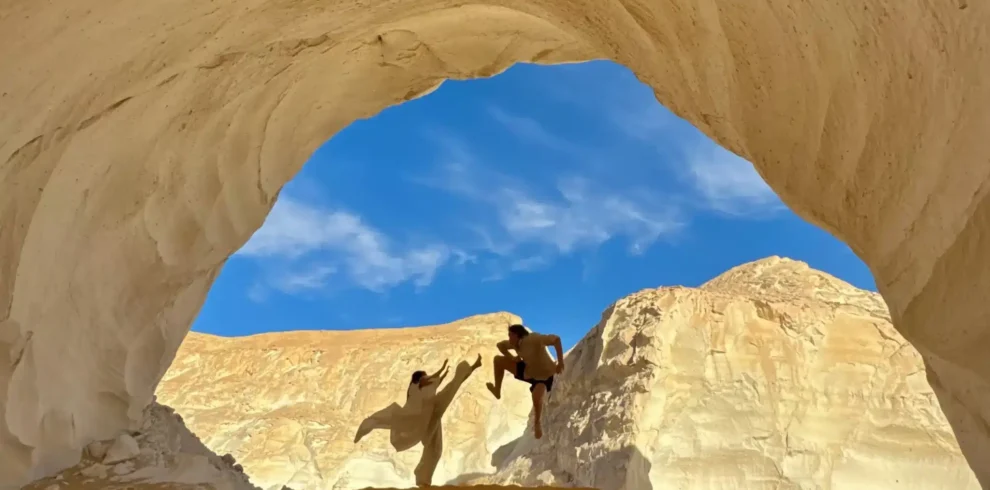
Egypt's Black Desert and White Desert are two different protected landscapes on the same Western Desert route. The Black Desert is closer to Bahariya Oasis and is known for widely spaced dark hills, iron-rich sedimentary rocks and igneous material. The White Desert lies farther south in the northern Farafra Depression and is known for bright chalk plains, domes and wind-sculpted formations. Most travelers should not choose one instead of the other: a properly planned two-day or three-day trip can visit both.
The Black Desert is usually a daytime landscape stop for viewpoints, short walks and geological contrast. The White Desert normally receives more time because it is the principal formation area and the common setting for sunset, an authorized camp, stargazing and sunrise. Bahariya Oasis—especially Bawiti—is the logistical gateway for road transfers, local guides, four-wheel-drive vehicles, food, permits and equipment.
If you have only one desert night, the most balanced sequence is Cairo or Giza to Bahariya, then Black Desert, El Heiz, Crystal Mountain and Agabat before camping in the White Desert. If you have three days, add an oasis hotel night and explore Bahariya's springs, salt lake, farms and English Mountain before starting the same southbound route.
The Black Desert is not a continuous field of black sand. Its identity comes from dark hills and rock fragments set against paler desert surfaces.
Black Desert vs White Desert: quick comparison
| Feature | Black Desert | White Desert |
|---|---|---|
| Main look | Dark hills, iron-rich colors and black gravel over pale ground | Bright chalk plains, stacks, domes and sculpted formations |
| Best known for | Geological contrast, viewpoints and short walks | Iconic formations, sunset, camping, stars and sunrise |
| Position on route | Closer to Bahariya Oasis | Farther south toward the Farafra depression |
| Typical visit style | Daytime stop or shorter outing from Bahariya | Longer stop and usual overnight focus |
| Camping | Not the usual choice on standard combined trips | Common in an authorized camp sector |
| Best for | Geology, dark-landscape photography and shorter visits | First-time visitors, camping, night photography and iconic scenery |
| Can you see both? | Yes. A 2-day / 1-night route commonly combines both, while 3 days gives a slower pace and more Bahariya time. | |
The short decision: see both if you can
Choose both deserts if you have at least two days and one night. Their contrast is the point: living oasis, dark hills, crystal-bearing ridge, pale escarpments, chalk formations, sunset, stars and sunrise form one coherent route.
Choose the White Desert only as the higher-priority landscape if a route closure, physical limitation or very short schedule forces a decision and your main goal is camping among iconic formations. Even then, the route from Bahariya may pass the Black Desert corridor, so ask whether a safe viewpoint can remain in the itinerary.
Choose the Black Desert without a White Desert camp if you are already staying in Bahariya, want a shorter daytime excursion, cannot tolerate a remote overnight, or need a hotel bathroom and bed. This is not the same as a same-day trip from Cairo; the Cairo–Bahariya road transfer is still substantial.
Choose a three-day combined trip if you care about the inhabited oasis as much as the scenery, travel with children or older relatives, want a slower photographic pace, or prefer one hotel night before the camp.
Are the Black Desert and White Desert the same place?
No. They are separate named landscapes and separate protected-area contexts, although tourism itineraries commonly combine them.
The Black Desert is associated with the southern part of the Bahariya Depression. A peer-reviewed study of geological heritage in Bahariya and Farafra describes the Bahariya Formation weathering into black conical hills, mesas and buttes. It places the familiar Black Desert landscape roughly 50 km southwest of Bawiti and notes black gravel and rock fragments scattered across the floor.
The White Desert National Park is in the northern part of the Farafra Depression. The Egyptian Environmental Affairs Agency's White Desert management plan describes snow-white chalk, chalk stacks, inselbergs, dunes and other sedimentary features. It also defines management zones, which is why an old photograph or map pin cannot prove that driving or camping is allowed at that exact point today.
Between the headline attractions, a normal route may include El Heiz or El Hez, Crystal Mountain, Agabat and other approved landscape stops. These are not interchangeable names for the Black or White Desert.
Where are the two deserts on the route?
The practical north-to-south sequence for a Cairo-based itinerary is:
- Cairo or Giza pickup;
- paved road to Bahariya Oasis;
- Bawiti for lunch, guide, vehicle, supplies and permit coordination;
- Black Desert;
- El Heiz, depending on the active route;
- Crystal Mountain;
- Agabat and nearby formations or caves included in the itinerary;
- White Desert formation and camp sector;
- return through Bahariya to Cairo.
NASA's Bahariya Oasis overview describes Bawiti, date and olive groves, and the groundwater-fed depression about 380 km southwest of Cairo. The official Egyptian Tourism Authority calls Bahariya a convenient starting point for both deserts and recommends experienced, licensed guides with a 4×4 for excursions outside the oasis.
Use the Bahariya Oasis Egypt Travel Guide for the gateway as a destination, and Where to Stay in Bahariya Oasis when adding a hotel night.
Read How to Get to the White Desert from Cairo for the full transfer sequence. The planned How to Visit the Black Desert from Cairo focuses on shorter Black Desert-only and combined scenarios.
What the Black Desert actually looks like
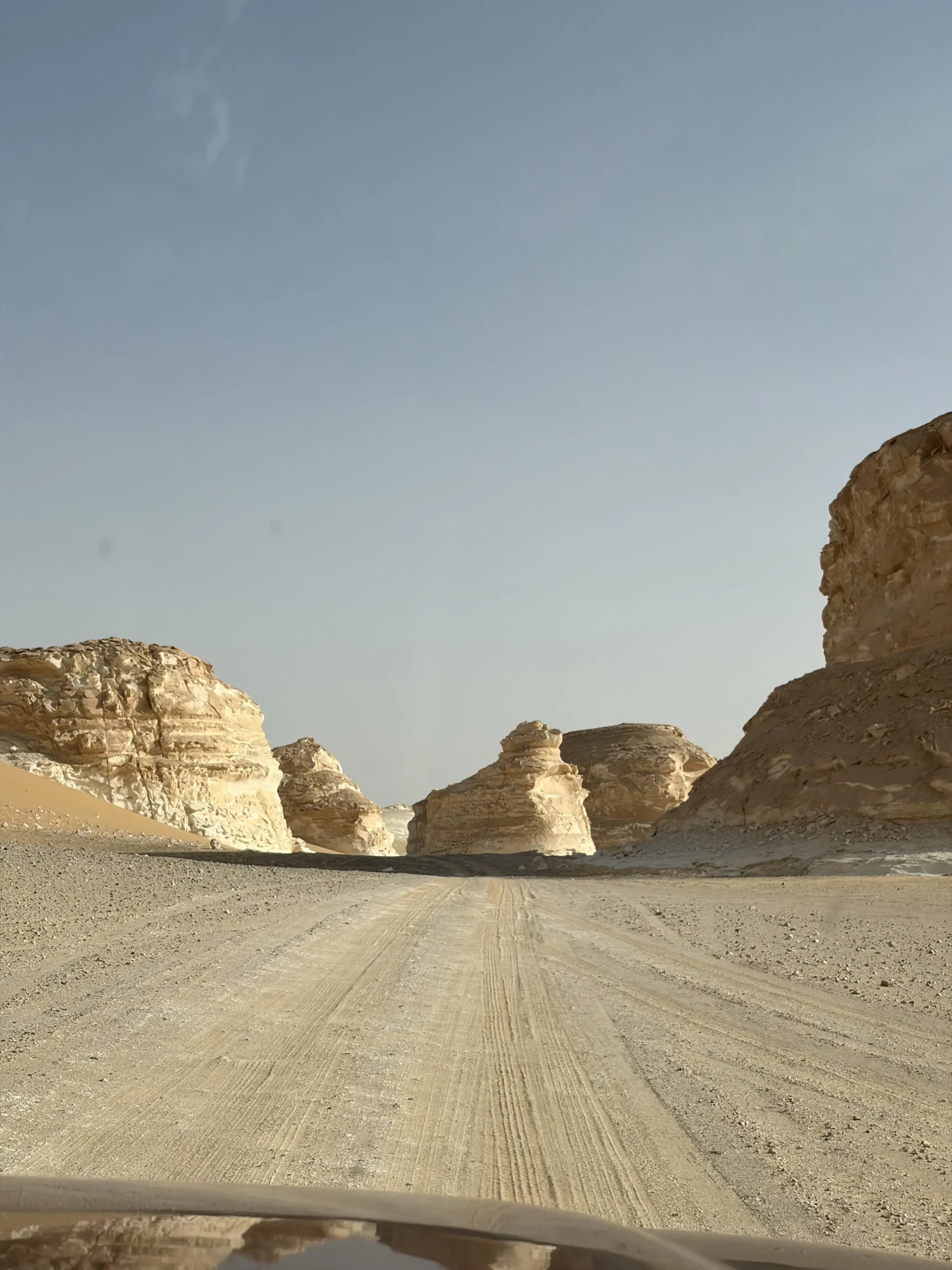
The Black Desert is not a black equivalent of the Sahara's golden dune fields. Pale sediment remains visible between isolated hills. Some slopes are charcoal or dark brown; others are red, orange or ochre because iron-rich rocks weather into different colors.
The visual elements include:
- conical or rounded hills;
- flat-topped mesas and buttes;
- dark caps protecting softer layers below;
- black gravel and fragments spread down slopes;
- ferruginous sandstone and shale;
- igneous material such as basaltic sills or dolerite in parts of the region;
- beige and pale ground that makes the dark material more visible;
- long gaps between hills rather than a continuous mountain wall.
This landscape rewards observation more than a checklist. Look for the edge of a cap rock, the way fragments become smaller downslope, the difference between a dark band and rusty sandstone, and the alignment of hills across the depression.
Use the complete Black Desert Egypt Travel Guide for access, climbing, photography, permits and the route from Bahariya.
What the White Desert actually looks like
The White Desert is a broad pale landscape rather than one field of identical “mushrooms.” Its best-known forms are erosional remnants of chalk and chalky limestone. The official Egyptian Tourism Authority describes dunes, domes, wind-carved sculptures and marine fossils within the pale layers. The EEAA management plan identifies chalk stacks, inselbergs and dunes as major landforms.
Visitors may see:
- bright chalk plains;
- freestanding stacks and columns;
- mushroom-like and animal-like silhouettes;
- domes and low rounded forms;
- joint-controlled ridges;
- polished or pitted chalk surfaces;
- dark hematite stones against white ground;
- cliffs, dunes and wider Farafra Depression relief;
- marine fossils where observation is permitted.
Do not touch, climb or collect a formation because it looks solid. Chalk can be fragile, and repeated footsteps, vehicle tracks and handling accumulate damage.
The White Desert Egypt Travel Guide covers the formations, tour formats, camp experience and practical planning in detail.
The White Desert normally receives the overnight portion of a combined trip. The approved camp location and setup must be reconfirmed for the travel date.
Geology comparison: why one is dark and the other is white
Black Desert geology
The Black Desert sits within the geological story of the Bahariya Depression. The peer-reviewed 2016 geoheritage paper describes the Cenomanian Bahariya Formation as ferruginous sandstone and shale weathered into black conical hills, mesas and buttes; it reports basalt sills capping many hills.
The dark appearance therefore has more than one contributor:
- iron-rich sedimentary rocks and crusts;
- goethite, hematite and other iron-bearing minerals;
- dark igneous material in parts of the landscape;
- erosion distributing black fragments across pale ground;
- shadow and low-angle light increasing contrast.
A 2015 study of ironstone crusts in the Bahariya Formation explains that regional ironstone can form through complex post-depositional processes involving fluids, carbonate replacement and iron oxyhydroxides. Scientific work also documents genuine volcanic and intrusive features in the wider Bahariya Depression. The accurate statement is not “nothing is volcanic” but “not every dark, cone-shaped hill is a volcano.”
Continue to Why Is Egypt's Black Desert Black? for the dedicated geology article.
White Desert geology
The White Desert's famous formations are sedimentary. The EEAA management plan says exposed rocks range from Cretaceous to recent and identifies the Khoman chalk as the oldest widespread unit in the Farafra Oasis. It describes Upper Cretaceous chalk beds cut by joints, with differential weathering producing white stacks that rise above the plain.
The simplified sequence is:
- marine sediment accumulated when this region was under ancient seas;
- chalk and related sedimentary units became rock;
- uplift and exposure placed them within an arid surface environment;
- joints and differences in hardness guided weathering;
- wind, sand, temperature change and occasional water action removed weaker material;
- more resistant remnants survived as stacks, domes, ridges and other shapes.
The official tourism site calls the White Desert an ancient seabed and highlights marine fossils. A fossil is evidence of the sedimentary environment; it is not a souvenir. Leave it in place.
Rock age is not the same as formation shape age
Online articles often attach one age to the White Desert and imply that both the chalk and today's mushroom-like shapes appeared at the same moment. That is not sound geology.
The rock unit can be Upper Cretaceous—many tens of millions of years old—while the exposed landform is a later erosional result that continues changing today. Similarly, a dark cap in the Black Desert can be older than the modern hill profile preserved beneath it.
The official Egyptian tourism page says the White Desert's natural art gallery has been “in the making” for about 30 million years. The EEAA management plan identifies older Upper Cretaceous chalk. These statements describe different parts of the story: the age of the sedimentary material and the long period of exposure and sculpting should not be collapsed into one date.
For SEO and visitor education, the safest wording is:
- White Desert rock: ancient marine chalk and limestone, including Upper Cretaceous units.
- White Desert shapes: later erosional landforms whose exact age varies and is not one universal date.
- Black Desert rock: mixed sedimentary and igneous components of different ages.
- Black Desert hills: erosional forms; appearance alone cannot date or classify each hill.
The names are visual, not absolute scientific categories
The Black Desert contains pale sand, light sediment and colored iron oxides. The White Desert contains black hematite stones, shadows, cream layers and sand. Neither name means that every square meter has one color or one mineral.
This matters for expectations. Travelers sometimes feel that the Black Desert “isn't black enough” at midday or that the White Desert “looks yellow” in sunset light. Both observations are normal. Color depends on mineral composition, dust, moisture, sun angle, camera processing and human perception.
The most truthful comparison is dark-dominant hills versus pale-dominant chalk formations—not pure black versus pure white.
Protected-area status: two different conservation settings
Both landscapes are protected, but not under one interchangeable label.
Black Desert
Egypt's State Information Service says the Bahariya Oasis Reserve includes the Black Desert, English Mountain, and the Dast and Magharfa areas, and reports that the reserve was declared in 2010. The official Egyptian Tourism Authority lists the Black Desert within Al Wahat al Bahariyya Protectorate.
White Desert
The EEAA management plan records the White Desert Protected Area's declaration in January 2002. It describes zoning as a management tool and identifies strict-nature and other zones with different purposes. The park is more than its famous roadside formations; it also includes cliffs, dunes, wadis, small oases, habitats and wildlife.
What protected status means for visitors
- A tour company's historic route is not permanent permission.
- The approved driving track can change.
- The camp sector must be confirmed for the date.
- Some areas may be closed or restricted.
- Rocks, fossils and mineral specimens must remain in place.
- New vehicle tracks should not be created.
- Waste, toilet use and fire require a controlled plan.
- Drone permission involves aviation, security and protected-area rules.
Do not ask a driver to enter a prohibited zone merely to reproduce a social-media photograph.
Which desert has better scenery?
“Better” depends on your priority. Choose the Black Desert for dark hills, iron-rich color, broad geological contrast and a shorter landscape stop. Choose the White Desert for the most iconic formations, more varied compositions, sunset, an overnight camp, stars and sunrise. For a first Western Desert trip, the strongest experience is usually to see both rather than treat them as competing attractions.
Which desert is better for photography?
Black Desert photography
The strongest subjects are layered hills, dark caps, rusty slopes and black fragments over pale ground. A short telephoto lens compresses widely spaced hills; a wide lens shows the emptiness and transition from the oasis corridor.
Early or late light adds relief. Midday can flatten the scene, but it may reveal rock color more honestly. Avoid making the ground unnaturally black in editing.
White Desert photography
The White Desert offers isolated shapes, repeating forms, negative space, long shadows, camp scenes, stars and sunrise. Wide lenses exaggerate nearby formations; normal lenses preserve proportion; telephoto lenses isolate patterns.
Protect highlights in bright chalk. At night, plan moon phase, astronomical twilight, wind and batteries. Do not illuminate wildlife or direct strong lights at other camps.
Which wins?
The White Desert provides a greater range of images across afternoon, night and morning. The Black Desert gives the comparison story and darker graphic frames. A complete photo essay should include both.
Use the White Desert Stargazing and Photography Guide for moon planning, camera settings and ethical night work.
Can you camp in both deserts?
Theoretically, camping suitability depends on current permissions, zoning, route conditions and the operator. In normal combined tourism itineraries, the Black Desert is a daytime stop and the White Desert is the overnight focus.
That pattern is practical because the camp becomes part of the White Desert experience: sunset over chalk forms, dinner, stars, a cold or windy night, then sunrise. It also allows the journey to progress south instead of returning to the Black Desert after passing Crystal Mountain and Agabat.
Do not interpret “White Desert camping” as a permanent resort. A mobile or temporary camp may offer tents, mattresses, blankets, meals and a privacy arrangement for the toilet, but normally lacks a shower, mains electricity, plumbing and reliable signal.
Ask for:
- authorized camp area;
- enclosed tent or open sleeping choice;
- mattress thickness;
- clean blankets or sleeping bags;
- private or shared toilet arrangement;
- handwashing and waste method;
- food preparation and allergy controls;
- drinking-water supply;
- fire and fuel management;
- charging capability;
- wind or route contingency;
- camp breakdown and leave-no-trace process.
Read the White Desert Egypt Camping Guide before booking.
Activities: what you do in each desert
Black Desert
- stop at a broad landscape viewpoint;
- walk at the base of an approved hill;
- climb only a known open route if conditions and ability allow;
- compare iron-rich colors and dark rock fragments;
- photograph layered hills;
- learn why “volcano-shaped” does not prove a volcano;
- continue to El Heiz and the southern corridor.
White Desert
- walk between approved formation areas;
- observe stacks, domes, joints and marine fossils without touching;
- photograph sunset and long shadows;
- eat and camp in an authorized sector;
- stargaze where light and moon conditions permit;
- watch sunrise;
- visit additional formations on the return route.
Shared activities
Both require a licensed or official guide, current permits, a suitable vehicle, sun protection, water management and respect for protected geology. Neither should be treated as a place for unregulated dune driving, rock collection or graffiti.
Is the Black Desert or White Desert better for children?
The right comparison is not simply which terrain looks safer. The whole journey includes a long Cairo road transfer, a second vehicle, off-road movement, heat, limited toilets and—if chosen—a cold or windy camp night.
Black Desert advantages for families
- can be experienced as a shorter day outing from Bahariya;
- does not require camping;
- viewpoints can be selected close to the vehicle;
- children can learn simple color and geology differences.
Black Desert cautions
- loose fragments make hills slippery;
- children may run downhill faster than they can stop;
- shade is scarce;
- touching and collecting stones must be prevented.
White Desert advantages for families
- formations are visually engaging;
- sunset, camp dinner and stars create a memorable sequence;
- a private trip can adapt food and sleep timing.
White Desert cautions
- longer remote exposure;
- basic toilet setup;
- open flame and hot cookware at camp;
- cold nights;
- fragile formations that should not be climbed;
- fatigue on the return to Cairo.
A hotel night in Bahariya before the camp is the better choice for many first-time families. Read White Desert Egypt with Kids and confirm a child restraint for every vehicle.
Older travelers and limited mobility
The Black Desert can be the easier standalone experience because the essential panorama does not require an overnight or long formation walk. A vehicle-level viewpoint can still show the spaced dark hills.
The White Desert can also be customized, but the camp introduces extra transfers, low bedding, an uneven path and a basic toilet. Ask for exact details rather than a generic “accessible” label.
Questions to send:
- What is the step height into each vehicle?
- Can I use the same seat throughout the desert stage?
- How far is the walk from vehicle to viewpoint or camp?
- Is the surface firm, sandy, gravelly or sloped?
- Can a chair with arms be supplied?
- What is the mattress height?
- Is the toilet seat raised and stable?
- Is there nighttime lighting from tent to toilet?
- Can the itinerary return to a Bahariya hotel instead of camping?
- Where is the nearest appropriate medical facility?
No natural desert route is automatically wheelchair accessible. A private plan can reduce barriers but should not conceal them.
Which desert is better in different seasons?
The two deserts share the same broad regional climate, so seasonal choice affects both.
October and November
Often a comfortable balance of warm days and cooler evenings. Night layers remain necessary. Demand can increase, so book permits and private vehicles early.
December to February
Good daytime walking conditions are possible, but nights can be genuinely cold. Wind increases heat loss. The White Desert camp requires more insulation than a Black Desert day stop.
March and April
Temperatures can be comfortable, but wind and dust may affect visibility and camp comfort. Protect eyes and equipment.
May to September
Heat becomes the dominant planning factor. The Black Desert's short vehicle-based stop may be more manageable than a long walk, but a full route still exposes travelers to remote heat. Summer operation must follow current local judgment, water planning and conservative timing.
The Best Time to Visit the White Desert explains seasonal clothing, daylight, wind and camp nights.
Best time of day in each desert
| Time | Black Desert | White Desert |
|---|---|---|
| Early morning | Long shadows reveal hill relief and layered slopes | Soft light works well if you are already camping nearby |
| Midday | Strong contrast between dark fragments and pale ground, but flatter light | Very bright chalk and strong glare; protect highlights in photos |
| Late afternoon | Excellent for rusty tones and deeper hill shadows | Usually the priority for sunset, long shadows and camp arrival |
| Night | Not normally the main overnight stop on combined routes | The practical choice for stargazing and night photography from camp |
Do not delay so long at the Black Desert that the team must rush camp setup after dark. On a combined route, the White Desert usually deserves the late-afternoon and overnight window.
How to see both from Cairo
Stage 1: Cairo or Giza to Bahariya Oasis
Arrange pickup, driver contact and rest stops. Travel time varies with traffic, checkpoints, road conditions and the exact address. Do not build the itinerary around one guaranteed duration.
Stage 2: Operational change in Bawiti
Meet the local guide and driver, verify permits, use a proper bathroom, eat and reorganize luggage. The road-transfer vehicle and desert vehicle may be different.
Stage 3: Black Desert
Continue south to approved dark-hill viewpoints. The stop may include photographs and a short walk. Climbing is optional.
Stage 4: Middle corridor
Proceed through the active itinerary's El Heiz, Crystal Mountain and Agabat stops. These transitions make the Black-to-White comparison understandable.
Stage 5: White Desert and camp
Reach the approved formation and camp sector with enough daylight for orientation and setup. Stay for sunset, dinner, night sky and sunrise if conditions allow.
Stage 6: Return
The route returns through Bahariya, where passengers may change back to the Cairo vehicle. Build rest and bathroom time into the day.
Bahariya is not merely a fuel stop. It is an inhabited oasis, logistics base and destination with farms, springs, heritage and accommodation.
Two-day versus three-day combined tour
Two days and one night
Best for travelers with limited time who accept a faster pace.
Typical structure:
- early Cairo/Giza pickup;
- transfer to Bahariya;
- lunch and desert-vehicle change;
- Black Desert and corridor stops;
- White Desert sunset and camp;
- sunrise and return to Cairo.
Trade-offs:
- long vehicle time relative to sightseeing;
- limited Bahariya cultural content;
- little margin for slow walking or extensive photography;
- only one overnight, normally the camp.
See the active 2 Days / 1 Night White Desert Adventure and reconfirm the current route, permits and camp.
Use the 2-Day White Desert Egypt Itinerary from Cairo for a more detailed timeline and realistic transfer expectations.
Three days and two nights with Bahariya
Best for a balanced first visit, families, older travelers and anyone who wants the oasis rather than using it only as a transfer point.
Elzaghandi Travel's active Bahariya-focused itinerary currently follows this broad sequence:
- Day 1: Cairo/Giza pickup; hotel lunch; Zawya Mosque; El Beshmo; Salt Lake with tea; dunes; Pyramid Mountain; natural hot spring; English Mountain sunset; hotel dinner and night.
- Day 2: hotel breakfast; Black Desert; El Heiz lunch and sulfur-spring stop; Crystal Mountain; Agabat and Moon Cave; White Desert camp.
- Day 3: sunrise, formations and return.
For the first-day choices, compare Things to Do in Bahariya Oasis, the Bahariya hot-springs guide and the Bahariya Salt Lake sunset guide.
See the 3 Days / 2 Nights Bahariya Oasis & White Desert Adventure. The hotel, camp and exact stops should be confirmed for the date.
Three days focused on desert landscapes
The 3 Days / 2 Nights White Desert Adventure may suit travelers who want more desert time and less oasis sightseeing. Ask where each night occurs and how the second day differs from the Bahariya-focused product.
Use 2-Day vs 3-Day White Desert Tour for a complete pace, comfort and inclusion comparison.
Can you visit only the Black Desert?
Yes, especially when staying in Bahariya. A licensed local excursion can focus on one or more viewpoints and return to the oasis hotel. This works for:
- travelers who do not want to camp;
- people with limited time after reaching Bahariya;
- older travelers who need a conventional bed and bathroom;
- photographers targeting late light;
- geology-focused visitors who want a slower hill walk;
- families testing desert travel before a future camp.
It is less efficient from Cairo because the road transfer dominates the day. Add a Bahariya hotel night rather than forcing a same-day Cairo return.
Can you visit only the White Desert?
A direct conceptual focus on the White Desert is possible, but a Bahariya-based route normally travels through or near other landscapes. It is usually inefficient to demand that the driver skip every Black Desert viewpoint merely to call the tour “White Desert only.”
Reasons to prioritize the White Desert include:
- iconic formations are the main objective;
- one overnight is available;
- sunset, stars and sunrise matter more than hill walking;
- the traveler has already visited the Black Desert;
- route or access conditions require a modified plan.
Ask the operator to preserve useful stops without turning the day into a rushed checklist.
White Desert, Black Desert and nearby places are not synonyms
English Mountain
A specific historical viewpoint near Bawiti and Mandisha, not the Black Desert as a whole. A three-day itinerary can visit English Mountain on day one and the Black Desert on day two.
Crystal Mountain
A separate ridge or formation stop on the corridor. Its visible crystals should not be collected, and the material should not automatically be called quartz without site-specific evidence. Read the planned Crystal Mountain Egypt Travel Guide.
Agabat Valley
A distinct pale and dramatic landscape between major route sectors. It is not the White Desert's mushroom field. Use the planned Agabat Valley Egypt Travel Guide.
Farafra Oasis
The inhabited oasis associated geographically with the White Desert National Park. Many Cairo-based tours still use Bahariya as the operational gateway because of route structure and tourism services.
Djara Cave
A much longer expedition objective requiring additional time and off-road planning. It is not a short detour on every two-day trip. See the Djara Cave Egypt Travel Guide.
Permits, guide and vehicle requirements
The current UK FCDO regional advice for Egypt lists the Black Desert, White Desert, Bahariya and Farafra among exceptions to its broader Western Desert warning, but says tourists entering these areas must apply for permits in advance and use an official guide. It also warns of limited phone reception and poor medical facilities.
The current U.S. Department of State Egypt Travel Advisory takes a stricter position on the Western Desert and says travelers should only visit the Black and White Deserts with a licensed tour company.
The Egyptian Tourism Authority's Bahariya Natural Wonders page recommends experienced licensed guides who know the terrain and a 4×4 for excursions outside the oasis. It also tells travelers to check permits, transport and logistics with an authorized operator before departure.
Ask the operator to confirm:
- permit process and document deadline;
- licensed guide and company;
- Cairo transfer vehicle;
- local desert vehicle;
- seat belt for every passenger;
- child restraint where needed;
- tires, spare, jack and recovery equipment;
- fuel and water reserve;
- first-aid equipment;
- communication plan outside mobile coverage;
- authorized route and camp sector;
- contingency for wind, closure or mechanical failure.
Is one desert safer than the other?
It is misleading to assign a universal safety winner. Both are remote, regulated and exposed. The risk profile changes by activity.
Black Desert-specific considerations
- loose rock on hill slopes;
- temptation to climb an unstable or closed hill;
- short stops during the hottest part of the day;
- vehicle movement near viewpoints.
White Desert-specific considerations
- longer time away from permanent facilities;
- overnight cold and wind;
- basic toilet and sleeping arrangement;
- open fire, hot cookware and camp movement in darkness;
- fragile formations;
- night walking away from the vehicle.
Shared considerations
- permits and checkpoints;
- limited phone reception;
- poor or distant advanced medical facilities;
- vehicle breakdown;
- heat, dehydration and sun exposure;
- wind and dust;
- travel-advisory and insurance exclusions;
- navigation and route restrictions.
Use the detailed Is the White Desert Egypt Safe? guide for advisory differences, insurance and emergency planning. No tour provider should promise that any remote desert trip is “100% safe.”
Toilets, food, water and signal
Communicate allergies before supplies are purchased. Ask whether drinking water is sealed bottled or safely treated. Do not assume a spring or tap is suitable for drinking.
What to pack for both deserts
Essential items:
- closed shoes with grip;
- hat and sunglasses;
- sunscreen;
- breathable daytime layers;
- wind and dust protection;
- warm evening and sleep layers;
- personal medication in original packaging;
- headlamp and backup light;
- power bank;
- tissues and hand hygiene;
- small overnight bag;
- camera protection and spare batteries;
- passport copy, insurance and emergency contacts.
Black Desert emphasis:
- footwear grip for loose rock;
- trekking pole only if the guide approves and it will not damage the surface;
- sun protection for exposed viewpoints.
White Desert emphasis:
- insulated night layers;
- sleep socks and warm hat in cold weather;
- headlamp for camp-to-toilet movement;
- compact toiletries and quick-dry towel if not supplied;
- battery insulation for night photography.
Use the complete White Desert packing checklist and verify supplied equipment in writing.
Drone and photography rules
Do not assume open desert means open airspace. Egypt's Ministry of Civil Aviation publishes a formal unmanned-aircraft flight-permit service. A flight permit does not automatically resolve every customs, security or protected-area requirement. Verify all applicable permissions before bringing or operating a drone.
Never photograph checkpoints, military facilities, police sites or other sensitive infrastructure. Do not launch from a camp based only on verbal approval. A conventional camera or phone is the practical choice for most visitors.
Which trip costs more?
The White Desert normally adds more operational cost because the itinerary includes a longer route, camp equipment, food, water, overnight staff time and return logistics. A Black Desert day outing from Bahariya may cost less, but comparing totals without the same starting point is misleading.
Quote factors include:
- Cairo versus Bahariya start;
- two or three days;
- private versus shared trip;
- number of guests;
- hotel night and room category;
- camp style and bedding;
- meals and dietary preparation;
- vehicle and guide language;
- current permits and access costs;
- child restraints or mobility adaptations;
- date, demand and cancellation terms.
Do not publish an undated universal price. Request a written quote that lists Cairo transfer, local 4×4, guide, permits, meals, water, hotel, camp, bedding and return separately. See White Desert Egypt Tour Cost.
Responsible travel comparison
In the Black Desert
- do not collect black stones or iron-rich fragments;
- use approved viewpoints and tracks;
- avoid creating a direct climbing path;
- do not dislodge cap rock;
- do not label or paint stones.
In the White Desert
- do not climb fragile chalk formations;
- leave fossils and hematite stones in place;
- keep vehicles away from formations unless on an authorized track;
- use a controlled toilet and waste plan;
- camp only where allowed;
- dismantle the camp and remove all waste.
In both
- do not feed wildlife;
- keep noise and light controlled;
- avoid single-use waste where practical;
- follow guide and ranger instructions;
- respect local communities and ask before photographing people;
- never pressure the operator to ignore conservation rules.
Common comparison myths
Myth 1: You should choose only one desert
Correction: Most two-day and three-day routes can combine both, and the contrast is one of the main reasons to travel the Bahariya–Farafra corridor.
Myth 2: The Black Desert is a field of black sand
Correction: Its identity comes from dark hills, iron-rich sedimentary rocks, igneous material and black gravel spread across paler ground.
Myth 3: Every Black Desert hill is a volcano
Correction: The region has genuine igneous history, but many familiar hills are erosional remnants with resistant caps. Shape alone does not prove volcanic origin.
Myth 4: The White Desert is just white sand
Correction: Its iconic landscape is built from chalk and chalky limestone formations, not simply loose white sand.
Myth 5: You can camp anywhere in the White Desert
Correction: Camping depends on current protected-area rules, permits and the authorized camp sector.
Myth 6: A rental car is enough for both deserts
Correction: Reaching Bahariya by road is separate from the regulated desert stage. Use the required official guide and appropriate locally operated 4×4.
Decision matrix
Choose a two-day combined trip when:
- you have only one night;
- you accept a fast pace;
- the main goal is landscape contrast and White Desert camping;
- you do not require a full Bahariya sightseeing day.
Choose a three-day combined trip when:
- it is your first Western Desert journey;
- you want Bahariya culture and springs;
- you travel with children or older relatives;
- you want one hotel night;
- you need more recovery time;
- photography matters.
Choose a Black Desert day outing from Bahariya when:
- you do not want to camp;
- you need a conventional bathroom and bed;
- you want a shorter geology or photography trip;
- current access prevents the full route.
Choose a custom private itinerary when:
- mobility, medical, dietary or child needs require adaptation;
- you want slower geological interpretation;
- you need a particular photography window;
- a group tour's fixed schedule is unsuitable.
Booking questions to copy and send
Please quote a Black Desert and White Desert trip for [dates], [adults/children] and pickup at [location]. Confirm the exact day-by-day route; which Black Desert viewpoint, Crystal Mountain, Agabat and White Desert formation areas are included; permit and licensed-guide arrangements; Cairo and local 4×4 vehicles; seat belts and child restraints; hotel and camp details; camp authorization, tent, mattress, blankets and toilet; meals, drinking water and allergies; luggage storage; guide language; total price, deposit and balance; cancellation and route-change terms; and the contingency for wind, closure, vehicle breakdown or medical need.
Send this through Elzaghandi Travel on WhatsApp or the customize-trip form. The company uses a request-a-quote system, so the useful output is a dated written itinerary with inclusions.
Final booking checklist
- Current government travel advice reviewed.
- Insurance checked for the Western Desert, camping and evacuation.
- Licensed operator and guide confirmed.
- Permit deadline confirmed.
- Cairo pickup and driver contact saved.
- Black Desert and White Desert listed separately.
- English Mountain not confused with Black Desert.
- Corridor stops and walking time stated.
- Authorized camp area confirmed.
- Hotel and camp described separately.
- Seat belts and child restraints confirmed.
- Vehicle recovery and communication plan checked.
- Meals, water and allergies confirmed.
- Toilet and hygiene setup understood.
- Warm night layers and sun protection packed.
- Route-change and cancellation policy saved.
- Drone left home unless every applicable permission is documented.
Compare the landscapes in detail: Read the Black Desert travel guide, the White Desert travel guide, and why the Black Desert is black before choosing your route.
Frequently asked questions
What is the main difference between the Black Desert and White Desert?
The Black Desert is known for dark hills, iron-rich colors and black gravel, while the White Desert is known for pale chalk plains, sculpted formations and the usual overnight camp experience.
Can you visit both on one tour?
Yes. Combining both is the normal and most efficient plan from Bahariya Oasis, especially on a 2-day / 1-night or 3-day / 2-night route.
Can you see both deserts in two days?
Yes. A two-day route commonly reaches Bahariya, visits the Black Desert and corridor stops, then camps in the White Desert before returning the next day.
Is three days better?
Three days is better if you want a slower pace, more Bahariya sightseeing, a hotel night, extra photography time or easier planning for families and older travelers.
Which desert is closer to Bahariya?
The Black Desert is closer and normally appears earlier on the southbound route from Bawiti.
Which desert is better for camping?
The White Desert is the usual overnight focus on combined trips because the camp, sunset, stars and sunrise are part of the experience.
Which desert is better for photography?
The White Desert offers more variety from sunset through sunrise, while the Black Desert adds strong dark-landscape contrast. The best photo story includes both.
Is the Black Desert volcanic?
The Bahariya region includes real igneous and volcanic material, but not every dark cone-shaped hill is a volcano. Many familiar hills are erosional forms with resistant caps.
Is the White Desert volcanic?
No. Its iconic formations are sedimentary chalk and chalky limestone shaped by weathering and erosion.
Can you camp anywhere in the White Desert?
No. Camp locations depend on current protected-area zoning, permits and the authorized route for the date.
Do you need a 4×4 and guide?
Yes for the regulated desert stage. Current official guidance requires advance permit coordination and an official guide, and Egyptian tourism guidance recommends an experienced licensed guide with a suitable 4×4.
Can you visit only the Black Desert?
Yes, especially if you are already staying in Bahariya and want a shorter daytime excursion without camping.
Can you visit only the White Desert?
You can prioritize the White Desert, but the normal route from Bahariya may still pass or include useful stops in the Black Desert corridor.
Which is better for children?
The Black Desert is easier as a shorter standalone outing, while the White Desert adds the memorable camp. A private three-day itinerary can combine both with more flexibility.
What is the best first-time itinerary?
For most first-time visitors, a combined route is best: two days if time is limited, or three days if you want Bahariya, a hotel night and a slower pace.
Final recommendation
For most travelers, the answer to Black Desert versus White Desert is both. Visit the Black Desert for dark hills, iron-rich colors and the geological transition out of Bahariya. Continue through Crystal Mountain and Agabat, then give the White Desert enough time for formations, sunset, an authorized camp, stars and sunrise.
Choose two days when time is limited and you accept a fast itinerary. Choose three days when you want the oasis, a hotel night, a slower pace or better support for children and older travelers. Choose a Black Desert-only day outing only when you are already based in Bahariya or do not want the remote camp.
Request a combined Black and White Desert itinerary on WhatsApp, including dates, group size and pickup location, or use the custom trip page for a private pace.
Sources and further reading
- Egyptian Tourism Authority: Bahariya Natural Wonders — official Black/White Desert positioning, licensed-guide, 4×4 and logistics guidance.
- Egyptian Tourism Authority: Natural Protectorates — official White Desert and Al Wahat al Bahariyya protected-area descriptions.
- Egypt State Information Service: Bahariya Oasis Reserve — Black Desert inclusion in the Bahariya reserve.
- Egypt State Information Service: White Desert Reserve — official summary of the chalk floor and formations.
- Egyptian Environmental Affairs Agency: White Desert National Park Management Plan — protected-area declaration, geology, landforms, habitats and zoning.
- Geological heritage of the Bahariya and Farafra oases — peer-reviewed comparison of Black Desert hills, Bahariya/Farafra geology and geoheritage.
- Diagenetic origin of ironstone crusts in the Bahariya Formation — peer-reviewed evidence on regional ironstone processes and mineralogy.
- NASA Earth Observatory: Bahariya Oasis — oasis geography, Bawiti, agriculture and Cairo distance context.
- UK FCDO: Egypt regional risks — current Western Desert exceptions, permits, official guide, signal and medical limitations.
- U.S. Department of State: Egypt Travel Advisory — stricter Western Desert position and licensed-company instruction.
- Egyptian Ministry of Civil Aviation: Unmanned-aircraft flight permit — official drone-flight permit process.
Editorial note: routes, protected-area access, permits, camp locations, travel advisories and tour inclusions can change. Recheck official information and the active itinerary immediately before publication and travel. Geological descriptions apply to varied landscapes and should not be used to identify one rock or hill without site-specific evidence.

Things to Do in Cairo Egypt: 15 Best Attractions & Experiences

Cairo Egypt Travel Guide: Itinerary, Attractions & Practical Tips
Dahshur Pyramids Guide: Bent Pyramid, Red Pyramid & Visiting Tips
Recent Posts

Things to Do in Cairo Egypt: 15 Best Attractions & Experiences

Cairo Egypt Travel Guide: Itinerary, Attractions & Practical Tips
Dahshur Pyramids Guide: Bent Pyramid, Red Pyramid & Visiting Tips