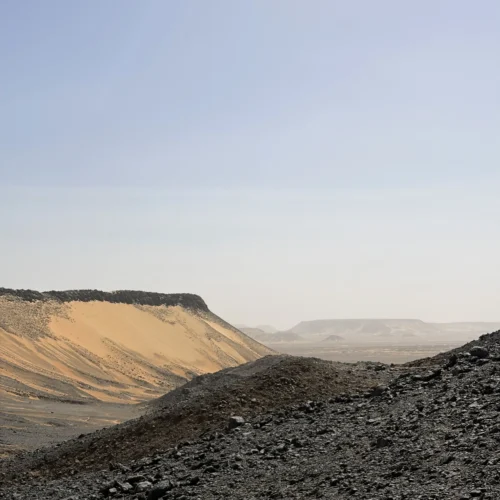
Black Desert Egypt: Quick Answer for First-Time Visitors
Last reviewed: 17 September 2026
Egypt’s Black Desert is a landscape of widely spaced dark hills, rusty slopes, pale ground and black stone south of Bahariya Oasis. It is normally visited from Bawiti with a licensed local guide and a four-wheel-drive vehicle, either as the first major landscape on a Black-and-White-Desert circuit or as a shorter outing from the oasis. It is not a continuous field of black sand, and not every cone-shaped hill is an extinct volcano.
For a first visit, the most efficient plan is usually to travel from Cairo to Bahariya, change to the locally arranged desert vehicle, see the Black Desert on the route toward El Heiz, Crystal Mountain and Agabat, and continue to a White Desert camp. A two-day trip is the compact version. A three-day trip gives more time for Bahariya’s springs, salt lake and viewpoints before the desert circuit.
The practical requirements matter as much as the scenery. Current official travel guidance says that visitors entering Bahariya, the Black Desert and the White Desert must arrange permits in advance and use an official guide. Mobile reception and medical facilities are limited, so this is not a place to improvise an off-road rental-car journey.
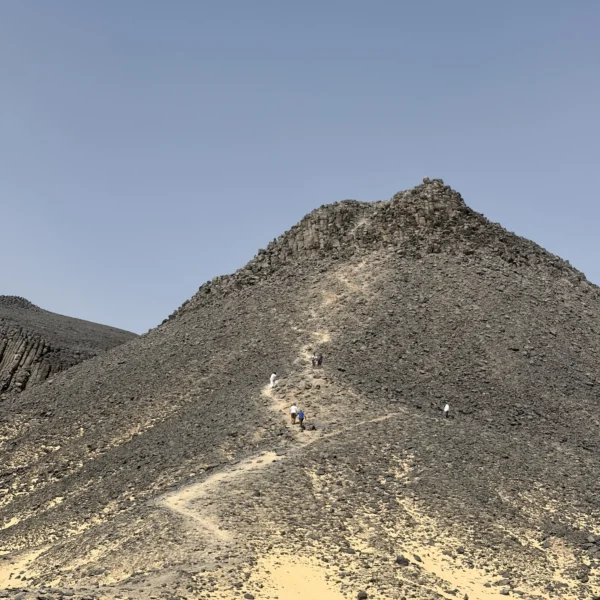
The Black Desert is a mixed landscape of dark-capped hills, stone, sand and iron-rich colors—not one uninterrupted sheet of black sand.
Black Desert Egypt at a glance
Gateway: Bawiti, Bahariya Oasis.
Best format: Usually combined with Bahariya Oasis, Crystal Mountain, Agabat Valley and the White Desert in a 2- or 3-day itinerary.
Access: Organized travel with the required permits, a licensed local guide and a suitable 4×4 for the desert sector.
Landscape: Dark-capped hills, iron-rich sedimentary rocks, igneous material, black gravel and pale desert ground.
Typical visit: One or more viewpoints plus a short guided walk, depending on access, weather and group ability.
What is the Black Desert in Egypt?
The Black Desert is a named landscape within the Western Desert corridor associated with Bahariya Oasis. In Arabic it is commonly called Al-Sahara Al-Sawda or As-Sahra’ as-Sawda’. Its visual identity comes from isolated dark hills and scattered black or brown rock fragments lying across paler desert surfaces.
The official Egyptian Tourism Authority presents Bahariya as the home of both the Black and White Deserts. Its Al-Bahariyya destination page places the oasis about 370 km southwest of Cairo and identifies Bawiti’s surrounding landscapes, springs, farms and viewpoints as part of the wider destination. NASA’s Bahariya Oasis overview describes the oasis as a depression deep enough to reach underground water, with Bawiti, date groves and olive groves set against the arid plateau.
The Black Desert should therefore be understood as one element of a larger geographic sequence:
- Cairo and the Nile Valley;
- the paved road southwest to Bahariya Oasis;
- the inhabited oasis around Bawiti, villages, farms and springs;
- the dark hills of the Black Desert farther south;
- El Heiz or El Hez and the route toward Crystal Mountain;
- Agabat’s pale escarpments and valleys;
- the chalk formations and camping areas associated with the White Desert.
This sequence is why the Black Desert is rarely sold as an isolated international trip. It works best as the geological opening chapter of a Bahariya–White Desert journey.
Where exactly is the Black Desert?
There is no entrance gate beside Bawiti that marks one universally agreed tourist boundary. The landscape emerges along the southbound corridor from Bahariya toward Farafra. A peer-reviewed Bahariya groundwater and geology study describes the Black Desert about 50 km south of El Bawiti and links its conical hills to ferruginous sandstone and chalky clay of the Bahariya Formation, with ironstone and doleritic material on many hills.
That distance is a geographic reference, not a promised hotel-to-viewpoint drive time. Your actual route depends on:
- the pickup point in Bawiti or Cairo;
- checkpoints and permit processing;
- the selected viewpoint;
- whether the vehicle stays near the paved corridor or enters approved off-road tracks;
- weather, visibility and surface conditions;
- stops at El Heiz, Crystal Mountain or Agabat;
- whether the group is continuing to a camp.
Ask the operator for a day-by-day route rather than a single map pin. A pin can identify a viewpoint, but it does not define the whole Black Desert.
What does the Black Desert look like?
The name creates three common expectations that the real landscape does not consistently meet: a black-sand sea, a dense field of perfect volcanoes, or fresh lava. In reality, visitors usually see a more varied scene:
- isolated conical, rounded or flat-topped hills;
- dark caps or dark stone scattered down slopes;
- brown, orange, red and yellow iron-rich surfaces;
- pale beige ground between the hills;
- gravel, fragments and powder produced by weathering;
- broader escarpments and sedimentary layers in the surrounding depression;
- changing contrast as the sun moves across the terrain.
The visual effect is strongest when low-angle light catches the relief. At midday, the scene can look flatter and more uniformly brown. After sunrise or before sunset, the same slopes reveal black, charcoal, rust and ochre bands. A dusty or hazy day reduces the distant contrast; strong wind can make walking and photography uncomfortable.
Do not judge the site only against heavily edited photographs. Its value lies in the transition from cultivated oasis to dark geology and then to the pale formations farther south.
Why is the Black Desert black?
The short answer is that dark igneous material and iron-rich sedimentary rocks both contribute, while erosion distributes darker fragments across slopes and surrounding ground.
The longer answer is more interesting because the hills are not all made in exactly the same way.
1. The Bahariya Formation supplies iron-rich sedimentary rocks
The Bahariya Formation contains sandstones, siltstones, shale and related sedimentary units dating to the Cenomanian stage of the Late Cretaceous. A 2015 study in the Journal of African Earth Sciences, Diagenetic origin of ironstone crusts in the Lower Cenomanian Bahariya Formation, found widespread ironstone crusts and identified goethite and hematite among the principal final iron minerals.
“Diagenetic” means that changes occurred after sediment was deposited, during burial and later interaction with fluids and oxygenated water. The study is regional geological evidence; it does not mean that every tourist hill has the same mineral proportions. It does show why a simple “all black rock is lava” explanation is wrong.
2. Ferruginized sandstone can form resistant dark caps
An earlier Lithos study of ferruginized sandstone in Bahariya describes isolated residual hills capped by nearly black ferruginized sandstone. A resistant cap protects softer material below it from eroding as quickly. Over long periods, the surrounding surface is lowered while the capped remnant remains as a hill.
This process helps explain why some hills can look volcanic without being volcanic cones: erosion can sculpt sedimentary terrain into a conical or mesa-like remnant.
3. Dolerite, basaltic material and real volcanism also exist
Official Egyptian tourism sources describe volcanic activity as part of the Black Desert’s formation, and scientific work documents genuine igneous and volcanic features in the Bahariya Depression. A Geoheritage study of Bahariya’s monogenetic volcanic field documents basaltic lava features, pyroclastic deposits, dykes and other volcanic landforms in the wider depression.
Dolerite—also called diabase in some geological traditions—is a dark igneous rock with a grain size between fine basalt and coarse gabbro. It can occur as intrusions such as sills and dykes. Weathered dolerite or basaltic material can add dark fragments to a hill and its slopes.
The accurate conclusion is therefore not “the Black Desert is not volcanic.” It is: the region has real igneous and volcanic geology, but the familiar tourist landscape also contains iron-rich sedimentary rocks and erosional remnants; not every dark cone is a volcano.
4. Erosion spreads the visual effect
Wind, temperature change, gravity and occasional water movement break down exposed rock. Dark fragments move downslope and collect on surrounding surfaces. From a distance, that scatter visually joins the hills into a broader black landscape even where pale sediment remains visible underneath.
For a more focused scientific explanation, continue to Why Is Egypt’s Black Desert Black? Geology Explained. That supporting article is designed to handle mineral terms and the volcanic-versus-sedimentary question without crowding the travel-planning sections here.
Is every cone-shaped hill an extinct volcano?
No. “Volcano-shaped” describes appearance, not origin.
A field geologist would ask questions that a distant photograph cannot answer: What rock makes the hill? Are there lava flows, scoria, pyroclastic layers, a vent or an intrusion? Is the dark material a cap over sedimentary beds? Does the structure match surrounding faults and folds? Has erosion produced the cone?
Visitors should avoid three claims unless a qualified guide is identifying a specific feature:
- “This is a crater” merely because the summit is hollow or eroded.
- “This stone is basalt” merely because it is black.
- “These volcanoes erupted recently” without a dated geological source.
The Black Desert is still visually dramatic when described accurately. In fact, the overlap of sedimentation, iron mineralization, igneous activity and erosion makes it more significant as a geotourism landscape.
Why the geology matters to a traveler
Understanding the landscape changes how you look at it. Instead of photographing one dark hill and leaving, notice:
- whether a resistant cap protects softer layers below;
- how fragments become smaller farther down the slope;
- where iron produces red, orange or yellow tones rather than black;
- how a dark igneous band differs from ferruginous sandstone;
- how hills align across the depression;
- how the Black Desert contrasts with the chalk-dominated White Desert;
- how human roads and vehicle tracks intersect a fragile geological surface.
The 2016 peer-reviewed paper Geological heritage of the Bahariya and Farafra oases treats the Black and White Deserts as major geomorphological features within a globally important concentration of geological heritage. That is a stronger reason to visit responsibly than a simplified “alien volcano desert” label.
Is the Black Desert a protected area?
Yes. Egypt’s State Information Service says the Bahariya Oasis Reserve includes the Black Desert, Gabal al-Ingleez, and the Dast and Maghrafa areas, and that it was declared a nature reserve in 2010. The official Egyptian Tourism Authority also places the Black Desert within Al Wahat al Bahariyya Protectorate.
Protected status does not mean every point has the same visitor rules or that an old map automatically proves access today. The practical implications are:
- use the currently authorized route;
- let the licensed operator handle required permissions;
- obey guide and ranger instructions;
- do not collect black stones, fossils or mineral specimens;
- do not drive new tracks across undisturbed ground;
- do not climb a closed or unstable slope;
- take all waste out;
- confirm camping and fire rules for the exact location.
The Ministry of Environment’s simple principle is appropriate here: leave nothing and take nothing. A small rock is still part of the protected geological record.
Black Desert versus White Desert
The two landscapes are complementary rather than interchangeable.
Read Black Desert vs White Desert Egypt: What’s Different? for a decision-focused comparison of scenery, time, camping and suitability.
For the full pale-landscape counterpart to this guide, use the White Desert Egypt Travel Guide.
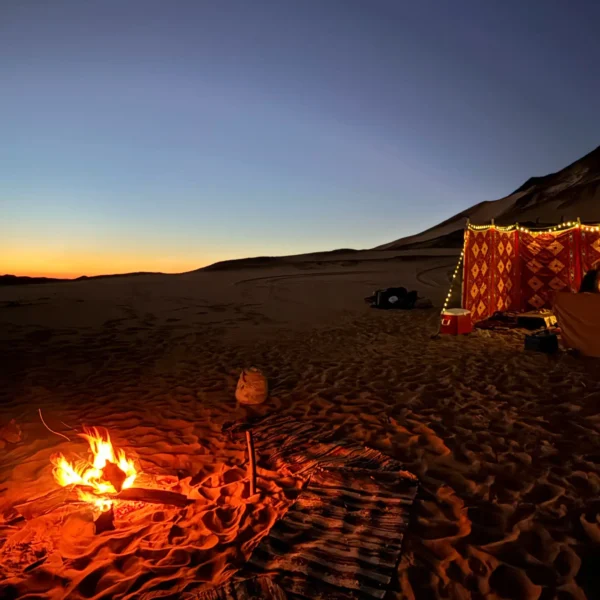
The Black Desert and White Desert are separate landscapes. Many itineraries visit the dark hills by day and camp later among the pale White Desert terrain.
Black Desert, Black Mountain and English Mountain are not the same thing
Names are often blended in tour descriptions, map listings and social posts. Keep these entities separate.
The Black Desert
This is the wider region of dark hills south of Bahariya on the corridor toward Farafra and the White Desert.
English Mountain or Gabal al-Ingleez
English Mountain is a specific historical viewpoint near Bawiti and Mandisha within the inhabited Bahariya area. Official Egyptian tourism information describes its dark summit and links its name to a British lookout during the occupation period. It overlooks oasis settlements and agriculture.
It is not a synonym for the entire Black Desert. An itinerary can include English Mountain sunset on the Bahariya day and the Black Desert the following morning.
“Black Mountain”
Guides, maps and translated itineraries may use this as an informal label for a particular dark hill or viewpoint. Ask for the local name and map pin. Do not assume that every “Black Mountain” listing identifies English Mountain or the same visitor stop.
Elzaghandi Travel’s active 3 Days / 2 Nights Bahariya Oasis & White Desert Adventure keeps the sequence clear: English Mountain is an oasis sunset stop on the first day, while the Black Desert is visited after breakfast on day two.
Bahariya Oasis is the practical gateway
Bawiti is where the trip changes character. The long road transfer from Cairo ends in an inhabited oasis with hotels, meals, fuel and local teams. The landscape circuit then uses a vehicle and guide arranged for the desert sector.
This makes Bahariya useful for:
- completing or confirming permit procedures;
- meeting the local guide and driver;
- changing from a road-transfer vehicle to a 4×4 when required;
- checking water, fuel, food and camp equipment;
- leaving a large suitcase in approved secure storage;
- eating before the off-road route;
- adapting the itinerary to wind, access or group needs;
- adding salt lake, springs, heritage and sunset viewpoints.
Use the Bahariya Oasis Egypt Travel Guide for the destination as a whole, and How to Get to Bahariya Oasis from Cairo for the road-transfer stage.
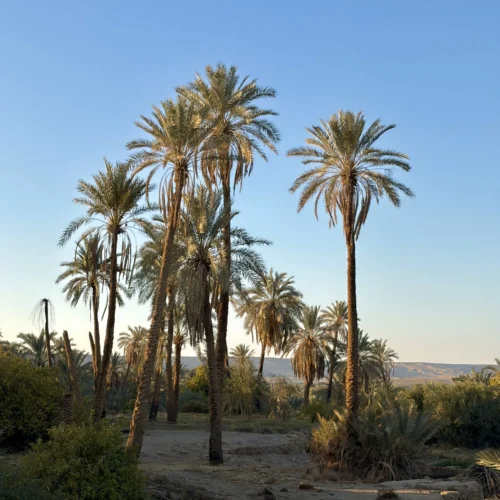
Bahariya is an inhabited oasis and logistics base. It is different from both the Black Desert landscape and the later White Desert camp.
How to visit the Black Desert from Cairo
Step 1: Arrange the trip before departure
Send the operator your dates, pickup address, passport details through the agreed secure channel, nationality, group size, luggage, dietary needs and medical or mobility requirements. Ask when permit information is due. Do not arrive in Cairo expecting to secure an immediate independent Black Desert entry the next morning.
Step 2: Travel from Cairo or Giza to Bahariya
The transfer follows the road southwest to the oasis. Exact time varies with pickup traffic, rest stops, checkpoints and road conditions. Treat any advertised drive time as an estimate rather than a guarantee.
The Egyptian Tourism Authority places Bahariya about 370 km southwest of Cairo; NASA gives a broadly similar regional distance. The transfer consumes a substantial part of the day, which is why a same-day Cairo–Black-Desert–Cairo attempt is poor planning for most travelers.
Step 3: Meet the local desert team in Bawiti
Confirm the guide, driver, vehicle, route, permit status and emergency plan. Eat, use a proper bathroom and reorganize luggage. If the itinerary includes a hotel night, verify pickup time for the next morning.
Step 4: Continue south with the authorized vehicle
The official Egyptian Tourism Authority’s Bahariya natural-wonders guidance recommends licensed, experienced guides who know the terrain and a 4×4 for excursions outside the oasis. The need is not about creating a dramatic safari image; it is about navigation, changing surfaces, mechanical preparation, permissions and local route knowledge.
Step 5: Visit one or more approved viewpoints
A normal stop may include a broad panorama, a short walk at the base of a hill and, where permitted and safe, a climb on a known path. Your guide should choose the location according to current access, heat, wind and group ability.
Step 6: Continue or return
From here, either return to Bahariya for a day outing or continue through the landscape sequence toward El Heiz, Crystal Mountain, Agabat and the White Desert. Read How to Visit the Black Desert from Cairo: Route & Safari Options for transport scenarios in more detail.
Can I visit by public transport or rental car?
Public transport may bring a traveler to Bahariya, subject to current schedules, but it does not provide the permit, official guide or suitable desert operation. You would still need a prearranged local excursion.
A standard rental car is not an appropriate substitute for the authorized desert vehicle. Even if part of the landscape is visible from or near a paved road, entering tracks without local authorization and knowledge adds avoidable risks:
- soft sand or loose gravel;
- unmarked route changes;
- tire damage;
- mechanical failure far from services;
- missing mobile signal;
- checkpoint or permit problems;
- accidental entry into restricted terrain;
- damage to protected ground.
Self-driving to Bawiti and self-driving into the protected desert are separate questions. Rental agreements and insurance may exclude remote or off-road use. Current government advice also favors or requires licensed providers for this region.
The best Black Desert itinerary for most travelers
Option 1: Two days and one night
This is the compact Black-and-White-Desert format. A typical structure is:
- early Cairo or Giza pickup;
- road transfer to Bahariya;
- lunch and change to the desert operation;
- Black Desert and southbound landscape stops;
- White Desert sunset and camp;
- sunrise, formations and return through Bahariya to Cairo.
This option is efficient but fast. It gives less time for Bawiti’s salt lake, springs, farms, English Mountain and archaeology. Check the current route of the 2 Days / 1 Night White Desert Adventure and ask for every included stop in writing.
Option 2: Three days and two nights with Bahariya
This is the most balanced choice for a first-time traveler who wants both the living oasis and the desert landscapes. Elzaghandi Travel’s active Bahariya-focused itinerary currently uses this sequence:
- Day 1: Cairo/Giza pickup; lunch at the hotel; Zawya Mosque; El Beshmo; Salt Lake with tea; dunes; Pyramid Mountain; a natural hot spring; English Mountain sunset; hotel dinner and night.
- Day 2: hotel breakfast; Black Desert; El Heiz lunch and sulfur-spring stop; Crystal Mountain; Agabat and Moon Cave; White Desert camp.
- Day 3: sunrise and formations; return journey.
See the full 3 Days / 2 Nights Bahariya Oasis & White Desert Adventure. Inclusions, route permissions, hotel and camp setup should still be reconfirmed for the exact date.
Option 3: Three days and two nights focused on desert landscapes
Choose the 3 Days / 2 Nights White Desert Adventure when the priority is a slower desert circuit rather than a full first-day oasis program. Ask how the two nights are divided and whether the Black Desert stop is longer than in the compact trip.
If the main decision is pace rather than destination, compare the formats in 2-Day vs 3-Day White Desert Tour.
Option 4: Black Desert day outing from Bahariya
This can work if you are already staying in Bawiti, do not want to camp, or need a lower-complexity introduction to the landscape. A sensible outing can include a viewpoint, a careful walk and a return to the hotel before dark. It still needs the current permit and guide arrangement.
Option 5: Customized private route
A private itinerary is valuable when the group needs:
- slower walking pace;
- more photography time;
- a child-adapted schedule;
- a hotel instead of a remote camp;
- specific dietary planning;
- ground-level accommodation;
- a second oasis night;
- a geological interpretation focus;
- a current-access archaeology addition.
Use the customize-trip form or send the requirements on WhatsApp.
How long should you spend in the Black Desert?
There are two different answers: time physically viewing the hills, and total time required to reach them.
A quick circuit stop may be 45–90 minutes. A more useful first visit allows roughly two hours for orientation, photographs and a short walk, subject to temperature and schedule. A geology-focused or carefully timed photography stop may take longer.
The total trip is not a two-hour excursion from Cairo. Reaching Bahariya, meeting the local team and returning or continuing south makes it a full travel operation. This distinction prevents the common mistake of building an unrealistic Cairo day trip.
Do not maximize a checklist by reducing every landscape to ten minutes. It is better to see one safe viewpoint properly than race between several similar pins.
What to do in the Black Desert
Observe the landscape transition
Watch the terrain change south of the green oasis. The contrast between farms, pale open ground and dark hills helps explain the region better than an isolated close-up.
Take a short guided walk
Walking at the base of a hill reveals the range of fragment sizes, colors and textures. Follow the guide and stay on a durable or established surface.
Use a safe viewpoint
Where access is open, a known viewpoint can show the spacing of the hills and the broader depression. The best viewpoint is not automatically the highest hill. Stability, heat, wind and descent matter.
Photograph patterns rather than only panoramas
Look for dark fragments over pale ground, rust-colored layers, cap-rock edges, converging tracks and shadow lines. A medium or telephoto lens can compress the widely spaced hills.
Compare the geology later in the route
Crystal Mountain, Agabat and the White Desert are not extra versions of the same scene. Their pale rock, relief and erosional forms create a useful geological contrast. Continue with the Crystal Mountain Egypt Travel Guide and Agabat Valley Egypt Travel Guide.
Can you climb the Black Desert hills?
Only climb a specific hill if the guide confirms that access is permitted and the route is appropriate that day. Loose dark fragments can behave like ball bearings underfoot. A slope that is easy to ascend may be difficult to descend.
Before starting, assess:
- surface stability;
- gradient and exposure;
- wind strength;
- heat and available shade;
- footwear grip;
- knee or balance limitations;
- the turnaround time;
- whether climbing damages a protected surface.
Do not create a direct line up an untouched slope. Do not run downhill. Keep distance between walkers so one dislodged stone does not hit another person. Children should remain within arm’s reach on loose ground, and a traveler with reduced balance can enjoy the landscape from the base without losing the essential experience.
Best time to visit the Black Desert
Cooler season
Late autumn, winter and early spring generally provide more comfortable daytime exploration than peak summer. Nights can be cold, especially when the itinerary includes a White Desert camp. Wind can make the perceived temperature much lower.
Hot season
Heat increases vehicle, hydration and walking risk. Shade is extremely limited. A trip should use conservative walking times, adequate water, sun protection and current operator judgment. A functioning hotel air conditioner in Bahariya does not reduce the next day’s exposure on an open slope.
Wind and dust
Wind can change visibility, destabilize loose footing and blow dust into eyes and equipment. The right response may be a shorter stop or a changed viewpoint, not forcing the original photography plan.
Rain
Rain is uncommon but possible, and desert drainage can react quickly. Do not enter low channels or assume a dry route remains safe because the rain fell elsewhere. Follow the local team.
Use Best Time to Visit the White Desert Egypt when the trip continues to camp; it covers day-and-night clothing rather than only daytime Black Desert conditions.
Best time of day for views and photography
Early and late light produces stronger shadows and color separation. Midday is useful for geological detail because the surface is fully lit, but broad photographs can look flatter. The exact choice depends on the itinerary:
- morning works naturally when leaving a Bahariya hotel southbound;
- late afternoon can be attractive on a dedicated Bahariya day outing;
- sunset should only be planned where the return or camp route remains authorized and safe after the light fades;
- night photography should be tied to an approved camp or supervised stop, not an independent walk away from the vehicle.
If the White Desert is the overnight objective, do not delay the group so long in the Black Desert that camp setup and sunset become rushed.
Photography guide
Useful lenses
- A phone or wide-angle lens for the environmental panorama.
- A normal lens for natural-looking hill proportions.
- A short telephoto for layering widely spaced cones and isolating cap rock.
- A macro-capable option for texture, used without removing or rearranging stones.
Exposure
Dark rock beside bright sand can confuse automatic exposure. Check highlights in the pale ground and shadows in the black rock. Bracketing can help in high-contrast light. A polarizer may deepen the sky but can create uneven color on an ultra-wide lens.
Dust protection
Change lenses inside the stationary vehicle if possible. Keep equipment zipped away when not in use, use a blower rather than rubbing grit across glass, and protect batteries from heat and cold.
People in the landscape
Ask permission before photographing guides, drivers or residents. Avoid making a person climb an unstable slope for scale. A figure on a safe established path provides enough context.
Drones
Do not bring or fly a drone on the assumption that empty desert equals unrestricted airspace. Egypt has formal aviation and security controls, and protected-area rules add another layer. The Egyptian Ministry of Civil Aviation publishes a specific unmanned-aircraft flight-permit service. Permission must be obtained through the proper authorities before import, possession or flight as applicable; verbal approval from a driver is not a legal permit. Military sites, checkpoints and sensitive infrastructure must never be photographed.
For night work, see the White Desert Stargazing and Photography Guide.
Is the Black Desert suitable for children?
It can be, when the route is private or well matched to the child and the adults understand the long road, heat, loose slopes and remote facilities. There is no universal minimum age that makes every itinerary appropriate.
Ask about:
- a correctly fitted child restraint for every road and desert vehicle;
- maximum continuous driving time;
- motion sickness;
- shade and drinking schedule;
- familiar food;
- toilet stops;
- sleeping arrangement if camping;
- cold-night layers;
- supervision around fire and steep ground;
- ability to return to the vehicle without delaying a large shared group.
A Bahariya hotel night before the desert sector lets a family recover from Cairo and test food, sleep and vehicle comfort. Read White Desert Egypt with Kids before adding the camp.
Older travelers and limited mobility
The Black Desert can be appreciated from or close to a suitable vehicle stop. A summit is not required. The main challenges may be more practical than visual:
- stepping up into a high 4×4;
- prolonged road vibration;
- uneven gravel;
- lack of handrails;
- limited toilets;
- heat and cold;
- distance from advanced medical care.
Describe functional needs precisely. Ask for vehicle step height, seat position, walking distance and surface. A private group can shorten the walk and add an oasis hotel, but no operator should label a loose desert slope “wheelchair accessible” without a route-specific assessment.
Toilets, food, water and phone signal
Toilets
Use a proper bathroom in Bawiti before departure. Facilities on the landscape route are limited and may be basic at meal or spring stops. A remote camp normally uses a privacy and waste arrangement rather than a permanent bathroom. Ask exactly what is provided.
The White Desert Egypt Camping Guide explains tents, bedding, toilets, hygiene, electricity and signal for the overnight part of the circuit.
Food
Meals are generally organized by the operator. Specify allergies, vegetarian requirements and cross-contact concerns in writing before supplies are purchased. Carry appropriate personal snacks without relying on them as the operator’s emergency food plan.
Water
The team should carry drinking water for the group plus operational reserve. Ask what quantity and whether sealed bottled or safely treated water is supplied. Do not use a spring or tap as drinking water unless a reliable local authority or operator explicitly confirms it is suitable.
Signal
Reception can be limited or absent outside the oasis. Download documents and maps, share the operator contact and route, and keep a power bank. A phone is useful but is not the team’s only emergency system.
What to pack
For a day stop:
- closed shoes with grip;
- sun hat;
- sunglasses;
- broad-spectrum sunscreen;
- breathable layers;
- wind or dust protection;
- personal medication;
- water bottle as directed by the operator;
- tissues and hand hygiene;
- power bank;
- small secure camera bag.
For an overnight circuit, add:
- insulating evening layers;
- warm sleep clothing;
- headlamp plus backup light;
- spare socks;
- compact toiletries;
- quick-dry towel if not supplied;
- camera batteries protected from temperature extremes;
- a small overnight bag rather than the full suitcase.
Use the complete White Desert Egypt packing list and confirm what the operator supplies. A packing article cannot prove that a particular vehicle contains blankets, tents or a first-aid kit on your date.
Permits, guides and current travel advice
The rules and advisory context must be stated without a blanket safety promise.
The current UK FCDO regional guidance for Egypt lists the Black Desert, White Desert, Bahariya and Farafra among named exceptions to its broader Western Desert “all but essential travel” area. It also says tourists entering these areas must apply for permits in advance and use an official guide, and warns of limited phone reception and poor medical facilities. The Bawiti–Siwa road is subject to a separate, stricter warning and should not be confused with the normal southbound Black Desert corridor.
The current U.S. Department of State Egypt advisory is stricter. It classifies the Western Desert as “Do Not Travel” unless traveling with a professionally licensed tour company, and specifically says visitors should only go to the Black and White Deserts with a licensed company. It also notes that emergency and intensive-care facilities may be unavailable in remote areas.
These positions are not contradictory typos; governments apply different risk frameworks. Travelers should:
- read the advice issued for their nationality and residence;
- confirm insurance remains valid for the region and activities;
- consider medical evacuation coverage;
- use a properly licensed operator and current permits;
- avoid border regions and closed roads;
- follow checkpoint, police, guide and protected-area instructions;
- recheck advice immediately before travel.
Read Is the White Desert Egypt Safe? for the full advisory comparison, vehicle checks, camp precautions and emergency planning that also apply to the Black Desert corridor.
Vehicle and guide checklist
Ask the operator to confirm:
- company and guide licensing appropriate to the route;
- permit handling and deadline;
- Cairo transfer vehicle and local desert vehicle;
- seat belt for every passenger;
- child restraint arrangement where needed;
- tire condition and spare tire;
- jack and recovery equipment;
- fuel plan and operational reserve;
- drinking water and emergency reserve;
- first-aid supplies and responsible person;
- communication method when mobile service fails;
- driver rest and maximum workday;
- backup plan for mechanical trouble;
- exact camp and toilet arrangement;
- route-change and cancellation policy.
A glossy 4×4 photograph does not answer these questions. Obtain the operational details in writing.
How much does a Black Desert tour cost?
There is no honest universal price in this guide because a quote changes with:
- Cairo or Bahariya starting point;
- private or shared operation;
- group size;
- two-day, three-day or day-trip format;
- hotel category;
- camp setup;
- vehicle requirements;
- meals and dietary preparation;
- guide language;
- current permit and access costs;
- child restraints or mobility support;
- seasonal demand;
- route customization;
- payment method and cancellation terms.
Compare like with like. One quote may include Cairo pickup, a Bahariya hotel, all meals, a local 4×4, camping, permits and return; another may begin in Bawiti and exclude the first hotel or beverages. Ask for a line-by-line dated quote and avoid relying on an old blog price.
The same comparison method is explained in White Desert Egypt Tour Cost: What Changes Your Quote?.
Responsible visiting
The Black Desert is a protected geological landscape, not an off-road playground without boundaries.
Follow these rules:
- take no rocks, fossils, crystals or sand samples;
- leave no food, tissue, plastic or cigarette waste;
- use established or approved tracks;
- do not carve names or stack stones;
- do not move fragments to stage photographs;
- do not climb fragile caps or closed slopes;
- keep noise low around wildlife and camps;
- do not feed foxes or other animals;
- use a toilet and waste system explained by the operator;
- keep fires only where currently permitted and fully controlled;
- buy local products lawfully and photograph people only with consent;
- report damage rather than trying to repair a geological feature yourself.
Vehicle tracks remain visible in arid terrain. A “shortcut” can become a repeated scar after other drivers follow it.
Common Black Desert myths
- Myth: The Black Desert is one continuous field of black sand. In reality, it is a mixed landscape of dark hills, black and brown rock fragments, iron-rich surfaces and pale desert ground.
- Myth: Every cone-shaped hill is an extinct volcano. Some Bahariya landforms are genuinely volcanic or igneous, while others are erosional remnants or sedimentary hills with dark resistant caps.
- Myth: All dark rocks are basalt. Basaltic and doleritic material occurs in the region, but ironstone and ferruginized sandstone can also appear very dark.
- Myth: English Mountain is another name for the Black Desert. English Mountain is a specific viewpoint near Bawiti; the Black Desert is a wider landscape farther south.
- Myth: You can simply rent a car in Cairo and explore independently. The practical desert sector requires current route permissions, local guidance and an appropriate vehicle rather than an improvised off-road drive.
Who should choose the Black Desert?
It is a strong choice for travelers who value:
- unusual geology;
- landscape photography;
- a road-to-off-road expedition structure;
- contrast between oasis, dark hills and white chalk;
- a private or small-group itinerary;
- one camp night under a dark sky;
- a destination beyond Egypt’s principal monument circuit.
It may not be the right trip for someone who:
- has only one free day in Cairo;
- cannot tolerate long vehicle time;
- expects luxury facilities at every stop;
- requires immediate advanced medical care;
- wants independent off-road driving;
- cannot obtain appropriate insurance;
- assumes permits can be arranged at the last minute;
- wants guaranteed Wi-Fi or a private bathroom throughout.
A Bahariya-only stay can offer springs, farms, salt lake and viewpoints without the full remote camp. See Things to Do in Bahariya Oasis and Where to Stay in Bahariya Oasis for a lower-intensity alternative.
Booking questions to copy and send
Please quote a Black Desert and White Desert trip for [dates], [adults/children] and pickup at [location]. Confirm the exact day-by-day route; whether the Black Desert, El Heiz, Crystal Mountain, Agabat and White Desert are included; permit and licensed-guide arrangements; Cairo and local 4×4 vehicles; seat belts and child restraints; hotel and camp details; meals, water and dietary requirements; toilet and bedding setup; luggage storage; guide language; total price and payment schedule; cancellation or route-change terms; and the plan for wind, access restrictions, vehicle breakdown or medical need.
Send the request through Elzaghandi Travel on WhatsApp. Because the company uses a request-a-quote model, the useful response is a dated written itinerary, not a generic “from” price.
Final pre-departure checklist
- Passport and visa requirements checked.
- Current government travel advice reviewed.
- Insurance region and activities confirmed.
- Operator and guide licensing confirmed.
- Permit details sent before the deadline.
- Cairo pickup address and time confirmed.
- Driver and emergency contacts saved offline.
- Day-by-day route received.
- Black Desert and English Mountain correctly distinguished.
- Local 4×4 and seat belts confirmed.
- Child restraint or mobility needs confirmed.
- Hotel and camp described separately.
- Meals, allergies and drinking water confirmed.
- Toilets and hygiene setup understood.
- Warm, sun and dust layers packed.
- Medication and medical summary packed.
- Power bank and offline documents prepared.
- Drone left at home unless every required permission is documented.
- Route-change and cancellation terms saved.
Related Black Desert guides: Learn why the Black Desert is black, plan how to visit the Black Desert from Cairo, compare the Black Desert vs White Desert, and see how it fits into the best things to do in Bahariya Oasis.
Frequently asked questions
1. Where is the Black Desert in Egypt?
It lies south of Bahariya Oasis in Egypt’s Western Desert, on the wider route toward Farafra and the White Desert. Bawiti is the normal gateway for organized visits.
2. Why is it called the Black Desert?
Dark hills, iron-rich rock, igneous material and weathered black fragments create the landscape’s distinctive contrast against lighter desert ground.
3. Is the Black Desert completely black?
No. The landscape includes black, brown, rust, ochre and beige surfaces rather than one continuous field of black sand.
4. Is every hill in the Black Desert a volcano?
No. Genuine volcanic and igneous geology exists in the Bahariya Depression, but some familiar hills are sedimentary or erosional landforms with dark resistant caps.
5. How do you visit the Black Desert from Cairo?
The practical route is Cairo or Giza to Bahariya Oasis by road, followed by the locally arranged desert sector with the required permits, guide and suitable vehicle.
6. Can I visit the Black Desert as a day trip from Cairo?
A same-day Cairo return is generally too road-heavy for most travelers. A 2-day or 3-day itinerary gives a more realistic and useful experience.
7. Can I visit from Bahariya Oasis without camping?
Yes. A shorter organized outing from Bawiti can focus on Black Desert viewpoints and return to an oasis hotel, subject to current access and permit arrangements.
8. Do I need a guide and 4×4?
For the desert sector, use the guide and vehicle arranged for the authorized route. This supports navigation, permissions, recovery planning and safe travel on changing surfaces.
9. Can I combine the Black Desert and White Desert?
Yes. They are commonly combined on the same Bahariya-based circuit, often with El Heiz, Crystal Mountain and Agabat Valley between them.
10. Is two days enough?
Two days is the compact format for travelers whose priority is the classic Black-and-White-Desert route. Three days gives more time for Bahariya Oasis and a slower pace.
11. What is the best time of year to visit?
The cooler months are generally more comfortable for exposed desert travel than peak summer. Exact conditions, wind and route access should still be checked for your dates.
12. Can children or older travelers visit?
Often yes when the itinerary is adapted to the traveler, with appropriate vehicle access, conservative walking, temperature management and clear planning for medical or mobility needs.
13. Can I take rocks or geological samples?
No. The Black Desert is part of a protected geological landscape. Leave rocks, fossils and mineral material where they are.
14. Is English Mountain the same as the Black Desert?
No. English Mountain is a specific historical viewpoint near Bawiti, while the Black Desert is a wider landscape farther south.
15. Which Elzaghandi Travel itinerary is best for a first visit?
For a balanced first visit, the 3 Days / 2 Nights Bahariya Oasis & White Desert Adventure gives time for the inhabited oasis before continuing through the Black Desert, Crystal Mountain, Agabat and White Desert. The 2 Days / 1 Night White Desert Adventure is the more compact alternative.
Final recommendation
Use Bahariya Oasis as the gateway and visit the Black Desert as part of a properly arranged southbound circuit. The three-day Bahariya-focused itinerary is the strongest first choice when you want the oasis, English Mountain, Black Desert, Crystal Mountain, Agabat and White Desert without compressing everything into one road-heavy day. Choose the two-day trip when time is limited and the main priority is the Black-and-White-Desert contrast.
Look beyond the phrase “volcanic desert.” The dark landscape records more than one process: sedimentary deposition, iron mineralization, genuine igneous and volcanic activity, long erosion and modern conservation. That scientifically honest story is more useful—and more memorable—than calling every hill a volcano.
Request the current Black and White Desert route on WhatsApp, including the date, group size and pickup point, or build a slower private plan through the custom trip page.
Sources and further reading
- Egyptian Tourism Authority: Al-Bahariyya — official destination position, Cairo distance and Black/White Desert context.
- Egyptian Tourism Authority: Natural Wonders in Al-Bahariyya — licensed guide, 4×4 and safari-operator guidance.
- Egyptian Tourism Authority: Natural Protectorates — official protected-area context for Al Wahat al Bahariyya and the Black Desert.
- Egypt State Information Service: Bahariya Oasis Reserve — reserve components and 2010 declaration.
- NASA Earth Observatory: Bahariya Oasis — physical geography, groundwater depression, Bawiti and oasis agriculture.
- Multivariate Statistical Analysis and Structural Sovereignty for Geochemical Assessment and Groundwater Prevalence in Bahariya Oasis — peer-reviewed regional location and geological description of the Black Desert hills.
- Diagenetic origin of ironstone crusts in the Lower Cenomanian Bahariya Formation — peer-reviewed ironstone mineralogy and post-depositional formation processes.
- Mineralization, origin and age classification of ferruginized sandstone in Bahariya — peer-reviewed study of dark ferruginized sandstone and residual hills.
- Geological heritage of the Bahariya and Farafra oases — peer-reviewed geoheritage and geomorphological significance.
- Volcanic Geosites in the Bahariya Depression — peer-reviewed evidence for genuine volcanic landforms and deposits in the wider depression.
- UK FCDO: Egypt regional risks — current regional exceptions, permits, official guide, reception and medical limitations.
- U.S. Department of State: Egypt Travel Advisory — stricter Western Desert position, licensed-company instruction and remote medical context.
- Egyptian Ministry of Civil Aviation: Unmanned-aircraft flight permit — official evidence that drone flight is permit-controlled.