Saqqara, Memphis & Dahshur Day Tour from Cairo or Giza
This Saqqara, Memphis and Dahshur day tour follows one of the most important architectural stories in ancient Egypt: the development from early royal burial monuments to the true pyramids that later reached their most famous form at Giza.
The published itinerary begins with pickup from your hotel in Cairo or Giza at 8:00 AM, then continues to Saqqara and the Step Pyramid of Djoser, the ancient city of Memphis and its open-air museum, lunch at a local restaurant, and finally Dahshur for the Bent Pyramid and Red Pyramid. Transfer back to the hotel is scheduled for approximately 5:00 PM.
If you want to continue the pyramid story on another day, compare this tour with our Grand Egyptian Museum & Pyramids Day Tour. For a different side of Cairo’s heritage, see the Saladin Citadel, Muhammad Ali Mosque & St. Simon Cave Church Day Tour.
Day Tour at a Glance
- Duration: 1 day.
- Pickup: 8:00 AM from a hotel in Cairo or Giza.
- First stop: Saqqara and the Step Pyramid of Djoser.
- Second stop: Memphis and the open-air museum.
- Lunch: Local restaurant with soft drinks.
- Final archaeological stop: Dahshur, including the Bent Pyramid and Red Pyramid.
- Return: Transfer back to the hotel at approximately 5:00 PM.
- Guide: Professional Egyptologist tour guide.
- Transport: Private air-conditioned transportation.
Why This Route Matters
Saqqara, Memphis and Dahshur are closely connected historically. Memphis was one of the great capitals of ancient Egypt, while Saqqara and Dahshur formed part of the vast cemetery zone associated with the city.
Egypt’s Ministry of Tourism and Antiquities identifies Saqqara as one of the most important cemeteries of Memphis and describes Dahshur as the southern part of the Memphite necropolis. The wider area of Memphis and its Necropolis, including Saqqara and Dahshur, is also part of the UNESCO World Heritage property inscribed in 1979.
That relationship makes the itinerary more than a list of separate monuments. It gives travelers a chronological journey through royal power, burial beliefs and the technical development of pyramid architecture.
Morning: Saqqara Necropolis
The first major stop is Saqqara, located southwest of Cairo. Saqqara served as a burial ground for kings, royal family members, officials and elites over an exceptionally long period of Egyptian history.
The site contains monuments from many dynasties, but the published itinerary focuses on its most famous landmark: the Step Pyramid of Djoser.
Step Pyramid of Djoser
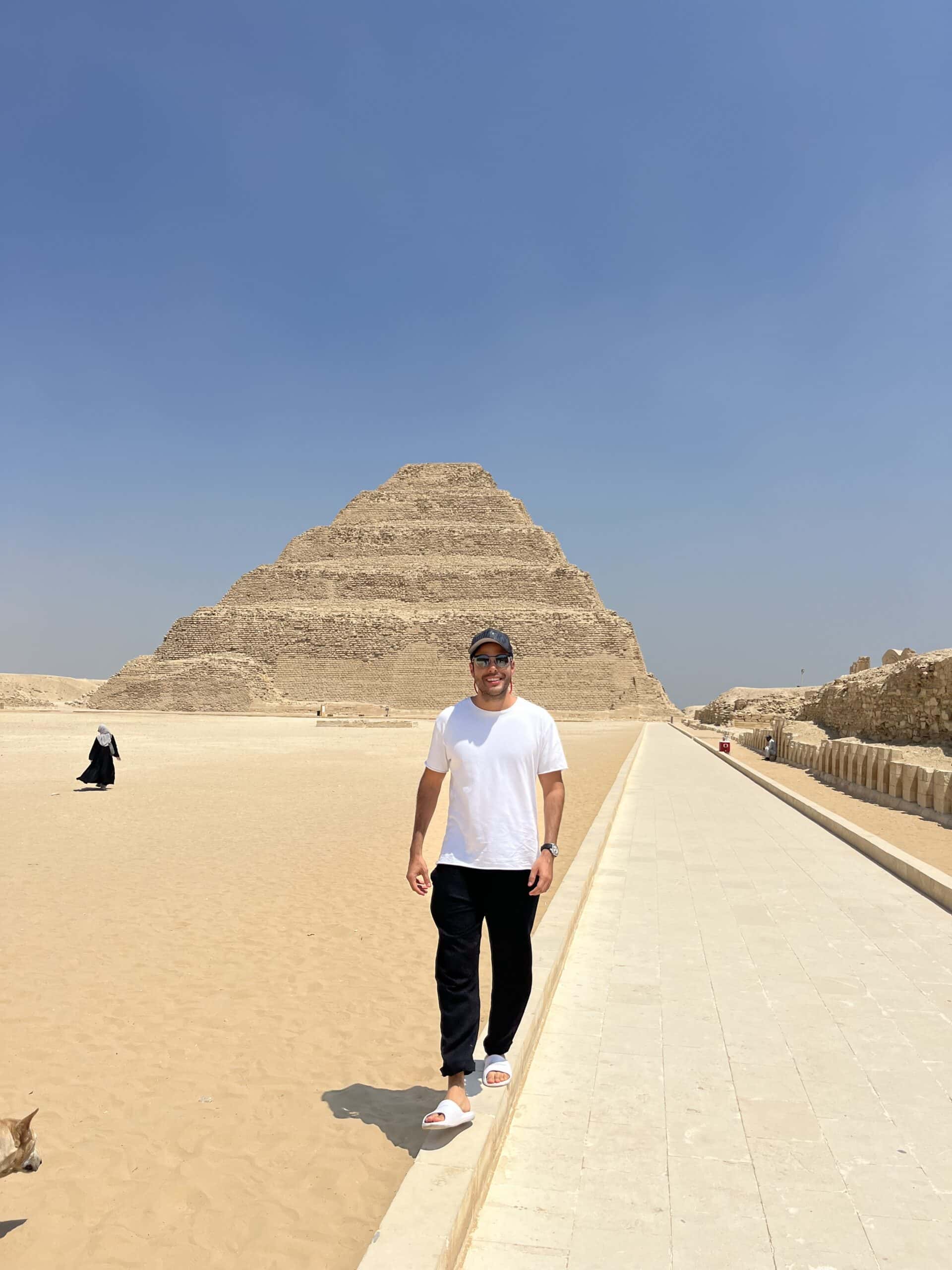
Egypt’s Ministry of Tourism and Antiquities describes the Step Pyramid as the first pyramid built by the ancient Egyptians and the oldest known ancient Egyptian stone structure. It dates to the early Third Dynasty and was built for King Netjerykhet, better known today as Djoser.
Before this period, royal and elite tombs were generally marked by rectangular structures known as mastabas. Djoser’s monument transformed that form by stacking six mastaba-like stages upward, creating the stepped silhouette that changed the history of monumental architecture.
The architect traditionally associated with the complex is Imhotep, one of the most famous figures of ancient Egyptian intellectual history. The Step Pyramid was not an isolated structure but the center of a large ceremonial complex with courtyards, ritual buildings, walls and underground spaces.
How the Step Pyramid Changed Pyramid Building
The importance of Djoser’s pyramid is not simply that it is old. It represents a turning point in the way royal tombs were designed and constructed.
Instead of a low mastaba built mainly from mudbrick and smaller materials, Djoser’s complex demonstrated what could be achieved through large-scale stone construction. Later kings continued experimenting with pyramid forms, and that sequence eventually led to the smooth-sided pyramids at Dahshur and Giza.
Your Egyptologist guide can use the site to explain this development before the tour continues toward Memphis and then Dahshur.
What Is Included at Saqqara?
The itinerary specifically promises the Step Pyramid of Djoser and exploration of the ancient necropolis. Saqqara contains many additional tombs, pyramids and museums, but these should not be assumed to be guaranteed stops unless confirmed on the day.
This is particularly important because Saqqara uses different ticket categories for the main archaeological area and certain special monuments. The current tour excludes entrance tickets, so any additional paid interior or special-access ticket is separate from the published package.
Memphis: Ancient Capital of Egypt
After Saqqara, the itinerary continues to Memphis, near modern Mit Rahina.
According to Egypt’s Ministry of Tourism and Antiquities, Memphis was the capital during the Early Dynastic Period and Old Kingdom and remained one of the most important cities in Egypt for more than three thousand years.
The city was strongly associated with the god Ptah, whose great temple was one of the most important religious centers of ancient Egypt. Memphis also occupied a strategic position near the beginning of the Nile Delta, helping it function as an administrative, religious and economic center.
Memphis Open-Air Museum
The published itinerary includes the colossal statue of Ramses II and the open-air museum at Memphis.
Mit Rahina continues to preserve and display monuments connected with the ancient city, including royal sculpture and blocks associated with the temple area of Ptah. Archaeological work in the area has continued to recover inscriptions, statue fragments and architectural blocks that help reconstruct the city’s long history.
The visit provides a useful contrast with Saqqara. Saqqara is primarily a necropolis, while Memphis represents the living capital that those cemeteries served.
Ramses II at Memphis
Ramses II ruled much later than the builders of the Step, Bent and Red Pyramids, but his monuments at Memphis show how important the city remained long after the Old Kingdom.
The itinerary specifically includes seeing the colossal statue of Ramses II. Your guide can explain how the city continued to receive royal monuments over many centuries and why Memphis retained major religious importance around the cult of Ptah.
Lunch Break
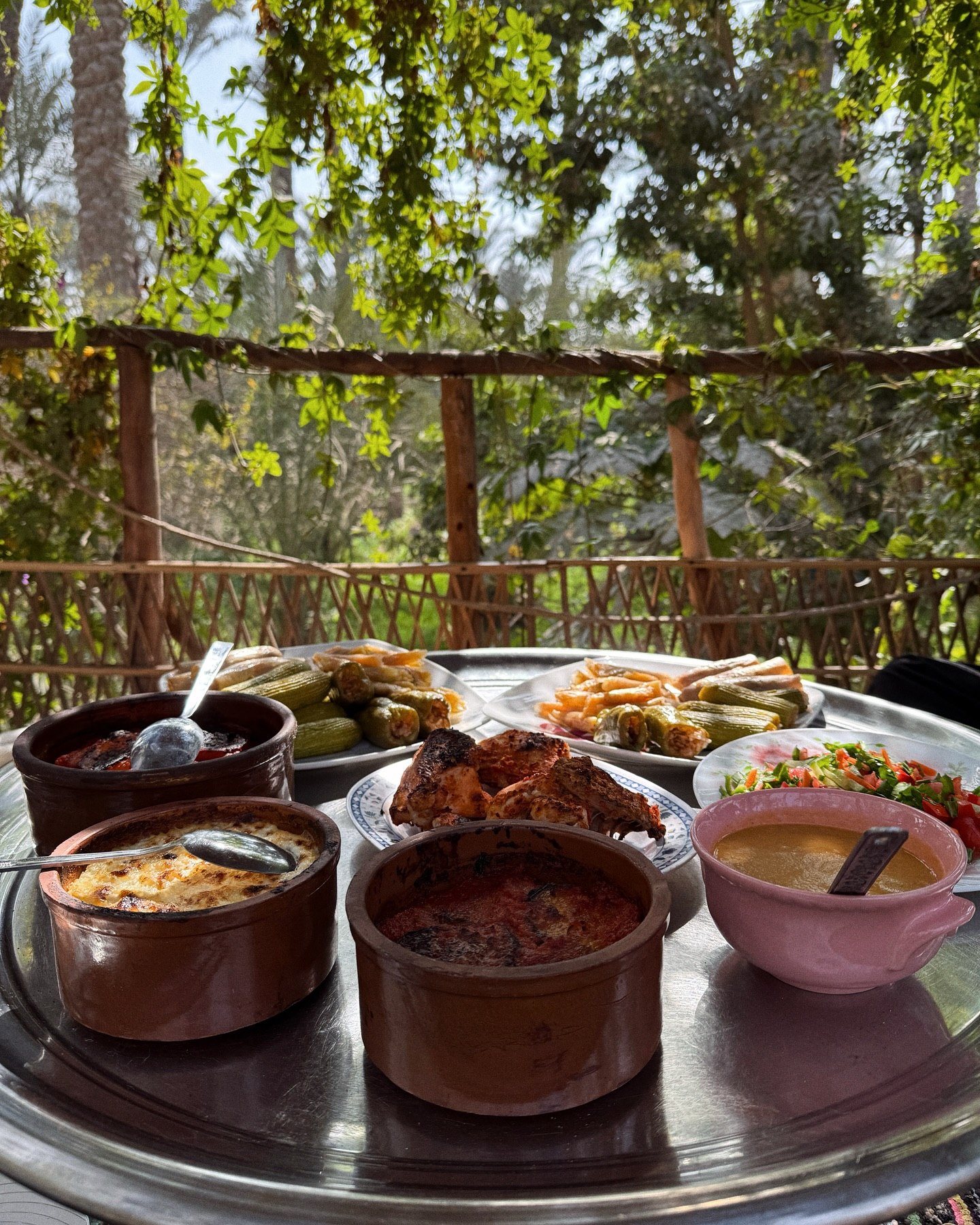
After Memphis, the itinerary includes lunch at a local restaurant with soft drinks.
Lunch, bottled water and soft drinks during the tour are included in the current package. The exact restaurant and meal format can vary according to the operating arrangements on the day.
Afternoon: Dahshur Pyramids
The final archaeological area is Dahshur, another major section of the Memphite necropolis.
Dahshur is especially important because it preserves the architectural experiments of King Sneferu, the first king of Egypt’s Fourth Dynasty. The two pyramids listed in the itinerary—the Bent Pyramid and Red Pyramid—show major stages in the transition toward the true smooth-sided pyramid.
The Bent Pyramid
The Bent Pyramid is one of the most recognizable pyramids in Egypt because its slope changes partway up the structure.
The Ministry of Tourism and Antiquities explains that construction began at an angle of approximately 55 degrees but was adjusted to about 43 degrees after structural concerns developed. This creates the distinctive “bent” profile visible today.
The monument is therefore an important piece of architectural evidence. It shows builders actively solving technical challenges as pyramid construction evolved from the stepped form of Djoser toward later smooth-sided monuments.
Why the Bent Pyramid Is Important
The Bent Pyramid stands between two major stages in pyramid development. Earlier at Saqqara, Djoser’s monument rose in steps. At Dahshur, Sneferu’s builders were attempting a true smooth-sided form, but the changing angle shows that the engineering process was still being refined.
That makes the sequence of this tour particularly strong for travelers interested in how ancient Egyptian architecture developed rather than simply seeing isolated monuments.
The Red Pyramid
Nearby stands the Red Pyramid, also built for Sneferu.
The Ministry of Tourism and Antiquities identifies it as the highest pyramid at Dahshur and the third-largest Egyptian pyramid after the pyramids of Khufu and Khafre at Giza. Its modern name comes from the reddish color of the exposed stone core, although it was originally covered with fine white Tura limestone casing.
The Red Pyramid represents a successful true smooth-sided pyramid and is one of the clearest architectural steps toward the later Great Pyramid of Khufu.
Can You Enter a Pyramid at Dahshur?
The published itinerary states that travelers have the opportunity to enter one of the old pyramids at Dahshur.
Current official information for the Red Pyramid describes visitor access through its northern entrance and descending passage into a sequence of interior chambers. However, entrance tickets are not included in this tour, and interior access can be affected by ticketing rules, conservation work, operational changes or temporary closures.
For that reason, pyramid entry should be treated as an opportunity subject to the site’s current conditions rather than an unconditional guarantee.
From Djoser to Sneferu to Giza
One of the strongest features of this itinerary is the architectural progression it reveals.
At Saqqara, the Step Pyramid shows the transition from mastaba tombs to a monumental stone pyramid. At Dahshur, the Bent Pyramid records a major engineering experiment, while the Red Pyramid demonstrates a successful smooth-sided form. The next famous stage came at Giza, where Sneferu’s son Khufu built the Great Pyramid.
Travelers who want to continue that story can pair this day with the Grand Egyptian Museum & Pyramids Day Tour, which includes the Great Pyramid of Khufu, Khafre, Menkaure and the Great Sphinx.
Entrance Tickets Are Not Included
The current exclusions clearly list entrance tickets.
This applies to the archaeological sites and any special interior tickets that may be required. Saqqara in particular has separate tickets for some monuments, and pyramid interiors may have their own admission or operational conditions.
Official prices and access rules can change, so final ticket requirements should be reconfirmed for the selected travel date.
What Is Included?
The current package includes private air-conditioned transportation, a professional Egyptologist tour guide, lunch at a local restaurant, bottled water and soft drinks during the tour, plus all service charges and taxes.
What Is Not Included?
The published exclusions are entrance tickets, tips for the guide, driver and tour team, and personal expenses.
No additional tomb, special pyramid interior or paid archaeological area should be assumed to be included unless specifically confirmed before the tour.
Who Is This Tour Best For?
This tour is particularly suitable for travelers interested in pyramid architecture, Old Kingdom history, archaeology and the early development of the Egyptian state.
It is also a strong choice for visitors who have already seen the Giza Pyramids and want deeper historical context. Instead of repeating the same monuments, this route explains the architectural experiments and older sites that helped make Giza possible.
Practical Tips for Saqqara and Dahshur
Both Saqqara and Dahshur are outdoor archaeological areas with exposed desert terrain. Comfortable walking shoes, sun protection and a hat are useful, particularly during warmer months.
If you plan to enter a pyramid, expect narrow or low passages, steep ramps and enclosed spaces. Interior pyramid entry may not be comfortable for travelers with mobility limitations, claustrophobia, certain back or knee conditions, or respiratory concerns.
Water is included in the package, but carrying a small personal bottle while walking between monuments is still practical.
Timing and Return to Cairo or Giza
The published itinerary starts at 8:00 AM and schedules the return transfer for approximately 5:00 PM.
Actual timing can vary with Cairo traffic, site queues, ticketing procedures and how much time is spent at each archaeological area. The 5:00 PM return should therefore be understood as the planned schedule rather than an exact guaranteed hotel-arrival time.
Plan a Full Pyramid-History Day
Saqqara, Memphis and Dahshur together provide one of the clearest one-day introductions to the origins of pyramid building and the ancient capital that connected these necropolises.
The route remains focused on the published program: Djoser’s Step Pyramid, Memphis and the colossal statue of Ramses II, lunch, then the Bent and Red Pyramids at Dahshur. It is a practical day trip for travelers who want historical depth without adding unrelated stops.
Overview
This Saqqara, Memphis & Dahshur Day Tour is a private full-day journey from Cairo or Giza through the early history of Egyptian pyramid building.
Pickup is scheduled for 8:00 AM. The tour begins at Saqqara with the Step Pyramid of Djoser, then continues to ancient Memphis and its open-air museum, including the colossal statue of Ramses II. After lunch at a local restaurant, the final stop is Dahshur for the Bent Pyramid and Red Pyramid.
The itinerary includes the opportunity to enter one of the old pyramids at Dahshur, but interior access is subject to current ticketing and site operations. Entrance tickets are not included in the published package.
The package includes private air-conditioned transportation, a professional Egyptologist guide, lunch, bottled water, soft drinks, service charges and taxes. Transfer back to the hotel is scheduled for approximately 5:00 PM.