Last reviewed: 7 September 2026
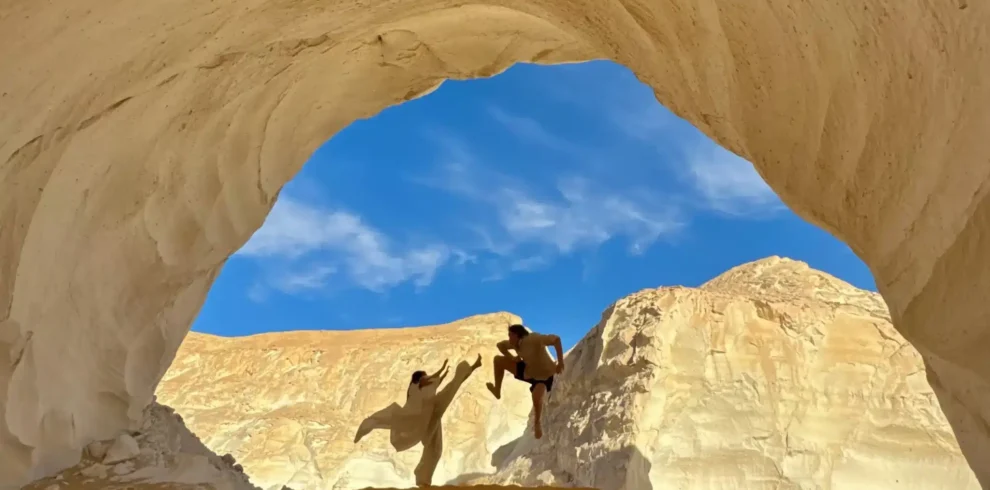
Crystal Mountain is one of the most recognizable short stops on the desert route between Bahariya Oasis and the White Desert. Despite its name, it is not a huge mountain made entirely of quartz. The scientifically documented feature is part of an exposed ancient karst and cave system containing large calcite crystals, cave deposits, collapse breccia, openings, and an arch-like structure that catches the sunlight.
This Crystal Mountain Egypt travel guide explains where the site is, what the crystals are, how the old cave became exposed, what travelers can realistically see, and how to include the stop in a Bahariya–White Desert safari without damaging it.
Direct answer: Crystal Mountain is a relatively small geological outcrop between Bahariya and Farafra. It preserves calcite-rich remains of an ancient cave or karst system whose roof and surrounding rock were partly removed by collapse and long-term erosion. The bright crystals and exposed cave structures—not a solid mountain of gemstone—gave the site its popular name.
Crystal Mountain quick facts
| Planning point | Practical answer |
|---|---|
| What it is | A compact crystal-rich karst outcrop and exposed cave remnant, not a high mountain |
| Main documented mineral | Calcite; site-specific geological studies also discuss cave deposits and collapse breccia |
| Location | Between Bahariya Oasis and Farafra on the wider White Desert route |
| Typical visit | A short guided stop within a Black Desert–Crystal Mountain–Agabat–White Desert circuit |
| How to reach it | Normally via Bahariya with a locally operated 4×4 as part of an organized desert itinerary |
| Can you collect crystals? | No. Leave crystals, rocks and fossils in place |
| Best trip length from Cairo | 2 days / 1 night is the practical minimum; 3 days / 2 nights gives more time |
| Current access | Visit through an authorized operator or official guide who confirms permits and route conditions |
Where is Crystal Mountain in Egypt?
Crystal Mountain is in Egypt's Western Desert, within the broad geological corridor between Bahariya Oasis and Farafra Oasis. It sits on the route travelers use when combining the Black Desert, El Heiz, Crystal Mountain, Agabat Valley, and the White Desert.
Scientific literature uses several connected names, including Crystal Mountain, Crystal Hill, Gebel Bellorat, and the wider Sheikh Abdallah–Crystal Mountain karst system. The differences matter because a research paper may discuss an extensive karst field or depression, while a tour itinerary may use “Crystal Mountain” for the compact roadside outcrop and arch that most visitors photograph.
A 2009 study in Geologica Acta describes a fossil-bearing karst exposure approximately 83 kilometers north of Farafra Oasis, immediately west of the Bahariya–Farafra road. That research concerns the wider Sheikh Abdallah/Crystal Mountain cave system, so the figure should not be treated as a door-to-door distance for every tour stop or map pin.
Egypt's official tourism portal describes Crystal Mountain as an excursion from Farafra and places it within the same desert landscape network as Agabat Valley and the White Desert. Most Cairo-based routes, however, approach from Bahariya because Bahariya is the practical transfer point between the paved Cairo journey and the desert circuit.
For the full approach, read how to get to Bahariya Oasis from Cairo and how to get to the White Desert from Cairo.
Why is it called Crystal Mountain?
The name comes from the crystals that sparkle on and within the exposed rock, especially when direct sunlight strikes clean crystal faces at the right angle. The outcrop also contains a natural opening commonly photographed as an arch.
“Mountain” is a tourist name rather than a precise statement about scale. Visitors expecting a high summit or a long mountain hike may be surprised by the compact stop. Its importance lies in the geological structures concentrated in a small area:
- Large visible calcite crystals
- Former cave openings and solution channels
- Cave deposits known as speleothems
- Broken rock cemented into collapse breccia
- Remnants of an ancient cave roof
- An exposed arch or karst window
- Contrasting chalk, limestone, crystal, and desert sediment
The site is valuable because it makes underground processes visible at the surface. You are effectively looking at parts of an old cave system after erosion removed much of the rock that once enclosed it.
Is Crystal Mountain really made of crystal?
The answer depends on what “made of crystal” means.
Crystals are present and visually important, but the entire landform is not one giant crystal. It is a mixed geological body containing host carbonate rock, calcite crystal masses, cave deposits, broken rock fragments, cement, cavities, and weathered surfaces.
A crystal is a solid whose atoms or ions are arranged in a repeating internal structure. Many minerals form crystals, including calcite, quartz, gypsum, halite, and barite. Calling a rock “crystal” without identifying its mineral does not tell us its composition.
The strongest site-specific evidence comes from peer-reviewed geological work:
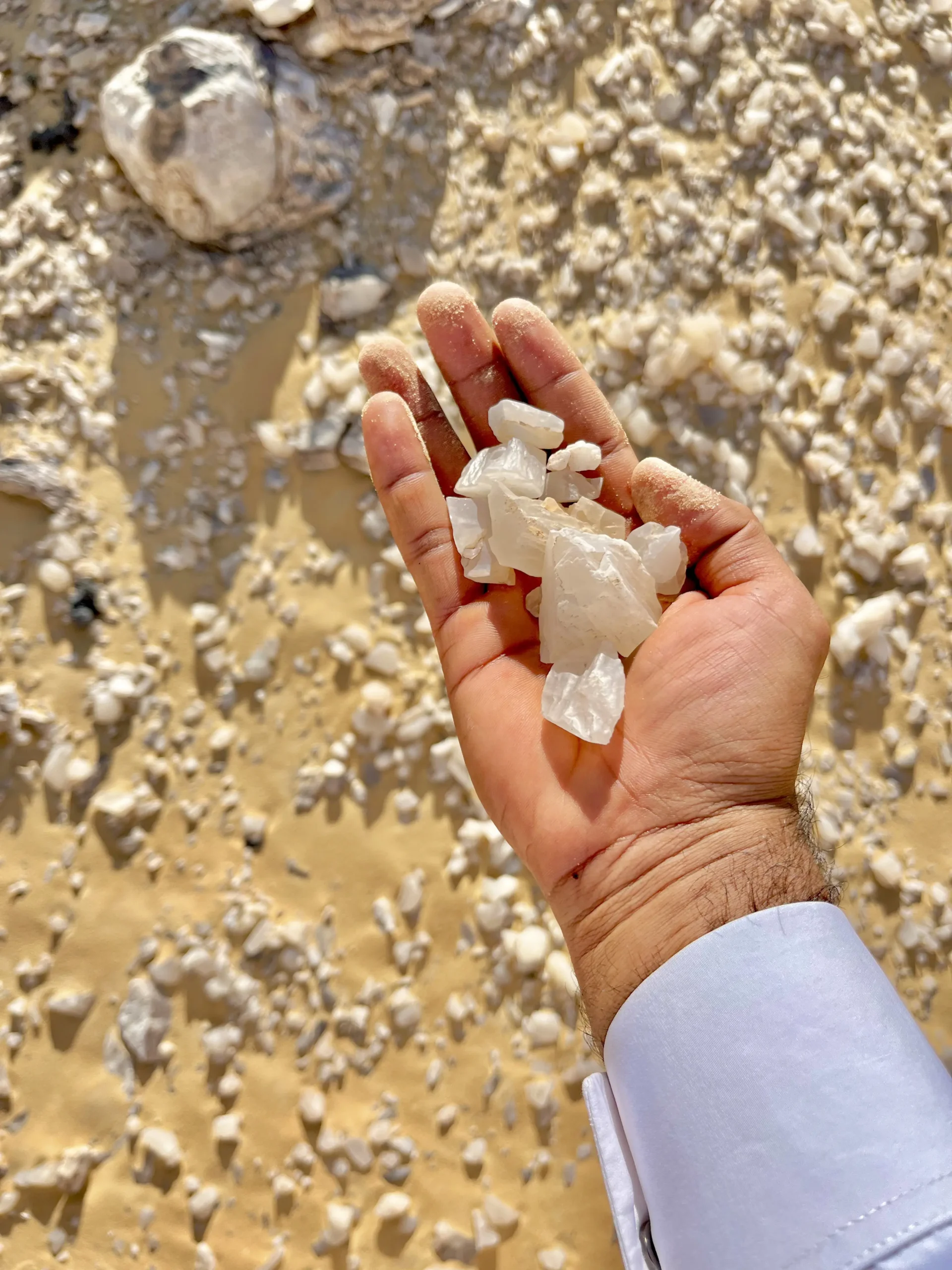
- A 2016 study of Bahariya and Farafra's geological heritage reports large calcite crystals at “Crystal Hill,” including speleothem forms, and a spectacular medusa- or umbrella-shaped body made from well-arranged calcite crystals.
- A 2022 Geoheritage study describes calcite crystals at Crystal Mountain in solution channels, cavities, flowstones, dripstones, and other cave deposits. It records crystals from microscopic size up to about 20 centimeters in the investigated karst system.
- A 2009 study describes coarse calcite crystals exposed in the Khoman Chalk cave system and connects the spelean deposits with a much wetter Late Miocene environment.
These sources justify saying that calcite is the principal documented crystal at the site. They do not justify saying the entire hill is a single block of pure crystal.
Calcite or quartz: what are the crystals?
Many tourism pages call Crystal Mountain a quartz mountain. That claim is repeated so often that it appears factual, but repetition is not mineral identification.
The peer-reviewed field studies most directly concerned with Crystal Hill and the Sheikh Abdallah–Crystal Mountain karst system identify large calcite crystals and calcite speleothems. Calcite is calcium carbonate, with the chemical formula CaCO₃. It is the principal mineral in many limestones and a common mineral deposited by water in caves.
Quartz has the formula SiO₂ and is significantly harder than calcite. Barite, BaSO₄, is another mineral sometimes mentioned in online descriptions of the site. Barite occurs elsewhere in the wider Bahariya region, but that regional occurrence is not enough to label every Crystal Mountain crystal as barite.
The responsible wording is:
Crystal Mountain's publicly documented cave crystals are predominantly calcite. Claims that the site is a pure quartz or barite mountain should not be repeated without sample-specific mineral analysis.
Why visual identification is unreliable
Calcite and quartz can both be colorless, white, translucent, or glassy. Desert dust, weathering, fractures, and reflected light make phone photographs even less reliable.
Geologists distinguish minerals using several properties:
- Crystal form
- Cleavage
- Hardness
- Reaction with dilute acid
- Density
- Optical behavior
- Laboratory mineralogy
Visitors should not perform scratch or acid tests. Scratching breaks crystal surfaces, acids alter carbonate material, and collecting destroys the context that gives the feature scientific value.
What is calcite?
Calcite is a common carbonate mineral and the main mineral component of many limestones. In caves, it often forms when water carrying dissolved calcium bicarbonate loses carbon dioxide. Calcium carbonate then precipitates on a ceiling, wall, floor, or existing deposit.
Over time, repeated thin layers can produce:
- Stalactites hanging from a cave roof
- Stalagmites rising from the floor
- Columns formed when the two join
- Flowstone coating a sloping wall or floor
- Crystalline crusts
- Helictites with curved or branching growth
- Crystals lining openings and cavities
The 2022 Geoheritage paper reports several of these forms in the White Desert karst area, including umbrella-shaped stalagmites, solution channels, flowstones, and curved or branching calcite growth. This is why Crystal Mountain is more than a collection of shiny stones: the crystal shapes preserve evidence of how water once moved through a cave.
What is karst?
Karst is a landscape and drainage system that develops when water dissolves soluble rock, especially limestone, chalk, dolomite, gypsum, or salt.
Rainwater absorbs carbon dioxide from the air and soil, becoming weakly acidic. When it enters joints and fractures in carbonate rock, it slowly dissolves the walls. Tiny cracks widen into channels. Channels can grow into cavities and caves. Roofs may weaken and collapse, producing sinkholes, broken-rock deposits, and open windows.
Common karst features include:
- Caves and chambers
- Enlarged joints
- Solution channels
- Sinkholes or dolines
- Uvalas, which are larger depressions formed by merging or expanding karst hollows
- Collapse breccia
- Stalactites and stalagmites
- Underground drainage
The present Western Desert is hyper-arid, so a major exposed cave system naturally raises a question: where did the water come from? The answer is that the Sahara's climate has changed repeatedly. Crystal Mountain records wetter conditions in the geological past.
Was Crystal Mountain once an underground cave?
Yes, that is the clearest way to understand the feature, but the exposure process needs careful wording.
The official Experience Egypt page says Crystal Mountain was once an underground cave that was “pushed” to the surface. The phrase is useful for visitors, but geological research describes a more complex process:
- Carbonate rocks were fractured and dissolved by water.
- Cavities, channels, and cave chambers developed below ground.
- Calcite was deposited inside the cave as crystals and speleothems.
- Sections of the roof collapsed, creating angular broken-rock deposits.
- Uplift, faulting, weathering, and denudation removed surrounding and overlying rock.
- Formerly underground cave structures became exposed at the modern surface.
The cave was therefore not lifted intact like an object placed on a platform. It was unroofed and exhumed: erosion stripped away the cover and revealed the internal architecture.
What does “unroofed cave” mean?
An unroofed cave is a former cave passage whose ceiling has been removed by collapse or erosion. Parts of its walls, floor, deposits, and mineral fillings can remain. From above, the remnant may look like an arch, trench, ridge, line of breccia, or crystal-rich opening rather than a conventional dark cave.
This explains why visitors see cave features in open sunlight.
What is collapse breccia?
Breccia is a rock or deposit made of angular fragments. In a cave, blocks can fall from the ceiling and walls, accumulate on the floor, and later become cemented by fine sediment or mineral-rich water. The resulting collapse breccia records structural failure inside the former cavity.
The 2016 geological heritage study specifically interprets the brecciated structure at Crystal Hill as evidence of a collapsed cave roof. The 2021 morphotectonic study also lists unroofed caves, sinkholes, widened joints, solution channels, and collapse breccias across the Crystal Mountain–Sheikh Abdallah karst depressions.
Do not climb onto loose or fractured breccia. Angular blocks may look solid while resting on unstable material, and crystal-lined cavities are easily broken by pressure.
How old is Crystal Mountain?
There is no single scientifically accurate age for every part of Crystal Mountain. The host rock, cave, crystal deposits, fossil-bearing fill, collapse, and modern exposure formed at different times.
The host carbonate rock
The 2009 study places the investigated cave system in the Khoman Chalk, a Maastrichtian unit from the Late Cretaceous. The rock hosting the cave is therefore much older than the cave deposits inside it.
The karst and cave deposits
Fossils in the Sheikh Abdallah/Crystal Mountain karst fill indicate a Late Miocene age of approximately 11–10 million years for important parts of the spelean deposit. The fossil assemblage included small mammals and other vertebrates whose ecological requirements point to a far wetter environment than today.
The exposed modern landform
Roof collapse, denudation, and erosion progressively revealed the cave system. The open arch and outcrops that travelers see are surface remnants created after the cave and its deposits already existed.
The safest concise answer is:
Crystal Mountain contains Late Cretaceous host rock and much younger cave deposits, including important Late Miocene material. Its present exposed form resulted from later collapse and erosion.
Statements such as “the crystals are 80 million years old” or “the mountain formed 11 million years ago” collapse several different events into one and should be avoided.
What does Crystal Mountain reveal about the ancient Sahara?
Today the region receives very little rain, but the cave system preserves evidence of a dramatically different environment.
The 2009 Geologica Acta study used fossil fauna and cave deposits to infer appreciably more humid conditions about 11–10 million years ago. The authors estimated mean annual rainfall of at least 750 millimeters and possibly as much as 1,200 millimeters for the environment represented by the deposits.
That range is a scientific reconstruction, not a modern forecast. Its importance is the contrast:
- Water circulated through carbonate rock.
- Caves and solution channels developed.
- Calcite precipitated as cave deposits.
- Animals lived in a landscape capable of supporting far more vegetation.
- Sediment and fossils accumulated inside karst cavities.
Crystal Mountain is therefore a climate archive as well as a photogenic stop. Its sparkling surfaces are evidence of past water, and its fossil-bearing deposits help researchers reconstruct a greener chapter of North Africa.
How did the crystals form?
The most evidence-based model is cave mineral precipitation.
- Rain and groundwater moved through fractures in carbonate rock.
- The water dissolved calcium carbonate.
- Water entered open cave spaces through cracks, ceilings, and walls.
- Changes in pressure, carbon dioxide, evaporation, and water chemistry caused calcite to precipitate.
- Repeated flow and dripping added new layers.
- Crystals and speleothems grew along openings, on walls, and on cave floors.
Crystal size and shape depended on the available space, water supply, chemistry, growth rate, and the surfaces on which minerals formed. This explains the range from crusts and flowstone to large individual crystals and unusual branching forms.
The crystals were not produced by desert sand polishing ordinary rock into glass. Wind can clean, abrade, and expose surfaces, but the internal crystal growth occurred through mineral precipitation.
Is Crystal Mountain a volcano?
No. Crystal Mountain is a carbonate karst and cave-related feature, not a volcanic cone.
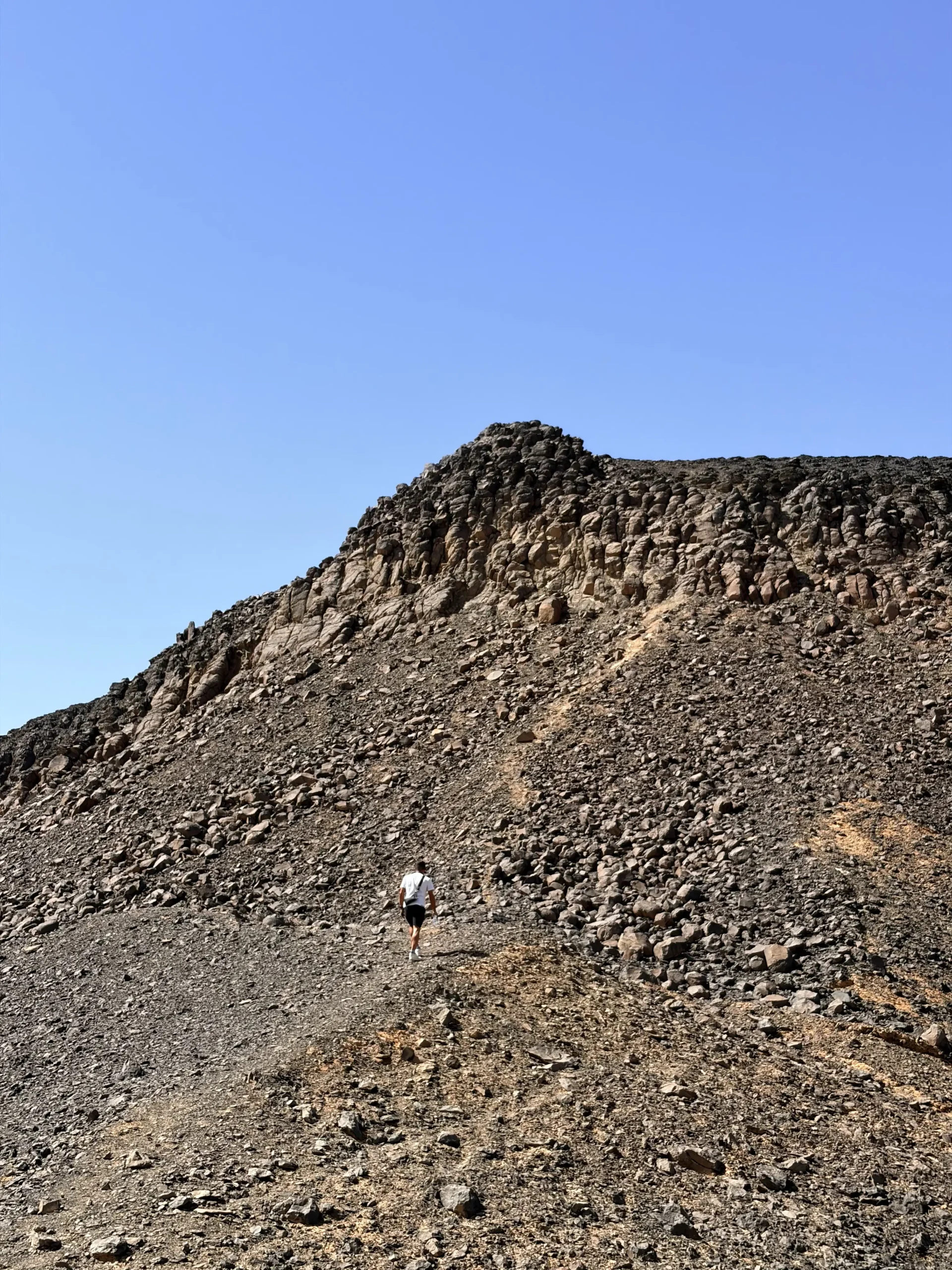
The confusion may come from its position on an itinerary that also crosses the Black Desert, where dark basaltic and related igneous rocks occur. The two stops record different geological processes:
Read why Egypt's Black Desert is black and the Black Desert vs White Desert comparison to see how sharply the geology changes across one route.
Is Crystal Mountain part of the White Desert?
Travel descriptions often say yes because it is included in White Desert circuits and lies within the wider protected karst landscape. Geographically and operationally, it is a transitional stop between the Bahariya/Black Desert sector and the better-known chalk sculptures farther south.
The exact phrase “inside the White Desert” can mean:
- Within the protected-area or northern White Desert landscape
- On a White Desert safari itinerary
- Near the approach to the classic chalk formation zones
It does not mean the arch is identical to the mushroom-shaped chalk sculptures photographed in the central visitor areas.
For a complete regional overview, use the ultimate guide to the White Desert in Egypt and the White Desert Egypt travel guide.
What will you see during a visit?
A typical stop is short and observational. Depending on the guide's permitted stopping point and the current condition of the site, you may see:
- The familiar natural arch or karst window
- Sparkling crystal faces in direct sunlight
- White or translucent calcite
- Cavity walls and former solution channels
- Angular fragments in collapse breccia
- Pale carbonate rock around the crystal-rich structures
- Weathered openings and honeycomb-like textures
- Broad desert views linking the Black Desert and White Desert route
Not every visitor will see the same sparkle. Dust, cloud, sun angle, season, and recent disturbance affect the appearance. The feature is more impressive when understood geologically; it should not be sold as a cave filled with gem-quality crystals.
How long do you need at Crystal Mountain?
For most general itineraries, approximately 20–45 minutes is enough to:
- Walk from the vehicle at the permitted stop
- View the arch from several safe angles
- Notice crystals and cave structures
- Take photographs
- Hear a short geological explanation
- Return without rushing
This is an operational estimate, not a fixed park rule. A geology-focused group may need longer, while heat, wind, daylight, route delays, or permit instructions may shorten the stop.
Crystal Mountain is rarely a standalone full-day destination. Its value comes from its place in a sequence of different landscapes.
The usual route from Bahariya
A common southbound route works like this:
- Travel from Cairo or Giza to Bahariya Oasis.
- Meet the local desert team and transfer to a 4×4.
- Cross or stop in the Black Desert.
- Continue toward El Heiz for a meal, rest, or spring stop depending on the program.
- Visit Crystal Mountain.
- Continue to Agabat Valley and other approved stops.
- Enter the White Desert and camp or return according to the itinerary.
The exact order can change. Vehicle condition, weather, permissions, daylight, and the selected route all matter. The website itinerary—not a general blog article—should be treated as the starting point for what is included.
Use the Black Desert Egypt travel guide and how to get to the White Desert from Cairo for the northern part of this journey.
Can you visit Crystal Mountain from Cairo in one day?
Technically, a long road journey can connect Cairo, Bahariya, and part of the desert route, but a same-day return creates a rushed schedule and leaves little room for delays, geological stops, or the White Desert.
Most travelers should choose:
- Two days / one night: the most compact practical circuit with desert camping
- Three days / two nights: more time for Bahariya, photography, route stops, or a second desert night
- A customized expedition: useful for geology, birding, photography, or combining Djara Cave
Compare the 2-day White Desert itinerary with the 2-day vs 3-day White Desert tour guide.
Which Elzaghandi Travel tours include Crystal Mountain?
Crystal Mountain appears within several active Elzaghandi Travel desert programs:
- 2 Days / 1 Night White Desert Adventure — a compact Bahariya, Black Desert, Crystal Mountain, Agabat, and White Desert camping route.
- 3 Days / 2 Nights Bahariya Oasis & White Desert Adventure — combines oasis sightseeing with the southbound desert circuit.
- 3 Days / 2 Nights White Desert Adventure — allows a deeper two-night route and more time across the desert landscape.
All itinerary details should be reconfirmed for the actual travel dates. Ask whether Crystal Mountain is scheduled, whether access conditions have changed, which permits are included, and how the day is paced.
To build a geology-focused version, use the customize your trip form and request time at the Black Desert, Crystal Mountain, Agabat, and contrasting White Desert formations.
Is a 4×4 required?
The wider desert circuit uses a 4×4 because many connected sections are off-road and remote. Even if a road passes near a particular Crystal Mountain exposure, the complete itinerary should be operated with the right vehicle, recovery capacity, local navigation knowledge, permits, and communications plan.
Do not rent an ordinary car and follow a map pin into the desert. A map pin does not tell you:
- Whether the route is currently permitted
- Whether tracks have shifted
- Whether sand is soft
- Whether a checkpoint requires documents
- Where phone reception ends
- Whether a damaged tire can be replaced
- Whether a seasonal or conservation closure applies
Egypt's official tourism portal advises travelers to confirm permits and regulations with a travel agency or authorized guide before a desert excursion.
Permits and current travel advice
Permit and access rules can change. The UK Foreign, Commonwealth & Development Office guidance reviewed on 23 July 2026 says visitors entering Bahariya, Farafra, the White Desert, and the Black Desert must arrange permits in advance and use an official guide. It also warns of limited phone reception and poor medical facilities in the region.
Travelers should:
- Check their own government's current Egypt advice
- Confirm that insurance covers the planned desert activity
- Send passport details only through the operator's legitimate process
- Ask who arranges the permit
- Carry the required identification
- Follow checkpoint and guide instructions
- Avoid routes close to separately restricted border areas
Read is the White Desert in Egypt safe? for a complete risk-based framework.
Is Crystal Mountain safe to walk around?
A guided visit on approved ground is generally manageable for travelers who can walk on uneven gravel, but the geology creates specific hazards:
- Loose angular rock
- Sharp crystal edges
- Unstable fragments
- Undercut cavities
- Fractured arches
- Sudden drops around holes
- Heat and strong sun
- Windblown dust
- Distance from medical care
Stay where the guide can see you. Do not stand on the arch, enter unstable cavities, jump between blocks, or pull yourself up by crystal surfaces.
Children require direct supervision. Travelers with limited mobility should ask about the distance from the vehicle and the condition of the ground before booking.
Can you climb Crystal Mountain?
Treat the feature as a geological exhibit, not a climbing structure.
Climbing adds body weight and friction to fragile crystal-rich rock. It can dislodge fragments, widen cracks, damage the arch, and create a fall risk. Even if older photographs show people standing on the formation, that does not establish current permission or safety.
The best viewpoint is normally at ground level, where the arch, crystals, collapse material, and surrounding landscape can be seen together.
Can you take crystals home?
No. Do not collect crystals, chalk, fossils, breccia fragments, or loose stones.
Removing a fragment causes three kinds of damage:
- Physical damage: material is permanently lost.
- Scientific damage: the fragment loses its exact position and relationship to surrounding deposits.
- Cumulative damage: one visitor's “small souvenir” becomes thousands of removals over time.
The Egyptian Environmental Affairs Agency's management material identifies the White Desert as a protected area established under Prime Ministerial Decree 1120/2002 and emphasizes balancing tourism with conservation. The correct practice is to photograph, observe, and leave everything in place.
What happened during road construction?
Online accounts often say Crystal Mountain was discovered by accident when the Bahariya–Farafra road was built. Scientific literature supports a more cautious version.
The 2009 paper reports that a fossil-rich roadside exposure was found in 1979 and that coarse calcite crystals and cave fill were visible immediately west of the road. Road cuts can expose geological structures that were previously hidden, and construction may have removed or damaged parts of the outcrop.
However, “the entire mountain was discovered by road workers” is too absolute without a clear primary historical record. The defensible statement is that road-related exposure helped reveal and provide access to parts of the karst system.
Is Crystal Mountain a cave you can enter?
It is not normally presented as a conventional walk-in cave tour. Much of the scientifically important feature is an exposed or unroofed cave system. Visitors view openings, an arch, crystal-lined structures, and remnants of former cave deposits in daylight.
Do not enter a cavity unless the official guide explicitly confirms that it is permitted and stable. A small opening can have loose ceilings, hidden drops, wildlife, poor footing, or fragile deposits.
For a true underground karst destination with different logistics and archaeological context, see the 3 Days / 2 Nights White Desert & Djara Cave Adventure.
Crystal Mountain versus Djara Cave
The sites complement one another. Crystal Mountain offers a quick view into an unroofed cave system, while Djara provides a more immersive cave and archaeological experience.
Crystal Mountain versus the White Desert formations
The iconic White Desert mushrooms and towers are mainly erosional landforms cut from pale chalk and carbonate rock. Crystal Mountain preserves crystal-rich cave deposits and structural remnants of a karst system.
Wind contributes to the modern exposure and surface texture of both areas, but it did not create their mineral composition from nothing. Water-driven dissolution and calcite precipitation were essential at Crystal Mountain; differential weathering and erosion dominate the classic sculptural appearance farther south.
The best time to visit Crystal Mountain
Cooler months are generally more comfortable for the Western Desert. The best choice depends on:
- Daytime heat
- Night temperature if camping
- Wind and dust
- Holiday demand
- Moon phase for stargazing
- Your tolerance for long drives
Crystal reflections depend on direct light, so a bright day can make the surfaces sparkle. Early morning and late afternoon produce better landscape relief, while higher sun may create stronger reflections on certain faces. The itinerary often determines the arrival time because Crystal Mountain is one stop in a long route.
Use the best time to visit the White Desert guide for seasonal temperatures, comfort, wind, and trip-planning tradeoffs.
Photography tips
Crystal Mountain is difficult to photograph accurately because a small reflective feature can look flat in a wide desert frame.
Show the scale
Take one wide photograph with a person at a safe distance, or use the vehicle only if parked in an approved position. Then photograph the arch and surrounding rock without a person.
Look for side light
Side light reveals cavities, breccia, crystal faces, and former cave channels. Front light can make the rock appear flat; strong backlight may turn the arch into a silhouette.
Protect highlights
Bright calcite and pale chalk can overexpose. Reduce exposure slightly and check the histogram if your camera provides one.
Use a polarizing filter carefully
A polarizer can reduce glare and deepen the sky, but it may also remove the reflections that make the crystals sparkle. Rotate it while watching the effect rather than leaving it at maximum.
Do not stage harmful photographs
Never place crystals in someone's hand, move loose pieces into a pattern, climb onto the arch, or scratch a clean surface for a close-up.
For batteries, dust, night photography, and camping equipment, see the White Desert stargazing and photography guide.
What should you wear?
Wear clothing for the full desert day, not only the short Crystal Mountain stop:
- Closed shoes with grip
- Breathable base layers
- Long light trousers
- Sun hat
- Sunglasses
- High-SPF sunscreen
- Scarf or buff for dust
- Warm layer in cool months
- Wind-resistant outer layer if forecast
Avoid open sandals around sharp fragments and uneven ground. The White Desert packing guide covers clothing, electronics, camping, medication, and seasonal adjustments.
What should you bring?
Useful items include:
- Drinking water supplied or confirmed by the operator
- Refillable bottle
- Camera or phone
- Dust protection for lenses
- Power bank
- Personal medication
- Small notebook
- Offline copy of the itinerary
- Passport or required identification
- Snack if permitted by the operator
- Small waste bag
Do not bring a geological hammer, chisel, acid, or sample bags. The purpose is observation, not extraction.
Responsible geotourism checklist
Crystal Mountain has already suffered from exposure, access pressure, and removal of material. A responsible visit should meet all of these conditions:
- Use an authorized operator and official guide.
- Follow current permit rules.
- Stay on the approved approach.
- Do not touch crystals unnecessarily.
- Never break, scratch, or collect material.
- Do not climb the arch.
- Keep food and litter contained.
- Avoid loud music near natural habitats.
- Do not enter cavities without permission.
- Do not publish sensitive fossil coordinates.
- Do not fly a drone without explicit legal authorization.
- Correct misinformation without inventing a new story.
The 2016 geological heritage paper argues that the combined geodiversity of Bahariya, Farafra, and the area between them has global significance. That value comes from the relationships between features. A crystal fragment in a pocket loses the context that makes it meaningful.
Common myths about Crystal Mountain
Myth 1: It is a mountain made entirely of quartz
Correction: The site is a mixed karst outcrop. Peer-reviewed studies document calcite crystals and calcite cave deposits.
Myth 2: The crystals grew because of volcanic heat
Correction: The best-supported explanation is precipitation from mineral-bearing water inside a carbonate cave system.
Myth 3: Wind turned limestone into crystal
Correction: Wind helped expose and weather the feature, but the crystals formed through mineral processes, mainly inside the former cave.
Myth 4: The cave was pushed above ground in one event
Correction: Collapse, uplift, faulting, weathering, and denudation progressively removed the roof and surrounding rock.
Myth 5: Every white crystal is quartz
Correction: Calcite, quartz, barite, gypsum, and other minerals can look pale or glassy. Site-specific evidence is required.
Myth 6: Loose pieces are free souvenirs
Correction: Loose fragments remain part of the protected geological site and should not be removed.
Myth 7: Crystal Mountain is the White Desert's largest mountain
Correction: It is a compact geological stop whose importance comes from its cave structures and crystals, not its height.
Myth 8: One map pin is enough for a self-drive visit
Correction: Permits, route conditions, navigation, recovery, and current access require an authorized operator and local guide.
How to evaluate a Crystal Mountain tour
Before booking, ask:
- Is Crystal Mountain specifically included in the current route?
- Is the trip private or shared?
- Where is the Cairo or Giza pickup?
- When does the 4×4 section begin?
- Who arranges permits?
- How much time is planned at the stop?
- Which other locations are included that day?
- Is camping equipment supplied?
- Are meals and drinking water included?
- What happens if weather or access changes?
- Can the guide provide a geology-focused explanation?
- What is the cancellation policy?
A request-price model is useful here because route cost depends on group size, vehicle allocation, duration, pickup, camping level, and customization. Avoid comparing quotes before confirming that the inclusions are equivalent.
A realistic two-day sequence
The following is a planning model, not a binding itinerary:
Day 1
- Early pickup in Cairo or Giza
- Road transfer to Bahariya
- Lunch or preparation in the oasis
- Change to a desert-ready 4×4
- Black Desert stop
- El Heiz stop according to the program
- Crystal Mountain visit
- Agabat and onward route
- White Desert camp, dinner, and stargazing
Day 2
- Sunrise and breakfast
- White Desert formations
- Approved route back toward Bahariya
- Transfer to Cairo or Giza
The White Desert camping guide explains what a desert camp normally involves and what questions to ask about toilets, bedding, meals, temperature, and privacy.
A better three-day geology route
Travelers primarily interested in geology should consider three days:
Day 1: Bahariya context
- Oasis depression and settlement landscape
- Geological view points where permitted
- Black Desert hills and dark gravel
- Overnight in or near Bahariya according to the itinerary
Day 2: Karst transition
- El Heiz route
- Crystal Mountain's calcite and unroofed cave features
- Agabat landforms
- White Desert camp
Day 3: Chalk landscape
- White Desert sculptures
- Comparison of chalk erosion with Crystal Mountain karst
- Return through Bahariya
This sequence explains the region as a geological story instead of a checklist of photo stops. The Bahariya Oasis Egypt travel guide and things to do in Bahariya Oasis provide the inhabited-oasis context.
Related Western Desert guides: See how Crystal Mountain fits into the best things to do in Bahariya Oasis, continue to the Agabat Valley guide, and compare the surrounding landscapes in the White Desert travel guide.
Frequently asked questions
What is Crystal Mountain in Egypt?
Crystal Mountain is a compact crystal-rich karst outcrop on the Western Desert route between Bahariya and Farafra. It preserves exposed cave structures, calcite crystals, solution features and collapse material.
Where is Crystal Mountain?
It lies on the wider Bahariya–Farafra route commonly used for Black Desert, Crystal Mountain, Agabat and White Desert itineraries.
Is Crystal Mountain made of quartz?
Site-specific geological studies primarily document calcite crystals and calcite cave deposits. Describing the whole feature as a quartz mountain is not well supported.
Was Crystal Mountain once a cave?
Yes. Geological research describes an ancient karst and cave system that became exposed after roof collapse, erosion and long-term denudation removed surrounding rock.
How old is Crystal Mountain?
There is no single age for the whole feature. The host carbonate rock is much older than the cave deposits, and important fossil-bearing cave material in the wider system dates to the Late Miocene.
Can you take crystals from Crystal Mountain?
No. Crystals, rocks, fossils and loose fragments should be left in place to protect the geological site and its scientific context.
Can you climb the Crystal Mountain arch?
No. Treat the feature as a fragile geological stop rather than a climbing structure. Climbing can damage the formation and creates a fall risk.
How long do visitors normally spend at Crystal Mountain?
Most general safari itineraries allow a short stop, often around 20–45 minutes, depending on route timing, weather, access and the guide’s plan.
Can I visit Crystal Mountain from Cairo in one day?
A same-day return would be very compressed. A 2-day/1-night White Desert itinerary is the practical minimum for most travelers.
Do I need a 4×4?
The wider desert circuit normally uses a suitable local 4×4 with an experienced driver, recovery equipment and route knowledge.
Do I need a guide and permits?
Yes. Current regional guidance requires advance permits and an official guide for the Bahariya, Farafra, Black Desert and White Desert areas.
Is Crystal Mountain part of the White Desert?
It is commonly included in White Desert circuits and the wider protected karst landscape, but it is a distinct geological stop from the classic mushroom-shaped chalk formations.
Can children visit?
Yes, if they can tolerate the driving and uneven desert terrain, but they need close supervision around fragile rock, sharp fragments and cavities.
What is the best season to visit?
Cooler months are generally more comfortable. Check current daytime heat, night temperatures, wind and dust before departure.
Which Elzaghandi Travel tours include Crystal Mountain?
The site is included in published 2-day and 3-day White Desert itineraries, subject to current route operation and confirmation for your travel dates.
Trusted sources and further reading
This article prioritizes site-specific field studies and official visitor guidance:
- Geological heritage of the Bahariya and Farafra oases — documents large calcite crystals, speleothems, collapse structures, and the geological heritage value of Crystal Hill.
- Late Miocene karst system at Sheikh Abdallah — provides the 11–10 million-year age, cave setting, fossil evidence, and palaeoclimate interpretation.
- Karst Heritage as a Tourist Attraction in the White Desert National Park — describes calcite speleothems, solution channels, flowstones, crystal sizes, cave forms, and geotourism value.
- Morphotectonic Evolution of Qaret El Sheikh Abdallah and Crystal Mountain — details the karst depressions, unroofed caves, sinkholes, collapse breccias, structural history, and denudation.
- Egyptian Environmental Affairs Agency: White Desert Protected Area management plan — official protected-area and conservation context.
- Experience Egypt: Desert Excursions — official tourism description and advice to confirm permits with an authorized guide or agency.
- Current UK regional travel advice for Egypt — current permit, guide, phone reception, and medical-facility guidance; recheck before travel.
Plan a Crystal Mountain and White Desert safari
Crystal Mountain works best as one chapter in a complete geological route: the inhabited Bahariya depression, the dark capped hills of the Black Desert, the exposed calcite cave system at Crystal Mountain, Agabat's pale cliffs and sand, and the sculpted chalk formations of the White Desert.
For a personalized quote, send:
- Travel dates
- Number and ages of travelers
- Cairo or Giza pickup point
- Two-day or three-day preference
- Private or shared-trip preference, if available
- Dietary requirements
- Medical or mobility considerations
- Camping comfort expectations
- Interest in geology, photography, or Djara Cave
Request a Crystal Mountain and White Desert itinerary on WhatsApp. Route, permits, availability, inclusions, and access should be confirmed in writing for your dates.