Last reviewed: 19 July 2026
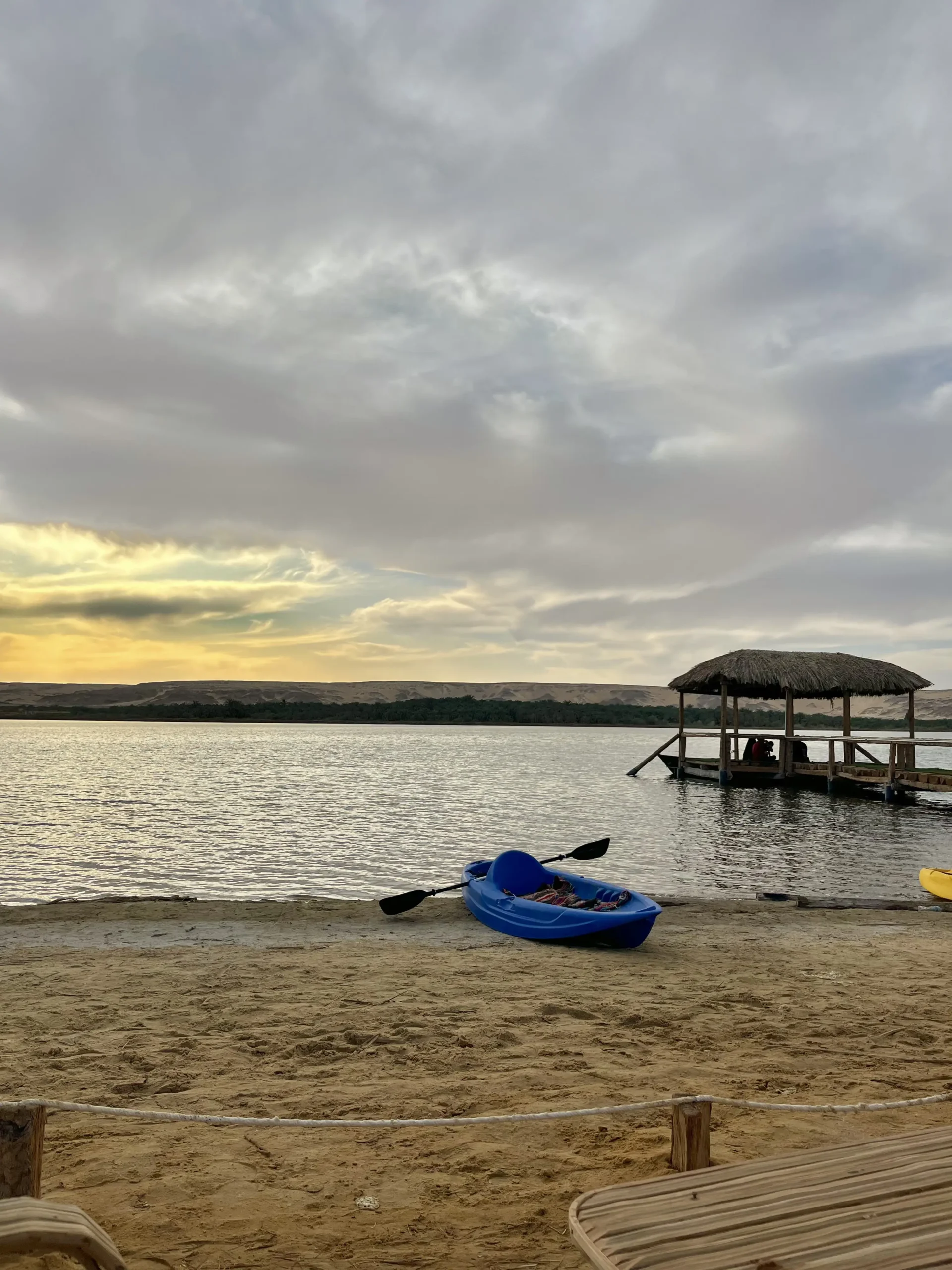
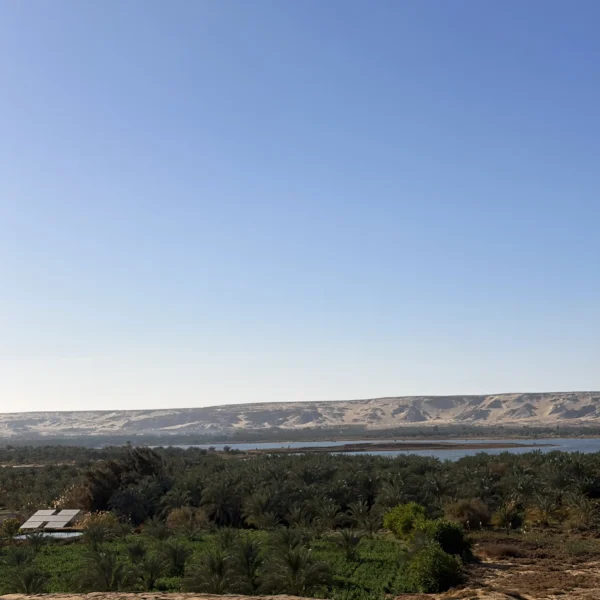
Bahariya Oasis Salt Lake is a scenic water-and-desert stop near the inhabited oasis, usually combined with Bawiti, palm groves, nearby dunes, a natural spring and an elevated sunset viewpoint. It is valuable because the water, palms, sand and low hills make the structure of an oasis visible in a single landscape. It should not be treated as a standardized beach, a guaranteed turquoise swimming lake or an attraction with fixed shoreline conditions.
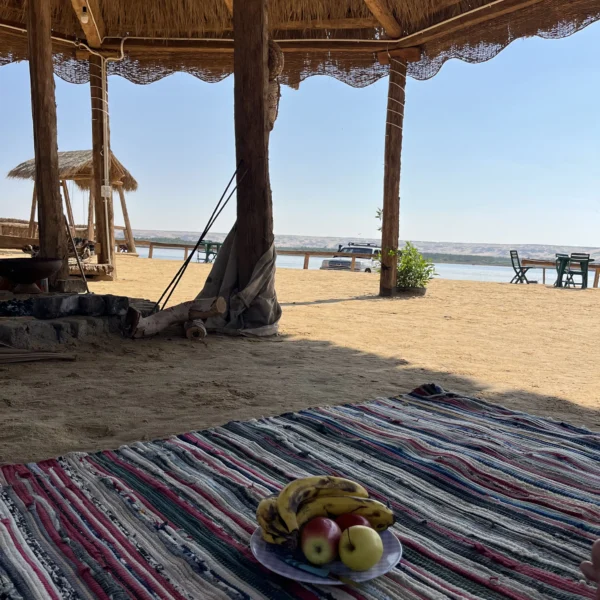
Elzaghandi Travel’s active three-day Bahariya Oasis and White Desert itinerary includes a Salt Lake stop with Bedouin tea during the first oasis day. The same published day continues to dunes, Pyramid Mountain, a hot spring and sunset at English Mountain. This means a normal itinerary does not necessarily place the group beside the Salt Lake at the exact moment of sunset. If “Bahariya Oasis Salt Lake sunset” is your priority, request that timing before booking and understand which other stop may need to move or become shorter.
Quick answer: Visit the Bahariya Salt Lake with a local guide, arrive 45–75 minutes before sunset if lake light is the priority, and stay briefly after the sun disappears for blue-hour colour. Do not promise mirror reflections, bright water colour or swimming: wind, water level, sediment, drainage, haze and the chosen shoreline can change the scene. For the standard three-day route, the lake is normally a daytime or late-afternoon tea stop and English Mountain is the planned sunset location.
Bahariya Salt Lake at a glance
What is the Bahariya Oasis Salt Lake?
Bahariya is a groundwater-dependent depression in Egypt’s Western Desert. NASA Earth Observatory shows the inhabited and cultivated areas as dark patches surrounded by desert and explains that the depression is deep enough to access groundwater. Date and olive groves exist because water supports settlement and agriculture in an otherwise arid environment.
The feature tourists call the Salt Lake belongs to this broader water landscape. It is safer to describe it as a saline lake, pond or low basin influenced by groundwater, irrigation, drainage and intense evaporation than to invent one simple origin story for every visible pool.
A 2026 Scientific Reports study of Bahariya groundwater describes the oasis as a closed basin. Its low, gentle depression floor functions as an accumulation and discharge zone, while high evaporation can contribute to soil salinization. It does not identify the tourist stop as a single permanent recreational lake. The reasonable inference is that surface water extent and shoreline appearance can respond to local water management, drainage and evaporation. That inference should be checked against local conditions rather than presented as a fixed map.
The word “lake” can also create the wrong expectation. This is not a large resort lake with one official gate, lifeguard, marked swimming beach and continuous promenade. The visit is normally a short landscape stop chosen by a local guide who knows which track and shoreline are usable that day.
Is it one lake or several saline basins?
Online articles and maps may use “Bahariya Salt Lake,” “Salt Lakes,” “salty lake” or a local name for different water areas. English transliteration and informal tourism labels are inconsistent. Water level and access can also change between photographs.
Before publishing a map pin or promising a location, ask:
- Which lake or basin will the itinerary visit?
- Is it close to Bawiti, farms or the dunes?
- Can a normal vehicle reach it, or is a local 4×4 needed?
- Is the selected edge dry enough for walking?
- Is the stop intended for tea, photography, sunset or swimming?
- Are residents, farms or private land nearby?
- Is there another shoreline if wind or mud makes the first unsuitable?
This approach avoids one of the most common destination-content errors: copying a dramatic photograph and assuming every “Salt Lake” pin leads to that exact view.
Why can the lake look different from online photos?
Water level changes
The visible area of water may expand or contract. A broad reflection in one season can become separated shallow pools or wet salt flats at another time. Do not guarantee a particular shoreline shape months in advance.
Wind changes reflections
Mirror reflections require relatively calm water. Wind creates ripples and breaks the symmetry. It can also lift dust, reducing contrast in the sky. Calm conditions may occur, but they cannot be sold as a fixed inclusion.
Sediment and salinity affect colour
Water can look blue, green, grey, brown or almost colourless depending on sky, angle, depth, sediment, dissolved material and camera processing. A saturated social-media image is not a reliable colour standard.
The sun angle changes by date
Sunset position moves along the horizon over the year. A mountain, dune or palm that aligns with the sun in one month may not align in another. The exact local sunset time also changes daily.
Agricultural activity affects the foreground
Bahariya is a working oasis. Irrigation, drainage, farm access, vegetation, animals, vehicles and local maintenance can alter a viewpoint. These are not flaws to hide; they show that the lake sits inside a lived landscape rather than an empty photography set.
Editing changes expectations
Phone HDR, presets, white balance and saturation can make water and sky look more intense. Use photographs as inspiration, not a contractual promise. A useful guide explains the conditions behind a photograph instead of guaranteeing the same pixels.
Does the Bahariya Salt Lake have a guaranteed sunset view?
No sunset is guaranteed. The sun will set, but the quality and visibility of the scene depend on cloud, haze, airborne dust, wind, route timing and the chosen shore. A low bank or hill can also hide the final moment before the calculated horizon time.
The NOAA sunrise and sunset calculator allows a date, latitude, longitude, time zone and daylight-saving adjustment to be entered. Use it as a planning reference, then confirm local time and weather close to travel. Egypt’s seasonal clock setting matters: an itinerary copied from another month can be an hour wrong if the time-zone adjustment is ignored.
For practical planning:
- Calculate sunset for the exact travel date and Bahariya location.
- Confirm the current Egyptian clock setting.
- Ask the operator which shoreline is planned.
- Schedule arrival 45–75 minutes before sunset.
- Preserve at least 15–25 minutes after sunset for blue hour.
- Keep a headlamp accessible for the return to the vehicle.
- Do not walk onto an uninspected edge in fading light.
The guide’s local assessment overrides a theoretical sun time. A safe parking point, stable shore and visible route back matter more than the last two minutes of colour.
Salt Lake sunset or English Mountain sunset?
The active three-day itinerary includes both places on Day 1, but it treats them differently: the Salt Lake is a lake-and-tea stop, while English Mountain is the published sunset viewpoint. Choosing the best one depends on the image and experience you want.
Choose the Salt Lake when
- Reflections are the main photography goal.
- You want water and palms in the sunset composition.
- A quieter, lower viewpoint is preferable to a hill.
- The guide confirms a stable, open shoreline.
- You accept that English Mountain may move or be visited before sunset.
Choose English Mountain when
- You want the widest view of the oasis.
- Water conditions are poor or the lake is windy.
- The standard itinerary timing is important.
- The group prefers a documented sunset sequence already built into the active route.
- You want to understand Bahariya’s scale from above.
Can you photograph both at sunset?
Not at the same moment. They are separate locations. Trying to leave one during the best light and race to the other risks missing both, creates unsafe driving pressure and reduces the experience to a checklist. Choose one primary sunset, then visit the other in daylight or late afternoon.
Best time of day for the Salt Lake
Early morning
Morning can offer calmer air, clean light and fewer visitors. The sun direction may illuminate palms or hills differently from sunset. It is an excellent backup if late-afternoon wind is expected.
Midday
Strong overhead light can make the water appear brighter but also produces glare, harsh contrast and heat. Midday is useful for a short route stop, not usually the most comfortable photography session.
Golden hour
The hour before sunset gives lower, warmer light and longer shadows. The exact useful period depends on hills, haze and season; “golden hour” is not always a full hour. Arrive before the light becomes dramatic so you can inspect the foreground safely.
Sunset
Expose for the brightest part of the sky, protect highlights and photograph a sequence as colour changes. The most saturated moment may occur before the sun disappears, at the horizon or several minutes afterward.
Blue hour
After sunset, the sky becomes cooler and exposure times lengthen. Reflections can become smoother if wind drops. Stay close to the guide and vehicle, use a tripod or stable support, and do not explore an unknown shore in darkness.
Best months for a Salt Lake and White Desert trip
October and November
Warm days and cooler evenings make an oasis day comfortable. Sunset timing is practical for continuing to a hotel after English Mountain or the lake.
December to February
Daytime light can be pleasant, but the temperature drops quickly after sunset. Carry a fleece or windproof layer in the vehicle. Wet or salty footwear feels colder than dry walking shoes.
March and April
Warm light and comfortable days are possible, but spring wind and dust can reduce reflections and visibility. Protect camera equipment and keep an alternative viewpoint.
May to September
High daytime heat makes exposed shorelines and dunes demanding. Schedule lake photography late, carry sufficient safe drinking water and confirm vehicle air conditioning. A hot day does not guarantee a clear sunset; dust and haze still matter.
Read the best time to visit the White Desert before coordinating the lake with an overnight camp.
What to expect on the active three-day route
Elzaghandi Travel’s published 3 Days / 2 Nights Bahariya Oasis and White Desert Adventure uses the first day for the inhabited oasis and the second day for the remote desert route.
Day 1: Bahariya Oasis
The active programme includes:
- Cairo or Giza pickup and road transfer
- Arrival in Bahariya and lunch
- Zawya Mosque and local heritage
- El Beshmo and palm-grove views
- Salt Lake stop with Bedouin tea
- Nearby dunes
- Pyramid Mountain
- Natural hot spring
- English Mountain sunset
- Hotel dinner and overnight
The order can change with daylight, water conditions, local access and group pace. If Salt Lake sunset is the top priority, write that into the quote request. Do not assume the word “sunset” in an article title changes the published itinerary automatically.
Day 2: Black to White Desert
The route continues through the Black Desert, El Hez, Crystal Mountain, Agabat Valley and a White Desert camp.
Day 3: Sunrise and return
After sunrise and breakfast, the group visits selected White Desert formations and returns through Bahariya for the road transfer to Cairo or Giza.
This three-day structure is more suitable than a two-day trip for travellers who want careful Salt Lake photography. The shorter 2 Days / 1 Night White Desert Adventure must prioritize the Black and White Desert route and normally cannot devote a full afternoon to Bawiti attractions.
How long should you spend at the lake?
Quick sightseeing stop: 30–45 minutes
Enough for tea, a few photographs and a short guided walk. This suits a broad oasis itinerary but not a planned sunset sequence.
Photography stop: 75–120 minutes
Allows time to inspect the edge, try several compositions, photograph golden hour, sunset and early blue hour, then pack safely.
Picnic or slow stop
Only when the operator confirms an appropriate area, waste plan, seating and timing. Do not set food on salt crust, leave tea cups or block a working farm track.
Time should be measured from vehicle arrival to departure, not only shutter time. A group needs time to walk, drink tea, change lenses, use facilities elsewhere and secure equipment before dark.
Bahariya Salt Lake photography guide
Start with a safe foreground
Look for a stable dry edge, salt patterns, stones, grass, a path or a low dune. Do not step onto a bright crust simply because it looks solid. Ask the guide where previous visitors can stand without damaging land or sinking into mud.
Use reflections intentionally
A centered horizon can work well when the reflection is nearly symmetrical. Nikon’s composition guidance notes that reflections are a reasonable case for breaking the usual advice against placing the horizon in the middle.
If the reflection is weak, place the horizon higher to emphasize salt and texture, or lower to emphasize sky. Do not force symmetry when wind has already broken it.
Arrive before the best light
Nikon’s sunrise and sunset photography guidance emphasizes arriving early and waiting for the light. At Bahariya, early arrival also has a safety purpose: it lets the guide inspect the shoreline while it is still bright.
Protect highlights
The sun and its reflection can be much brighter than the foreground. On a phone, tap the bright sky and lower exposure until cloud and colour remain visible. On a camera, check the histogram and highlight warning. A slightly dark foreground is easier to recover from a RAW file than a completely white sky.
Bracket when the contrast is extreme
Take three exposures—darker, normal and brighter—without moving the camera. Modern phones may combine them automatically. A tripod helps if you plan to blend files later, but avoid unrealistic halos and oversaturated water.
Keep the horizon level
A tilted waterline is immediately visible. Enable the camera grid or electronic level. Correcting a small tilt later is easy, but it can crop important salt patterns or the sun.
Clean the lens repeatedly
Dust, fingerprints and fine salt spray create flare around the sun. Carry a blower and clean microfiber cloth. Change lenses inside the vehicle or with the camera opening shielded from wind.
Try a wide lens
A phone’s normal camera or a 24–35 mm full-frame equivalent includes water, sky and foreground. An ultra-wide lens can exaggerate empty edges and make distant hills too small, so use it only when the foreground is strong.
Try a standard or short telephoto lens
A 50–100 mm equivalent can isolate palms, a mountain, people or the sun’s reflection. It also compresses layers and removes distracting shoreline.
Use a polarizer carefully
A circular polarizer can reduce glare from water, but it can also remove the reflection you came to photograph. Rotate it while looking through the camera and choose deliberately. Adobe’s reflection-photography guide explains that polarizers reduce reflected glare; at a salt lake, that is a creative choice rather than an automatic improvement.
A tripod is useful, not mandatory
Use a tripod for blue hour, exposure brackets, self-timer group images and lower ISO. Place the legs only on stable, guide-approved ground. Do not extend a leg onto wet salt or block a path.
Suggested starting settings
These are starting points, not fixed recipes:
- Handheld before sunset: ISO 100–400, f/8 to f/11, shutter speed fast enough to avoid blur.
- Tripod landscape: ISO 100, f/8 to f/11, shutter speed adjusted for the sky.
- Person in the frame: use a faster shutter speed and expose for skin while protecting the sky.
- Blue hour: tripod, ISO 100–400, f/5.6 to f/8 and a longer exposure.
- Windy water: a faster shutter preserves ripples; a long exposure may smooth them but will not create a true mirror reflection.
Always review sharpness at full size before the light disappears.
Phone photography tips
- Wipe the lens before every sunset sequence.
- Turn on the grid and level the horizon.
- Use the main lens for the best quality.
- Avoid excessive digital zoom.
- Tap the sky and reduce exposure.
- Use HDR when the sky and foreground differ greatly.
- Lock focus and exposure if the phone supports it.
- Photograph vertical, horizontal and square-friendly versions.
- Include a person for scale without placing them on unsafe ground.
- Hold the phone steady for several seconds after sunset or use a small tripod.
- Keep edits realistic; salt lakes do not need artificial neon colour.
- Back up the best images after returning to the hotel, not while standing near water.
Portrait and couple photographs
Use a stable dry area and keep people away from the edge. A person walking along a safe line can provide scale; a still silhouette works when the sky is bright. Ask the guide whether the ground can support two people and equipment.
For respectful local context:
- Do not photograph residents without permission.
- Avoid using working farms as an uninvited portrait set.
- Keep clothing suitable for the local community.
- Do not move objects, cut plants or enter private land for a composition.
- Keep pathways clear.
- Do not use smoke, confetti, glass lanterns or items that become litter.
A private tour does not create exclusive rights to the lake or surrounding land.
Can you swim in the Bahariya Salt Lake?
Do not plan the visit around swimming unless the operator confirms the exact water body, depth, bottom, access and current condition. The active itinerary describes a landscape-and-tea stop, not a guaranteed salt-lake swim.
Bahariya should not be marketed as a copy of Siwa’s highly saline quarry lakes. The water depth and salinity at a selected Bahariya basin are not standardized, so effortless floating cannot be promised. Some edges may be shallow, muddy, slippery or affected by drainage.
If swimming is locally permitted and recommended:
- Do not enter with open wounds or diarrhea.
- Do not swallow the water.
- Keep water out of eyes and nose.
- Wear secure footwear at the edge.
- Test depth and bottom with the guide’s advice.
- Supervise children within arm’s reach.
- Rinse later at the hotel with clean water.
- Stop if skin or eyes become irritated.
- Never dive into opaque or shallow water.
The CDC natural-water guidance explains that clear-looking natural water can still contain germs and advises against entering with diarrhea or open wounds and against swallowing water. This is general precaution, not evidence that a particular Bahariya lake is contaminated.
For a planned water experience, the Bahariya hot-springs guide is more relevant because the active three-day itinerary explicitly includes a natural spring stop.
Can you walk on the salt flats?
Only where the local guide confirms the surface is stable and access is appropriate. A dry white crust can cover wet mud or a thin water layer. Footprints can also damage fragile patterns that other visitors hope to see.
Practical rules:
- Follow existing durable paths.
- Do not drive onto an unapproved crust.
- Keep children close.
- Avoid isolated exploration at dusk.
- Do not test the surface by jumping.
- Do not collect salt or break crust patterns.
- Clean and dry footwear before entering the vehicle.
- Carry a headlamp for the return.
If the edge is soft, photograph from a dune or firm track. A longer lens can create a cleaner composition without approaching the water.
Is the Salt Lake suitable for children?
The viewing stop can suit children who tolerate the Cairo drive and remain close to an adult. The main hazards are vehicles, soft or slippery ground, water, heat, sun and falling light.
Ask for:
- A private vehicle and suitable child restraint
- Short walking distance
- A stable tea area
- Shade or late timing
- Safe drinking water
- A toilet plan
- No swimming unless specifically confirmed
- Warm dry layers after sunset
- Flexibility to leave before blue hour
A dune may be more enjoyable than the water edge for younger children, but it still requires supervision. Do not let a child run across an untested salt surface for a photograph.
Accessibility and mobility
The lake can be a low-walking attraction if the vehicle reaches a firm viewpoint. It can also be difficult when the approach involves soft sand, mud, a high step or uneven crust.
Ask the operator to describe:
- Distance from vehicle to view
- Surface type and slope
- Availability of a firm chair
- Vehicle step height
- Possibility of viewing from beside the vehicle
- Toilet location
- Need to cross soft ground
- Lighting after sunset
- Alternative viewpoint if the shore is inaccessible
Do not rely on the word “easy.” A photograph cannot show how soft the surface is. The Bahariya attractions guide includes additional low-walking stops and options.
What to wear and pack
Clothing
- Light, modest daytime clothing
- Sun hat and sunglasses
- Windproof layer
- Fleece or jacket for winter sunset
- Closed shoes or secure sandals suited to the confirmed edge
- Dry socks and spare footwear if mud or salt is likely
Photography equipment
- Phone or camera
- Wide or standard lens
- Optional telephoto lens
- Tripod or mini tripod
- Lens cloth and blower
- Spare battery
- Power bank
- Memory card
- Optional graduated ND filter
- Optional polarizer used carefully
- Protective bag or dry pouch
- Small headlamp with red mode if available
Practical items
- Safe drinking water
- Sunscreen
- Personal medication
- Tissues
- Sealable waste bag
- Hand sanitizer for use away from the water
- Tea cup only if the operator asks you to bring one
- Small cash amount if a local fee is confirmed
For the overnight desert section, use the complete White Desert packing list.
Weather, dust and backup plans
Strong wind
Expect ripples, dust and possible tripod vibration. Photograph texture rather than waiting for a mirror that may not appear. Lower the tripod, shield the lens and move sunset to English Mountain if the lake edge becomes unpleasant.
Dust or haze
The sun may become a soft orange disc, while distant hills lose contrast. This can create minimal photographs. Protect equipment and avoid repeated lens changes.
Cloud
Cloud can improve colour or block the sun completely. Continue through blue hour; light sometimes appears after the calculated sunset.
Muddy or unstable edge
Stay on the firm route chosen by the guide. Use a higher viewpoint or longer lens. Never trade safety for a reflection.
Delay from Cairo
Traffic, rest stops and checkpoints can reduce the Day 1 schedule. Agree on priorities before departure. If Salt Lake sunset is P1, the guide may shorten another viewpoint, move the hot spring or use English Mountain in daylight.
No useful water view
Shift the visual goal to salt texture, palms, dunes, tea and the wider oasis. A good destination article prepares travellers for the real landscape rather than one viral photograph.
Responsible photography and local respect
Leave salt and stones in place
Do not collect salt crust, rocks, plants or agricultural products. A photograph is the souvenir.
Carry all waste out
Tea cups, plastic bottles, tissues and snack wrappers move quickly in wind. Count items before leaving.
Do not contaminate water
No soap, shampoo, cosmetics, paint, smoke effects or food should enter the lake. Do not wash equipment at the shore.
Respect farms and drainage infrastructure
Do not cross a field, canal, pump, pipe or fence without permission. Water infrastructure is essential to the community, not a photography prop.
Ask before photographing people
Residents, farmers, children and other visitors deserve privacy. A landscape trip does not provide automatic model consent.
Keep vehicles on approved routes
Driving across crust, wet soil or vegetation can create lasting tracks and become dangerous. Follow the local driver.
Avoid unapproved drone use
Do not import, carry or fly a drone based on a travel-blog assumption. Confirm current Egyptian legal requirements, permits, security restrictions and operator policy in writing before travel. Never photograph checkpoints, military or other sensitive sites. Current UK regional travel guidance also emphasizes permit and official-guide requirements for Bahariya and the Black and White Desert route.
How to get to the Salt Lake from Cairo
The normal route is Cairo or Giza to Bahariya Oasis by road, followed by local sightseeing around Bawiti. The journey commonly occupies much of the morning. Actual time varies with pickup location, traffic, stops, checkpoints and vehicle.
Use the Cairo-to-Bahariya transport guide for road options and timing. A first-time visitor should not build a self-drive plan from an isolated map pin. Local knowledge is needed to select the current approach and avoid farms, soft ground and private tracks.
Can it be a day trip?
A same-day Cairo return is possible in theory but inefficient. The road journey can consume about ten hours in both directions before local driving. Sunset would be followed by a long night return. A Bahariya hotel provides safer pacing and supports a full oasis day.
Where should you stay?
Choose an accommodation that fits the pickup route, meal plan, private-room needs and next morning’s desert departure. Read where to stay in Bahariya Oasis and request the exact hotel in the quotation.
Two-day versus three-day planning
Two days and one night
Best for travellers whose priority is the Black and White Desert. The first day must continue south through El Hez, Crystal Mountain and Agabat to reach the White Desert camp. A full Salt Lake sunset usually does not fit without sacrificing major desert stops or camp sunset.
Three days and two nights
Best for the Salt Lake, Bahariya heritage, hot spring and English Mountain. One hotel night separates the oasis day from the remote desert day. It is the most logical format for requesting a customized lake sunset.
Three days with two camps
The active 3 Days / 2 Nights White Desert Adventure emphasizes two desert camping nights. Ask whether a short Bahariya lake stop can be added, but do not assume a full oasis afternoon.
Four days or more
Add archaeology, a slow photography session, an additional oasis night or deeper desert exploration. More time should create better pacing, not simply a longer checklist.
Combining the lake with the White Desert
The Salt Lake and White Desert are complementary, not interchangeable. The lake explains the inhabited oasis and its water landscape. The White Desert provides chalk formations, protected desert scenery, camp, stars and sunrise.
A strong three-day visual sequence is:
- Palm groves and lake in daylight or golden hour
- Salt Lake or English Mountain sunset
- Hotel night
- Black Desert textures
- El Hez spring and lunch
- Crystal Mountain detail
- Agabat cliffs and dunes
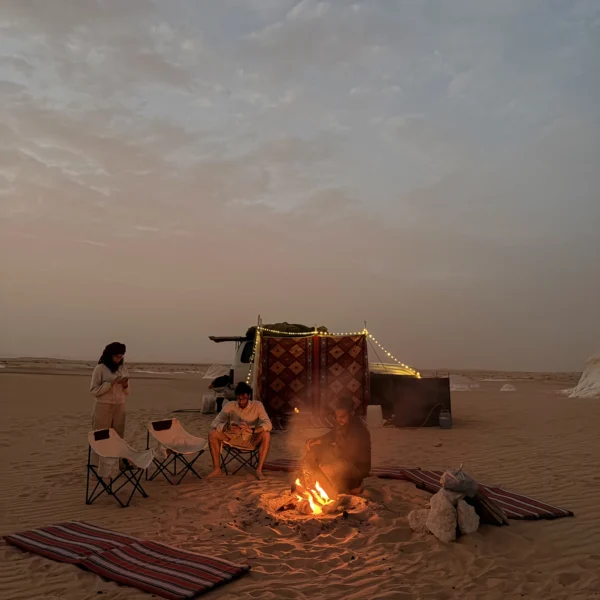
- White Desert sunset and camp
- Stars or moonlight
- White Desert sunrise
Photographers should read the White Desert stargazing and photography guide and camping guide before choosing dates.
Cost and quote factors
Elzaghandi Travel uses a request-a-price model. The Salt Lake is normally one inclusion in a larger private trip rather than a standalone ticketed product. Price depends on:
- Travel dates
- Nationality and permit processing
- Group size and ages
- Cairo or Giza pickup
- Private or shared format
- Two-day or three-day duration
- Bahariya hotel
- Number of camping nights
- Local 4×4
- Guide and driver
- Meals and water
- Protected-area entry and permits
- Camping equipment
- Photography timing and extra waiting
- Accessibility or privacy adjustments
- Optional archaeology
Request a written itinerary that states whether the lake is a quick tea stop, golden-hour visit or dedicated sunset session. “Salt Lake included” does not define the time or duration.
Questions to ask before booking
- Which Salt Lake or basin will we visit?
- What are the current water and shoreline conditions?
- Is the stop for tea, walking, swimming or photography?
- Is sunset at the lake or English Mountain?
- Can we arrive 45–75 minutes before sunset?
- How long can we remain after sunset?
- Is the ground stable for a tripod?
- How far is the vehicle from the viewpoint?
- Is the route suitable for children or limited mobility?
- Are toilets available nearby?
- Is swimming permitted and sensible at the exact location?
- Are local fees included?
- What is the wind or dust backup plan?
- Which Day 1 stop moves if lake sunset is prioritized?
- Is English Mountain still included in daylight?
- Which hotel is included?
- Are the White Desert permits, meals, water and camp equipment included?
- Are drones prohibited or subject to advance permits?
Related Bahariya guides: Explore the wider oasis with the Bahariya Oasis travel guide, compare the best things to do in Bahariya, and combine the lake with the Bahariya hot springs guide.
Frequently asked questions
Where is the Bahariya Oasis Salt Lake?
It is within the wider inhabited Bahariya Oasis landscape around Bawiti, farms, dunes and low basins. Ask the operator for the exact current stop rather than relying on one informal map pin.
Is there one Salt Lake in Bahariya?
Travel content uses both singular and plural labels for saline water bodies. The exact basin and shoreline can differ between itineraries and seasons.
Is the lake naturally salty?
The visible saline landscape is connected to Bahariya’s closed-basin groundwater, drainage and high-evaporation setting. The exact chemistry of a tourist stop should not be invented without testing.
Why is the water salty?
Salts can accumulate where water, dissolved minerals, drainage and intense evaporation interact in a low arid basin. Local agricultural and groundwater processes also matter.
Why does it look turquoise in some photos?
Sky reflection, sun angle, depth, sediment, salinity, camera white balance and editing can change the apparent colour. Turquoise is not guaranteed.
Is the water always present?
Do not assume a fixed area or depth. Surface water and shoreline conditions may vary with local water management, drainage and evaporation.
Is sunset guaranteed?
No. Cloud, haze, dust, wind, route delay and the selected viewpoint affect visibility and colour.
What time is sunset?
It changes by date. Calculate it for Bahariya, check Egypt’s current time setting and confirm with the operator shortly before travel.
How early should I arrive?
Arrive about 45–75 minutes before sunset for shoreline inspection and golden-hour photography. Dedicated photographers may want 90 minutes.
Should I stay after sunset?
Yes, when the guide approves. Early blue hour can provide cooler colour and longer reflections. Carry a headlamp and remain on the known route.
Is Salt Lake sunset better than English Mountain?
The lake is better for water and reflection compositions. English Mountain is better for an elevated panorama. The active itinerary normally uses English Mountain for sunset.
Can I see both at sunset?
No. Select one primary sunset and see the other in daylight. Racing between them can make the schedule unsafe and disappointing.
Can I swim in the Salt Lake?
Only if the local guide confirms the exact water body, depth, bottom and current condition. The published active route treats it as a tea and landscape stop.
Can I float like in Siwa?
Do not promise it. Bahariya’s selected lake depth and salinity are not standardized like a marketed floating pool.
Is the lake water safe?
No blanket claim is possible without current local assessment and testing. Do not swallow natural water, enter with open wounds or dive into opaque water.
Can children swim?
Only when the exact location is approved and an adult remains within arm’s reach. A viewing and tea stop is the safer default.
Can I walk on the white salt crust?
Only on a route confirmed by the guide. Crust can hide mud or water and may be fragile.
Can I collect salt?
No. Leave salt patterns and natural material in place.
Are there changing rooms?
Do not expect them. Confirm facilities before planning any water activity.
Is there a toilet?
Facilities may be absent at the shoreline. Ask where the last reliable toilet is before the visit.
Is it accessible by a normal car?
Access depends on the selected shore and current track. Use a local driver and do not take an ordinary vehicle onto soft or crusted ground.
Do I need a 4×4?
Not every central oasis stop requires one, but local track conditions determine the vehicle. The later Black and White Desert route does require an appropriate 4×4 and local driver.
Can I visit without a guide?
A local guide is strongly recommended to identify the correct shoreline, avoid private or soft ground and coordinate the broader itinerary.
How far is it from Cairo?
Bahariya requires a long road transfer commonly occupying about five hours each way under normal conditions. Pickup, traffic, stops and checkpoints change the total.
Can I visit on a Cairo day trip?
It is possible but creates a very long day and a late return after sunset. Stay one night in Bahariya for better pacing.
Is it included in the three-day tour?
Yes. The active Bahariya Oasis and White Desert itinerary lists a Salt Lake stop with Bedouin tea on Day 1, followed by other oasis sights and English Mountain sunset.
Is sunset at the lake included?
Not automatically. Request it as a timing priority. The standard published route identifies English Mountain as the sunset stop.
Is it included in the two-day tour?
The compact two-day White Desert route prioritizes the remote Black and White Desert sequence. Confirm any Bahariya lake stop rather than assuming it.
How long do I need?
Allow 30–45 minutes for tea and sightseeing or 75–120 minutes for planned golden-hour, sunset and blue-hour photography.
What lens is best?
A phone’s main lens or 24–35 mm equivalent is versatile. Add a 50–100 mm equivalent for palms, people, hills and compressed sun reflections.
Do I need a tripod?
No for daylight, but it helps with exposure brackets, group photographs and blue hour. Place it only on stable ground.
Should I use a polarizer?
Test it carefully. It reduces glare but can also remove the water reflection. Rotate it and choose the effect you prefer.
What camera settings should I use?
Start at low ISO, f/8 to f/11 and a shutter speed appropriate for handholding or tripod use. Protect sky highlights and bracket when contrast is extreme.
Can I photograph with a phone?
Yes. Clean the lens, enable the grid, use the main camera, lower exposure for the sky and avoid digital zoom.
Can I take couple photographs?
Yes on stable, permitted ground. Respect local users, farms and clothing norms, and do not place people on fragile crust.
Can I fly a drone?
Do not assume so. Confirm current Egyptian import, permit, security and operating rules in writing before carrying or flying one.
What should I wear?
Wear sun protection, modest clothing and secure footwear. Carry a windproof or warm layer for sunset and spare socks if the shore is muddy or salty.
What happens in strong wind?
Reflections become less distinct and dust may rise. Photograph ripples and texture, use a sheltered angle or move sunset to English Mountain.
What happens if the lake edge is muddy?
Stay on the guide-approved firm track and use a longer lens or elevated view. Do not walk farther merely to copy an online photograph.
Is the Salt Lake a protected area?
Do not assume that every lake edge has the same legal designation as the White Desert Protected Area. Responsible behaviour is required regardless of the exact boundary.
What should I send for a quote?
Send dates, nationality, group size, pickup, trip duration, whether lake sunset or English Mountain is the priority, photography equipment, children or mobility needs and hotel preference.
Choose the right Bahariya itinerary
- Choose the 3 Days / 2 Nights Bahariya Oasis & White Desert Adventure for the Salt Lake, a hot spring, English Mountain, a hotel night and one White Desert camp.
- Choose the 2 Days / 1 Night White Desert Adventure when the Black and White Deserts matter more than a full oasis day.
- Choose the 3 Days / 2 Nights White Desert Adventure for two desert camping nights and less emphasis on Bawiti attractions.
- Use the custom trip page to request Salt Lake sunset, a photography wait, mobility adaptation, private timing or archaeology.
Sources and further reading
- Elzaghandi Travel, 3 Days / 2 Nights Bahariya Oasis & White Desert Adventure. Active first-party route for the Salt Lake tea stop, Bahariya sights, English Mountain sunset and the following Black-to-White Desert day.
- NASA Earth Observatory, Bahariya Oasis. Geographic context for the groundwater-supported depression, Bawiti, date palms and olive groves.
- Scientific Reports, Mapping and Predicting Groundwater Accumulations in Bahariya Oasis. Peer-reviewed context for the closed basin, depression floor, groundwater discharge, evaporation and soil salinization.
- Sustainability, Groundwater Geochemistry and Management in Bahariya Oasis. Peer-reviewed discussion of the Nubian Sandstone Aquifer, groundwater pressure, mineralization and salinization.
- NOAA Global Monitoring Laboratory, Improved Sunrise and Sunset Calculation. Date- and location-based sunset planning with time-zone and daylight-saving inputs.
- Nikon, Best Tips for Sunrise and Sunset Photos. Practical advice on arriving early, observing changing light and choosing compositions.
- Nikon, Five Easy Composition Guidelines. Horizon placement and reflection composition.
- Adobe, Reflection Photography Guide. Wind, light, lens choice, shutter speed, tripods and polarizer considerations for reflected scenes.
- US Centers for Disease Control and Prevention, How to Safely Visit Natural Water. General precautions for untreated natural water; not evidence about contamination in a specific Bahariya lake.
- UK Foreign, Commonwealth & Development Office, Egypt Regional Risks. Current permit, guide, communications and regional-risk context for Bahariya and the Black and White Deserts.
Add the Bahariya Salt Lake to your trip
Message Elzaghandi Travel on WhatsApp with your dates, nationality, number of adults and children, Cairo or Giza pickup, preferred trip length and whether Salt Lake sunset or English Mountain sunset is your first priority.
Ask the team to confirm the exact lake, current shoreline, sunset timing, walking conditions, tea stop, photography duration, hotel, hot spring, White Desert route, permits, meals, water, camp equipment and final price. For the complete oasis-and-desert sequence, request the 3 Days / 2 Nights Bahariya Oasis & White Desert Adventure with one Bahariya hotel night and one White Desert camping night.