Last reviewed: 4 October 2026.
Dahshur is one of the best archaeological sites near Cairo for understanding how ancient Egyptian builders learned to construct true smooth-sided pyramids. The site is quieter than Giza and contains two of King Sneferu’s most important monuments: the Bent Pyramid and the Red Pyramid, plus later Middle Kingdom pyramids and tombs.
This Dahshur Pyramids guide explains why the Bent and Red Pyramids matter, current official opening hours and area ticket information, whether you can enter the pyramids, how Dahshur fits between Saqqara and Giza in the history of pyramid building, and how to combine the site with Memphis and Saqqara on a day trip from Cairo.
For a practical private route, see the Saqqara, Memphis & Dahshur Day Tour, or browse the Cairo & Giza destination page.
Dahshur at a glance
- Location: southern part of the ancient Memphite necropolis.
- Most important pyramids: Bent Pyramid and Red Pyramid of Sneferu.
- Official opening hours: the Ministry currently lists Dahshur from 8:00 AM to 5:00 PM daily.
- Current official area ticket: the Ministry currently lists a Dahshur area ticket, with separate foreign and Egyptian rates.
- Best for: pyramid architecture, Old Kingdom engineering and quieter desert archaeology.
- Typical visit length: 1.5–3 hours depending on interior entry.
- Best combined with: Saqqara and Memphis.
Why Dahshur matters
The Ministry of Tourism and Antiquities describes Dahshur as the southern part of the cemetery of ancient Memphis. Kings of both the Old and Middle Kingdoms built pyramids there.
For most visitors, however, Dahshur’s greatest importance comes from King Sneferu, the first king of the Fourth Dynasty. His monuments show major architectural experiments that helped lead to the perfected pyramid form later used at Giza.
Dahshur therefore works best when understood as a chapter in a sequence:
- Djoser’s Step Pyramid at Saqqara.
- Sneferu’s experiments at Dahshur.
- Khufu’s Great Pyramid at Giza.
The Bent Pyramid
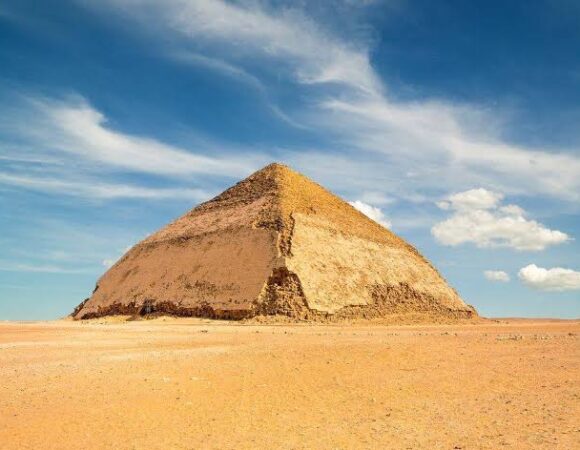
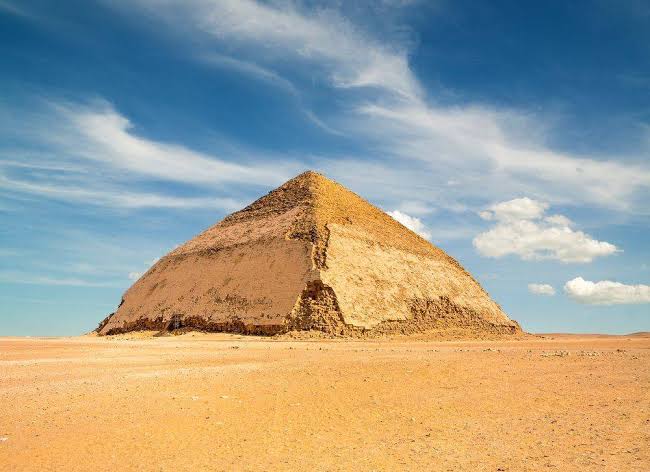
The Bent Pyramid is one of the most visually distinctive pyramids in Egypt because its angle changes partway up.
The Ministry explains that construction began at a steep angle of roughly 55 degrees, but the angle was reduced to about 43 degrees after structural concerns developed. That change created the unusual profile that gives the monument its modern name.
The pyramid is important because it shows builders solving engineering problems in real time. It was intended as a smooth-sided pyramid rather than a step pyramid, but the design had to be modified during construction.
Why did the Bent Pyramid change angle?
The exact engineering history is complex, but the official explanation links the change to instability caused by the original steep design and structural load.
The practical lesson for visitors is that pyramid building did not appear fully perfected. It developed through experimentation.
The Bent Pyramid therefore preserves a visible record of problem-solving that is missing from later, more successful monuments.
Two entrances in the Bent Pyramid
The Ministry notes that the Bent Pyramid has two entrances: one on the north side and another high on the west side. Each leads toward internal chambers with corbelled roofing.
This unusual internal arrangement adds to the pyramid’s architectural importance.
Visitor access can change, so do not assume every passage or entrance is open on every date.
The Red Pyramid
About one kilometer north of the Bent Pyramid stands the Red Pyramid, also built for Sneferu.
The Ministry identifies it as the highest pyramid at Dahshur and the third-largest pyramid in Egypt after those of Khufu and Khafre at Giza.
Its modern name comes from the reddish color of the exposed stone blocks. Originally, like other major pyramids, it was covered in fine white Tura limestone casing.
Why the Red Pyramid is important
The Red Pyramid is often described as Egypt’s first successful true smooth-sided pyramid. It represents a major architectural step between the Bent Pyramid and the later Great Pyramid.
That is why a visit to Dahshur is so valuable even for travelers who have already seen Giza. Giza shows the mature result; Dahshur shows the development process.
Can you enter the Red Pyramid?
Current official Ministry information describes visitor entry through the northern side and a descending passage leading into a sequence of internal chambers.
The descent is narrow and steep. The experience is more physical than simply walking through a museum.
Consider entering if:
- you are comfortable in confined spaces;
- you can handle a steep descent and climb;
- you are interested in pyramid interiors;
- you understand that the chambers are architecturally important but not richly decorated.
Skip the interior if you have serious claustrophobia, mobility problems, back or knee issues, or respiratory concerns.
Is the Red Pyramid interior worth it?
For many travelers, yes, especially because Dahshur can feel quieter and less compressed than Giza. The interior offers a strong sense of scale and construction.
But do not feel that going inside is required. The architectural story is already visible from the exterior relationship between the Bent and Red Pyramids.
Which is better to enter: Red or Bent Pyramid?
Access and conditions can change, so the best answer depends on what is officially open on your date.
The Red Pyramid is often the more straightforward choice for travelers who want one major interior experience at Dahshur. The Bent Pyramid is architecturally more unusual and may appeal to visitors especially interested in construction history.
If you only want one interior, ask your guide about current access, passage difficulty and time.
The Black Pyramid and Middle Kingdom remains
Dahshur is not only a Sneferu site. The Ministry notes later Middle Kingdom pyramids, including monuments associated with Amenemhat II, Senwosret III and Amenemhat III.
The Black Pyramid of Amenemhat III is one of the site’s distinctive later monuments, though it is in a much poorer state of preservation than the Bent and Red Pyramids.
These later pyramids show that Dahshur remained important long after Sneferu.
Dahshur and the ancient city of Memphis
Dahshur formed part of the wider cemetery landscape serving Memphis. Visiting the ancient capital at Mit Rahina helps explain why royal necropolises developed along this desert edge.
Read the Memphis Egypt travel guide for the urban side of the story.
Dahshur vs Saqqara
Saqqara is broader and richer in tombs, texts and long chronological history.
Dahshur is more focused and especially strong for pyramid engineering.
If you want to understand how the pyramid form developed, visit both on the same day.
See the Saqqara Egypt travel guide for the earlier chapter.
Dahshur vs Giza
Giza is more monumental and iconic. Dahshur is quieter and more educational for architecture-focused travelers.
At Giza you see the Great Pyramid and the mature Fourth Dynasty pyramid complex. At Dahshur you see the experiments that made that achievement possible.
For the Giza chapter, read the Giza Pyramids visitor guide.
Current opening hours
The Ministry currently lists Dahshur from 8:00 AM to 5:00 PM daily.
Individual pyramid access can still change due to conservation, operations or temporary closures, so confirm on the travel date.
Current official area ticket
At the time of this review, the Ministry’s Dahshur page lists a separate area-entry ticket with published rates for foreign, Egyptian and student visitors.
Because official ticket prices can change, use the current Ministry Dahshur page before travel rather than relying on an old copied price.
How long do you need?
1 hour: quick exterior views only.
1.5–2 hours: good first visit with both major pyramids.
2.5–3 hours: better if entering one pyramid and spending time on photography and context.
For a combined Saqqara–Memphis–Dahshur day, about two hours at Dahshur is a practical target.
Best time of day
Morning or later afternoon generally gives more comfortable temperatures and better light. On a combined day, Dahshur often works well as the final archaeological stop after Saqqara, Memphis and lunch.
Do not arrive too close to closing if entering a pyramid matters to you.
What to wear
- closed walking shoes;
- breathable clothing;
- hat;
- sunglasses;
- sunscreen;
- light scarf for dust.
If entering a pyramid, flexible clothing and secure footwear are especially important.
What to bring
- water;
- personal medication;
- phone or camera;
- power bank;
- small cash;
- ticket confirmation.
Photography
Dahshur’s open landscape gives strong views with fewer visual distractions than Giza. The Bent Pyramid works especially well from angles that make the change in slope obvious.
A moderate telephoto lens can compress the relationship between pyramid and desert, while a wider lens emphasizes the emptiness of the plateau.
Dahshur with children
Children can enjoy the “engineering experiment” story of the Bent Pyramid. The main issue is whether they can tolerate heat and whether entering a steep pyramid passage is appropriate.
Do not pressure children to enter a pyramid interior. The exterior story is enough for a valuable visit.
Older travelers and mobility
The main exterior viewpoints can be visited without entering the pyramids. This makes Dahshur still worthwhile for people who cannot manage steep internal passages.
Ask the guide how close the vehicle can approach and how much walking is required on the current route.
Common mistakes
Visiting only Giza
You miss the engineering story that explains how Giza became possible.
Assuming the Bent Pyramid is a failed monument
It is better understood as an important architectural experiment and completed royal complex.
Entering a pyramid without considering the climb back out
The descent may feel easy; the return can be physically demanding.
Arriving late
Interior access may close before you finish the site.
Expecting decorated chambers
The importance is architectural rather than decorative.
Suggested combined itinerary
- Saqqara and Djoser in the morning.
- Memphis and royal sculpture.
- Lunch.
- Bent Pyramid at Dahshur.
- Red Pyramid exterior.
- Optional Red Pyramid interior.
- Return to Cairo or Giza.
Frequently asked questions
What time does Dahshur open?
The Ministry currently lists 8:00 AM to 5:00 PM daily.
Can I enter the Red Pyramid?
Current official information describes visitor access, subject to current site conditions.
Why is the Bent Pyramid bent?
The angle was reduced during construction after structural concerns with the original steeper design.
Is the Red Pyramid older than Giza?
Yes. Sneferu’s Red Pyramid predates the Great Pyramid of his son Khufu.
Is Dahshur worth visiting?
Yes, especially for travelers interested in pyramid architecture and a quieter site than Giza.
How long should I spend?
About 1.5 to 3 hours depending on whether you enter a pyramid.
Can I combine Dahshur with Saqqara and Memphis?
Yes. That is the most efficient and historically coherent day trip.
Plan your Dahshur visit
Use the Saqqara, Memphis & Dahshur Day Tour for the complete development-of-pyramids route. For the later Fourth Dynasty monuments, compare the Grand Egyptian Museum & Pyramids Day Tour.
Sources and further reading