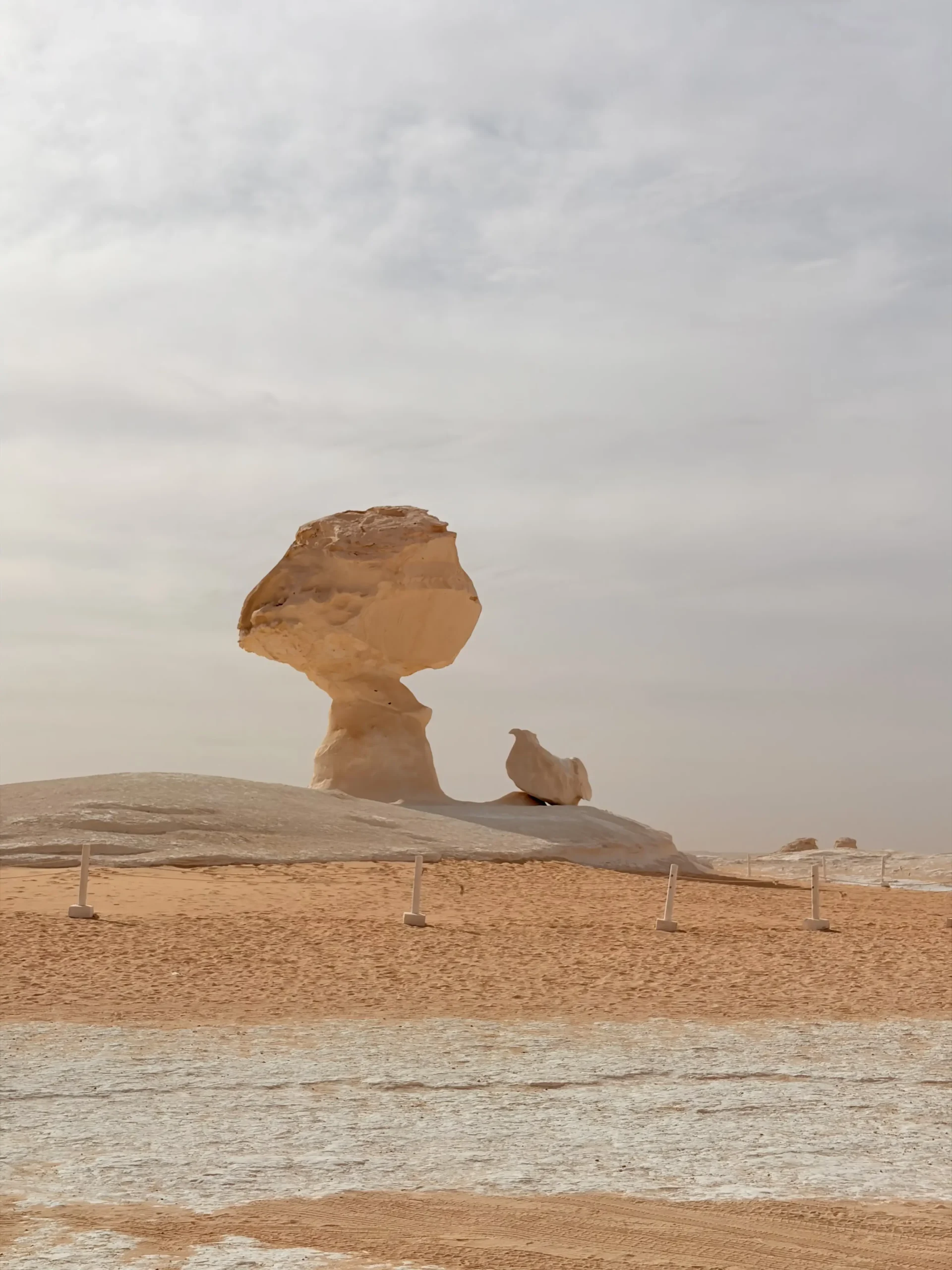
Traveling from Cairo to the White Desert is a two-stage journey: first you travel by road to Bahariya Oasis, then you change to a 4×4 for the off-road desert circuit. The Cairo-to-Bahariya drive usually takes about four to five hours before stops, traffic and pickup logistics are considered. From Bahariya, the route continues through landscapes such as the Black Desert, Crystal Mountain, Agabat Valley and the White Desert.
That simple summary answers the basic question, but it leaves out the decisions that make the difference between a smooth trip and a rushed one. This guide explains the route, realistic timing, transport choices, vehicle change, permits, pickup planning and return to Cairo. It also shows why the White Desert is not a practical conventional day trip from Cairo.
Quick answer: how do you get to the White Desert from Cairo?
The most practical route is:
- Morning pickup in Cairo or Giza.
- Drive southwest by paved road to Bahariya Oasis.
- Meet the local desert team and transfer to a 4×4.
- Enter the Western Desert circuit with the required arrangements.
- Visit the Black Desert and intermediate stops.
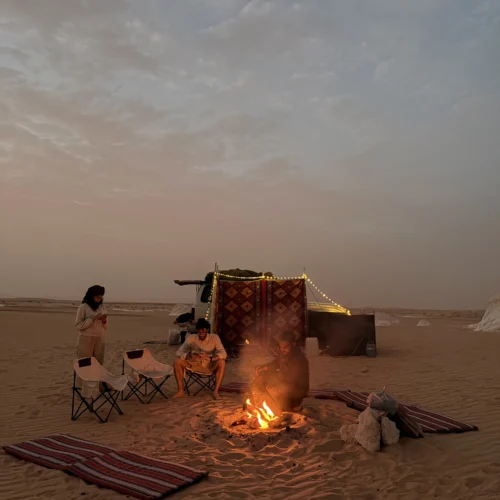
- Continue to the White Desert and camp overnight.
- Explore the main formations the next morning.
- Return through Bahariya and travel back to Cairo.
Elzaghandi Travel’s published two-day itinerary schedules pickup between 7:00 and 8:00 AM and estimates the Cairo or Giza to Bahariya drive at four to five hours. The return to Cairo or Giza is expected around 5:00 to 6:00 PM on the second day, subject to the route and conditions.
Egypt’s official tourism portal gives a similar broad estimate, describing Bahariya as approximately a five-hour road journey from Cairo and recommending that visitors confirm permits, transportation and logistics with an authorized operator.
Where exactly is the White Desert?
The White Desert is part of Egypt’s Western Desert and lies in the broad corridor between Bahariya Oasis and Farafra. Egypt’s official tourism website describes it as roughly 40 kilometers from Al-Farafra. That does not mean Cairo travelers normally drive directly to a point called “White Desert” using a standard navigation app.
Bahariya Oasis functions as the main gateway for many Cairo-based tours. It provides a practical point for changing vehicles, meeting a local guide, loading food and camping equipment, and organizing the protected-area journey. For a wider overview of the oasis itself, see the Bahariya Oasis Egypt Travel Guide.
The terms can be confusing:
- Western Desert: the vast region west of the Nile.
- Bahariya Oasis: an inhabited oasis and logistics base southwest of Cairo.
- Black Desert: a dark, volcanic-looking landscape commonly visited after Bahariya.
- White Desert: the protected chalk landscape that is the main destination.
- Farafra: another oasis south of the classic Bahariya route.
When an itinerary is advertised as a White Desert trip, it may include all of the first four places. Check the actual stops rather than assuming the title describes every part of the route.
How far is the White Desert from Cairo?
A single distance figure can be misleading because the journey has separate road and desert sections. Bahariya Oasis is around 370 to 380 kilometers southwest of Cairo depending on the point used for measurement. NASA’s Earth Observatory describes Bahariya as approximately 380 kilometers southwest of Cairo, while Egypt’s official tourism material describes the road journey as around five hours.
After Bahariya, more time is required for the 4×4 circuit, stops, lunch and the drive to the camping area. The White Desert is therefore not simply “five hours from Cairo.” Five hours is a useful estimate for reaching the oasis gateway, not for completing the whole sightseeing route.
Realistic travel-time framework
- Cairo hotel pickup and city traffic: variable.
- Cairo or Giza to Bahariya: approximately four to five hours.
- Breaks and operational stop in Bahariya: variable.
- Bahariya to the desert camp with sightseeing: several hours, because the route includes stops.
- Camp to Bahariya on day two: depends on the final formations and activities.
- Bahariya to Cairo or Giza: another four to five hours, plus traffic.
A two-day itinerary works because the desert journey is spread across two days. Trying to compress everything into one calendar day creates an exhausting schedule and removes the main reasons for going: sunset, dinner at camp, the night sky and sunrise.
The route from Cairo to Bahariya Oasis
The road stage begins in Cairo or Giza and heads southwest toward Bahariya. The precise pickup sequence depends on where travelers are staying. A hotel near the airport, a downtown address and a Giza hotel do not produce identical departure times.
Cairo pickup planning
Before booking, provide the exact hotel name and map location. Ask whether pickup is included from:
- central Cairo;
- Giza and the pyramid area;
- Cairo International Airport;
- New Cairo;
- 6th of October City;
- an apartment rather than a hotel.
A general statement such as “Cairo pickup included” does not answer whether a distant address creates a supplement or earlier departure. Clear pickup details also improve route planning for the driver.
What time should you leave?
An early departure is normal. On Elzaghandi Travel’s live two-day tour, the pickup window is 7:00 to 8:00 AM. Leaving later reduces daylight available for the first day’s desert stops and sunset camp setup.
Eat breakfast before pickup or ask whether a breakfast stop is planned. Keep water, medication and a light snack accessible rather than packed in the bottom of your main bag.
Road conditions and breaks
The road journey is long but normally straightforward with a professional driver. A rest stop may be included, but availability and quality of facilities vary. Use the bathroom when there is a sensible opportunity; do not assume another facility is close.
Travelers prone to motion sickness should prepare for both the road drive and the later off-road movement. Take medication only according to professional medical guidance and before symptoms become severe.
Why do you change to a 4×4 in Bahariya?
The vehicle change separates highway transport from off-road desert travel. A comfortable road vehicle is suitable for the paved Cairo–Bahariya section. The desert circuit requires a capable 4×4 and a driver who knows the terrain, authorized routes, camps and changing surface conditions.
A proper desert vehicle carries more than passengers. It may also transport:
- drinking water;
- food and cooking supplies;
- mattresses and bedding;
- tents or wind shelters;
- camp equipment;
- recovery equipment;
- luggage;
- fuel and operational supplies.
This is why luggage discipline matters. A large hard-shell suitcase may be acceptable in the road transfer but inconvenient around a loaded 4×4 and camp. Ask whether your main luggage can be stored safely in Bahariya while you take a smaller overnight bag.
Can you drive yourself from Cairo?
Driving a normal rental car to Bahariya is different from driving into the off-road protected desert. Even if a traveler reaches Bahariya independently, the White Desert circuit requires appropriate transport, local knowledge and current authorization.
Egypt’s official tourism portal recommends using a hotel, tour operator or authorized travel agency for permits, transportation and logistics. It also advises travelers planning desert excursions to confirm regulations with an authorized guide or agency.
A self-drive plan raises practical questions:
- Does the rental agreement permit the route?
- Is the vehicle appropriate for remote terrain?
- Who arranges permits and entrance tickets?
- How will you navigate without dependable signal?
- What is the recovery plan for a mechanical problem?
- Where is camping permitted?
- Which areas or tracks are currently restricted?
- How will sufficient water and food be carried?
For most international visitors, a guided arrangement from Cairo or a pre-arranged meeting in Bahariya is the safer and simpler choice.
Can you use public transport?
Public transport may help an independent traveler reach Bahariya, but it does not complete the White Desert journey. You still need an off-road vehicle, guide, camping arrangements and current permits after arrival.
A bus-based plan may make sense if you want to spend additional time in Bahariya or meet a known local operator there. It is less convenient for a short two-day trip because schedules, luggage and connections can consume the limited time.
Before choosing public transport, confirm:
- current departure point in Cairo;
- ticket method and luggage rules;
- arrival point in Bahariya;
- who will meet you;
- whether delays affect the desert departure;
- accommodation if you arrive too late;
- return transport availability.
Do not rely on an old blog timetable. Transport schedules can change.
Private transfer versus shared transport
Private Cairo transfer
A private vehicle generally offers the most flexibility for pickup, breaks and return. It is useful for families, travelers with luggage, photographers carrying equipment and groups staying outside central Cairo.
Shared departure
A shared trip can reduce the per-person cost, but the pickup route may take longer and the group must follow a common schedule. Ask about maximum group size, luggage, sleeping arrangements and whether the 4×4 is also shared.
Meeting in Bahariya
Travelers already staying in Bahariya can begin the desert section there. The quote should then distinguish the Cairo transfer from the safari service. Meeting locally can be efficient, but arrival the previous day may be more reliable than trying to connect from a same-morning bus.
For a transparent explanation of the variables, read White Desert Egypt Tour Cost.
What happens after arriving in Bahariya?
The exact sequence varies, but the usual process includes meeting the local team, using facilities, organizing luggage, loading supplies and changing to the 4×4. On a classic two-day itinerary, the group then starts the sightseeing circuit rather than driving directly to camp.
Elzaghandi Travel’s current route begins with the Black Desert, followed by lunch near the natural sulfur spring at El Hez. It then continues to Crystal Mountain, Agabat Valley, Moon Cave and the White Desert formations before sunset.
The order can change for operational reasons. A guide may adjust stops because of:
- weather or wind;
- route condition;
- permit instructions;
- daylight;
- group pace;
- temporary access;
- the best safe camp location.
A responsible itinerary is specific enough to set expectations but flexible enough to respond to the desert.
Typical day-one route in detail
Black Desert
The Black Desert is known for dark material covering hills and ridges. Short climbs may be possible, but wear stable footwear and follow the guide. This landscape is visually and geologically different from the chalk formations later in the trip. For more detail, read the Black Desert Egypt Travel Guide.
El Hez lunch and spring
The current two-day tour includes lunch near a natural sulfur spring at El Hez, where swimming may be possible. Bring swimwear and a compact towel if that matters to you, and confirm access before departure.
Crystal Mountain
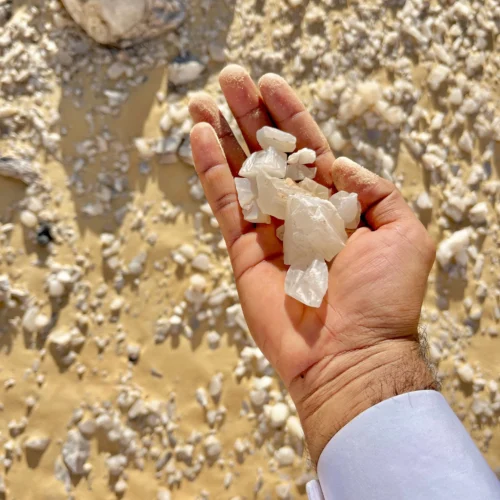
Crystal Mountain is a short geological stop on many routes. Do not collect pieces or climb fragile areas. A short visit is normally enough to see and photograph it.
Agabat Valley and Moon Cave
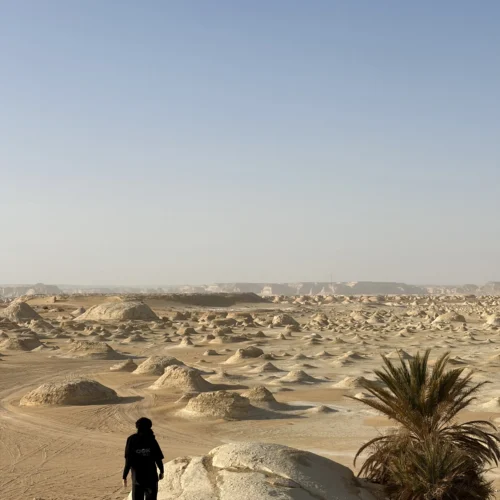
Agabat is one of the most dramatic parts of the journey, with pale cliffs and wide desert views. The drive between formations is part of the experience. Moon Cave is included in the published two-day route inside the wider Agabat landscape.
White Desert and camp
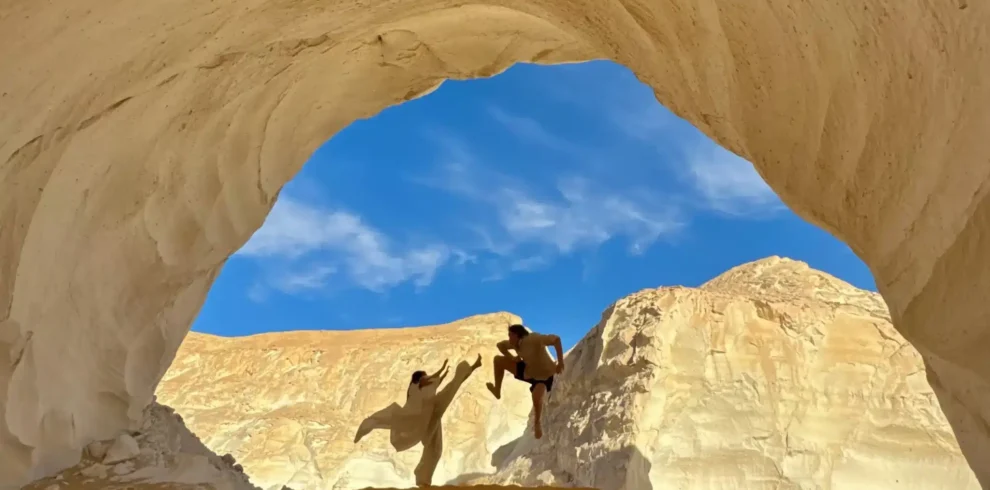
The route enters the White Desert and visits formations including the Valley of Tents before the team selects the camp area. Camp is set up before or around sunset. Dinner, tea and an overnight stay follow.
This schedule is described more fully in the 2-Day White Desert Egypt Itinerary.
Why a day trip from Cairo is not recommended
A conventional day trip would require a very early departure, approximately four to five hours to Bahariya, the vehicle change, desert driving and stops, followed by another four to five hours back to Cairo. It would either miss the White Desert or reduce it to a hurried drive.
More importantly, the visitor would miss:
- sunset among the formations;
- the camp dinner;
- stargazing;
- the quiet after day visitors leave;
- sunrise;
- morning light on Mushroom and Chicken Rock;
- an unhurried return through the desert.
If you cannot spare one night, consider a destination closer to Cairo rather than forcing the White Desert into an unsuitable day-trip format.
Two-day route versus three-day route
Two days and one night
Best for travelers with limited time who want the classic highlights. It includes long transfers but still delivers one sunset, one camp night and the main formations. See the live 2 Days / 1 Night White Desert Adventure.
Three days and two nights
Best for travelers who want more remote stops, two sunsets, slower photography and less pressure. Elzaghandi Travel’s 3 Days / 2 Nights White Desert Adventure can include Arch Rock, Karawen dunes, petrified trees, a spring lunch stop and the Waves Area.
Use 2-Day vs 3-Day White Desert Tour for a traveler-by-traveler comparison.
Return route and arrival in Cairo
On day two, the classic itinerary begins with breakfast and visits famous formations such as Mushroom Rock and Chicken Rock. Sandboarding may be possible. The group then returns toward Bahariya, changes vehicles and begins the road journey to Cairo or Giza.
The published expected arrival is around 5:00 to 6:00 PM. Treat that as an estimate, not a guaranteed appointment. Desert routes, stops, traffic and group logistics can create delays.
Do not schedule a flight too tightly
Avoid booking an international flight, non-refundable train or timed attraction immediately after the expected return. Build a buffer, ideally by sleeping in Cairo that night.
If you must travel onward, tell the operator before confirming. A route should not be made unsafe or excessively rushed to meet an unrealistic connection.
Permits, protected-area tickets and checkpoints
The current Elzaghandi Travel two-day itinerary lists desert permits and national park entrance tickets as included. Confirm that the same applies to your date and customized route.
Permit and checkpoint procedures can change. Travelers should provide requested identification details accurately and carry the required documents. Do not photograph checkpoints, military facilities or personnel.
A useful pre-booking question is not simply “Do I need a permit?” but:
- Who arranges it?
- Is the fee included?
- What passport information is needed?
- When must details be submitted?
- Does the planned route require additional authorization?
- What happens if access changes?
The operator should answer based on the live route rather than a historical rule.
Safety and current travel advice
No desert route can be guaranteed risk-free. Use an experienced team, confirm the itinerary, follow the guide and check official advice close to departure.
The current UK FCDO regional guidance distinguishes the White Desert, Black Desert and Bahariya Oasis from parts of the Western Desert covered by broader warnings. It separately advises against all but essential travel on the road between Bahariya and Siwa. This is a good example of why “Western Desert” is too broad for a safety conclusion: advice can apply differently to specific roads and regions.
Read the current UK government Egypt travel advice and your own government’s guidance. Make sure your insurance covers the actual region and planned activities.
The dedicated, date-sensitive article is Is the White Desert Egypt Safe?.
What to carry during the road journey
Keep a small day bag inside the vehicle with:
- passport or required identification;
- phone and charging cable;
- power bank;
- personal medication;
- water;
- light snack;
- sunglasses;
- tissues;
- hand sanitizer;
- warm layer;
- motion-sickness supplies if needed;
- offline copy of booking details.
Your camping bag can contain the rest. Avoid opening luggage repeatedly in windy or sandy areas.
For the full list, see What to Pack for the White Desert Egypt.
Traveling with children
The journey includes a long road transfer and off-road driving. Before booking for a family, ask about:
- suitable child restraints;
- vehicle seating and seat belts;
- frequency of bathroom stops;
- food and allergies;
- shade and heat management;
- private tent arrangements;
- additional blankets;
- flexibility if a child becomes tired or carsick.
A private trip may be easier because the pace can adapt. Read White Desert Egypt with Kids before deciding.
Accessibility and mobility considerations
The trip involves entering vehicles, uneven ground, sand and basic camp facilities. Accessibility varies significantly by vehicle and camp setup.
Explain mobility needs before paying. Ask for photographs or exact descriptions of:
- vehicle step height;
- seating;
- walking distance at stops;
- ground surface;
- toilet setup;
- sleeping height;
- assistance available.
Some parts may be adapted, while others may not be suitable. An honest discussion is more useful than a general promise that the tour is accessible.
Common planning mistakes
Assuming Bahariya is the White Desert
Bahariya is the gateway and an interesting oasis, but the main formations require additional desert travel.
Booking only by the cheapest price
A low figure may exclude Cairo transfer, permits, meals, camping equipment or private transport. Compare written inclusions.
Scheduling a flight after the tour
Return times are estimates. Keep a buffer.
Bringing unsuitable luggage
Use a manageable overnight bag and ask about storage for larger suitcases.
Expecting hotel facilities at camp
Clarify tents, bedding, toilets, washing and electricity.
Ignoring season and temperature
Warm Cairo weather does not guarantee a warm desert night. Read Best Time to Visit the White Desert Egypt.
Treating every three-day tour as identical
A standard three-day White Desert trip and a White Desert & Djara Cave expedition have different routes.
How to request an accurate quote
Send the operator:
- travel dates;
- number of adults and children;
- exact pickup area;
- two-day or three-day preference;
- private or shared preference;
- dietary requirements;
- mobility or medical considerations;
- luggage details;
- interest in Djara Cave, photography or Bahariya accommodation;
- onward travel deadline.
This information allows the operator to quote the actual transport and route. Elzaghandi Travel uses a personalized WhatsApp quote rather than a generic fixed price.
Request your White Desert itinerary on WhatsApp.
Related route guides: Compare the Cairo-to-Bahariya transfer, the 2-day White Desert itinerary, and the 2-day vs 3-day White Desert comparison.
Frequently asked questions
How long does it take to drive from Cairo to Bahariya?
Approximately four to five hours in normal planning, but Cairo traffic, stops and the pickup point can add time.
Is Bahariya the final destination?
No. It is the main gateway where many tours change to a 4×4 and begin the off-road circuit.
Can I take an Uber to the White Desert?
A city ride-hailing service is not a complete or appropriate solution for the protected off-road route. Arrange road transfer and desert logistics with a qualified operator.
Can I go without camping?
It may be possible to design an oasis-based itinerary, but a Cairo round trip that reaches the White Desert without an overnight stay is generally too compressed. Discuss a customized route.
Is the road paved?
The Cairo-to-Bahariya stage is by road. The desert sightseeing stage is off-road and requires a suitable 4×4.
Are permits included?
They are listed as included on Elzaghandi Travel’s published two-day itinerary. Confirm the current arrangement for your booking.
What time do tours return to Cairo?
The live two-day itinerary estimates approximately 5:00 to 6:00 PM on day two. Do not treat it as a guaranteed fixed arrival.
Can the tour pick me up from Giza?
The published itinerary includes Cairo and Giza pickup. Confirm your exact hotel.
Should I book two or three days?
Choose two days for the classic route and limited time. Choose three for more remote stops and a slower experience.
Where can I see the full White Desert overview?
Start with the White Desert Egypt Travel Guide, which connects the route, camping, seasons, safety and itineraries.
Sources and review date
This route guide uses Elzaghandi Travel’s current tour itineraries and the following authoritative sources:
- Experience Egypt: Natural Wonders around Bahariya
- Experience Egypt: Desert Excursions
- NASA Earth Observatory: Bahariya Oasis
- UK FCDO: Egypt regional risks
Last reviewed: 7 September 2026. Transport schedules, permits, access and official travel advice can change. Confirm live arrangements before departure.