Last reviewed: 17 July 2026
A White Desert trip can work well for some families, but the right question is not simply “Are children allowed?” It is whether the specific child can manage the road time, off-road vehicle, temperature changes, basic toilet arrangements, simple camp food and a night away from immediate medical care.
There is no single age that makes every child ready. A calm, travel-experienced seven-year-old may be more comfortable than an older child who becomes carsick, cannot tolerate basic toilets or needs a tightly controlled routine. Infants and toddlers create different challenges because they cannot explain early symptoms clearly, need more equipment and close temperature control, and depend entirely on adults for hydration, feeding and hygiene.
For families who decide to go, a private itinerary is usually easier than a shared departure. It allows planned stops, a slower off-road pace, food adjustments, a private sleeping arrangement and an early return if the child is uncomfortable.
This guide is a practical decision tool, not medical advice. Discuss the trip with the child’s clinician when there is a medical condition, recent illness, significant allergy, medication requirement or uncertainty about heat and remote travel.
Quick answer: is the White Desert suitable for children?
It may be suitable when:
- the child is healthy and comfortable with long road journeys;
- the family uses a licensed operator and official local guide;
- permits are arranged before the desert section;
- the vehicle has an appropriate restraint plan for the child;
- the itinerary is private or genuinely family-adapted;
- the season and daily timing avoid excessive heat;
- the child will drink regularly and communicate discomfort;
- parents accept basic toilets, simple washing and desert bedding;
- food, allergies and medication are planned in advance;
- the family has insurance that covers remote off-road touring and camping.
It may not be the right trip now when:
- the child is currently ill, dehydrated or recovering;
- a baby’s feeding, sleep or temperature needs cannot be managed reliably;
- severe motion sickness is not controlled;
- urgent medical access could reasonably be needed;
- essential medication cannot be stored correctly;
- the child cannot use the available vehicle restraint safely;
- the forecast is extreme;
- the program cannot be slowed or modified;
- adults are already uncomfortable with remote camping conditions.
Choosing a Bahariya hotel plus a shorter daytime desert experience can be a good alternative. Delaying the overnight is not a failure; it may create a better first desert trip later.
Is there a minimum age for the White Desert?
There is no universal minimum age that applies to every operator, itinerary and child. Families should be cautious with anyone who gives a single age without asking about the route, vehicle, season, camping setup and the child.
Use age bands only as a starting framework.
Babies under two
An overnight remote-desert trip is a high-burden choice with an infant. Feeding, nappies, sterilization, sleep safety, shade, heat, cold nights and inability to report symptoms all require detailed planning. A baby also needs an age-appropriate restraint for every road and off-road transfer.
A family considering it should obtain medical advice, verify the exact vehicle setup and choose a private program with a clear option to stay in Bahariya instead. The fact that an adult can carry a baby does not make holding the baby in a moving vehicle safe.
Toddlers aged two to four
Toddlers may struggle with long sitting time, toilet transitions, unpredictable sleep and the instruction to stay away from vehicles, fire or fragile formations. They can also become dehydrated or overheated without describing the problem well.
A short, private daytime route with an oasis hotel is often easier than a full overnight. If camping is considered, parents need constant one-to-one supervision and should understand that the desert is not a fenced campsite.
Children aged five to seven
Many children in this band can enjoy the landscape, but readiness varies widely. A suitable child can follow instructions, remain seated while the vehicle is moving, drink when prompted, tell an adult about pain or nausea and accept a simple toilet arrangement.
A two-day private itinerary may work when stops are frequent and dune driving is gentle. The child should see photos of the sleeping and toilet setup before the family commits.
Children aged eight to twelve
School-age children often engage well with geology, stars, photography and camp routines. They still need supervision around vehicles, cooking, fire and formations, and adults must manage hydration rather than expecting the child to remember.
This age group can help pack a personal day bag, keep a water bottle accessible and participate in leave-no-trace checks.
Teenagers
Teenagers may tolerate the logistics more easily, but independence can create new risks. Set clear rules about climbing, walking away for photographs, standing in moving vehicles, drone use and nighttime exploration. A teenager’s ability to use a phone does not replace staying with the guide when signal disappears.
The journey is longer than the photographs suggest
The White Desert is not a short excursion from central Cairo. Families normally travel from Cairo or Giza to Bahariya Oasis, then transfer to a local 4×4 for the off-road section. The road transfer commonly takes several hours each way before sightseeing, meals and stops are added.
Read how to get to the White Desert from Cairo before deciding. A child who manages a two-hour road trip may not react the same way to a long transfer followed by uneven off-road driving.
Ask for a door-to-door outline:
- expected pickup time;
- road journey and rest stops;
- meal timing;
- where toilets are available before the desert;
- when the 4×4 transfer occurs;
- approximate off-road periods;
- camp arrival;
- next morning’s route;
- realistic return window.
Do not schedule an international flight immediately after the expected Cairo return. Children make delays more likely because the family may need extra breaks.
Private versus shared family trips
A shared tour can cost less, but another guest’s preferred pace may conflict with a child’s needs. The vehicle may also have limited space for car restraints, snacks, spare clothes and family luggage.
A private trip provides more control over:
- toilet and stretching stops;
- the driver’s off-road pace;
- how long the family stays at each formation;
- meal timing;
- the camp location and sleeping arrangement;
- music and noise inside the vehicle;
- an early return;
- additional time in Bahariya;
- omission of a stop that is unsuitable for the child.
“Private” should be confirmed in writing. Ask whether the Cairo transfer, the 4×4 and the camp are all private, because some products use a private transfer but a shared desert vehicle or communal camp.
Vehicle safety and child restraints
This is one of the most important booking questions and one of the easiest to overlook. The trip can involve more than one vehicle, and a restraint that fits the Cairo transfer may not fit the off-road 4×4.
Tell the company the child’s age, height and weight and ask:
- Which vehicle is used from Cairo?
- Which vehicle is used in the desert?
- Are functional seatbelts available in the child’s seating position?
- Can the family’s car seat or booster be installed correctly?
- Who will check the installation?
- Will the same restraint be available for the return?
- Is luggage secured so it cannot move toward passengers?
- Can dune driving be kept gentle?
Do not plan to hold a baby or small child on an adult’s lap. Do not allow children to sit on the roof, stand through an opening, ride in an external area or move around the cabin while the vehicle is in motion. Dramatic dune-driving clips are not a model for a family itinerary.
Bring the child restraint you know how to use when feasible, but confirm compatibility before arrival. Vehicle models, belt types and anchorage systems differ. The operator should not promise compatibility without knowing the seat and vehicle.
Seatbelts also matter for adults. A restrained parent is better able to protect and assist a child after sudden braking or a rough movement.
Motion sickness and off-road comfort
A child who reads, watches a tablet or looks down during the drive may become nauseated. Before travel, ask the child’s clinician about appropriate motion-sickness management; do not give a new medicine in the desert without professional guidance.
Practical steps can include:
- a light, familiar meal before driving;
- looking toward the horizon;
- keeping air moving through the cabin;
- avoiding strong odors;
- frequent planned breaks;
- storing sick bags and wipes within reach;
- changing out of soiled clothes quickly;
- telling the driver at the first sign of nausea.
A child who becomes pale, quiet or unusually irritable may be unwell before saying so. Do not force the itinerary to continue at the original pace.
Heat: the risk parents must actively manage
Children depend on adults to create shade, schedule drinks, select clothing and notice early symptoms. The CDC warns never to leave an infant or child in a parked vehicle, even when windows are open. Car interiors can become dangerous quickly.
This rule applies at the oasis, a checkpoint, a photo stop and camp. “Only a few minutes” is not a safe plan.
During warm conditions:
- offer drinks at regular intervals;
- keep water beside the child, not buried with luggage;
- use a broad-brimmed hat and breathable coverage;
- apply suitable sunscreen and reapply as directed;
- plan active walks for cooler periods;
- create shade during stops;
- reduce running and climbing;
- watch urine frequency and color;
- use extra caution after vomiting or diarrhea.
Possible heat-exhaustion symptoms include headache, nausea, dizziness, weakness, thirst, heavy sweating, irritability, raised body temperature and reduced urine output. Stop activity, move the child to a cooler or shaded place, begin cooling and tell the guide. Confusion, collapse, seizure or a major change in responsiveness is an emergency.
Children with asthma may find heat, dust or exertion makes symptoms harder to control. Bring the prescribed rescue plan and medication, and discuss the remote environment with the clinician before booking.
Cold nights and rapid temperature change
Parents may pack for Egyptian daytime sun and underestimate the night. After sunset, desert temperatures can fall and wind increases heat loss. A child who was hot in the afternoon may need several dry layers before dinner.
Pack:
- a moisture-managing base layer;
- warm middle layer;
- wind-resistant outer layer;
- warm sleep clothes;
- socks;
- a hat suitable for the season;
- extra clothes in a sealed bag.
Do not wait for prolonged shivering. Add dry clothing, move out of wind and use appropriate bedding. Unusual drowsiness, confusion or clumsiness should be taken seriously.
The best time to visit the White Desert guide explains seasonal differences, but the operator should still check the forecast and modify the plan when conditions are unsuitable for the family.
Water, dehydration and toilet planning
A child may avoid drinking because they dislike the toilet setup. That trade-off is unsafe. Explain before departure that the facilities are basic and privacy is managed with the guide’s directions and family support.
Ask the operator:
- how much sealed drinking water is carried;
- whether refills are available;
- where the last conventional toilet is;
- what overnight toilet arrangement is used;
- how hands are cleaned before food;
- how waste and tissues are removed;
- whether a child’s travel potty can be carried.
Bring familiar tissues, wipes, hand sanitizer, disposal bags and a complete change of clothes. Wipes do not replace handwashing when proper washing is available, especially before eating.
Reduced urination, dark urine, dry mouth, unusual tiredness, dizziness, lack of tears and marked thirst can signal dehydration. Babies and young children can deteriorate faster than adults, particularly with diarrhea or vomiting. Seek medical advice promptly when the child cannot keep fluids down, is unusually sleepy or shows serious dehydration signs.
Food, allergies and selective eating
Desert meals are usually simple and prepared with practical camp equipment. A child who rejects unfamiliar food needs a backup plan that does not depend on finding a shop after entering the desert.
Send dietary information in writing:
- exact allergen;
- whether trace exposure is dangerous;
- foods the child reliably eats;
- vegetarian or religious requirements;
- medication carried for a reaction;
- whether separate utensils are required;
- how and where emergency medicine is stored.
“Nut allergy” is clearer than “special diet,” but even that may need detail. The remote setting may not support complete allergen separation, so parents must decide with medical guidance whether the risk is acceptable.
Pack stable, familiar snacks that tolerate the expected temperature. Avoid food that melts, spoils rapidly or attracts animals when left open. Keep a child from eating with dusty hands.
The CDC’s Egypt traveler information recommends food and water precautions and checking routine and destination-specific vaccination advice. Families should consult a travel-health clinician early enough to complete any recommended vaccine schedule.
Medication and medical conditions
Do not place all medication in checked luggage or a bag transferred to a different vehicle. Keep essential medicine with a responsible adult and carry a spare supply where appropriate.
Before booking, disclose conditions that could change the itinerary, including:
- severe allergies;
- asthma;
- diabetes;
- epilepsy;
- heart disease;
- mobility limitations;
- developmental or sensory needs;
- recent surgery or injury;
- medication requiring refrigeration;
- a history of severe heat illness.
Provide a concise written action plan. Adults in the party should know the child’s medicine, dose and emergency steps. The guide should know whom to alert, but a guide is not a replacement for a medical professional.
The White Desert is remote, phone reception can be limited and medical facilities are not comparable with Cairo. Read Is the White Desert Egypt safe? for permits, official advisories, communications and emergency preparation.
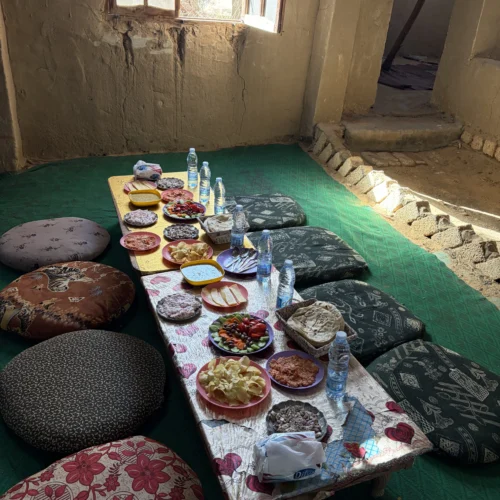
What is the toilet setup for children?
Do not promise a fixed bathroom unless the selected tour genuinely supplies one. A mobile camp may use a basic privacy arrangement rather than a permanent toilet, running water or shower.
Show the child an age-appropriate explanation before travel. Ask whether a private tent or screen is available and how far the toilet area is from the sleeping place. At night, a parent should accompany the child with a headlamp and follow the guide’s boundary.
For younger children, a compact travel potty may reduce stress if the operator can carry and dispose of waste correctly. Bring more nappies and disposal supplies than the expected minimum and pack everything out.
The full White Desert camping guide explains tents, bedding, washing, meals, power and phone signal.
Sleeping arrangements and bedtime
A child’s first night in the desert may be exciting at sunset and difficult at bedtime. Ask whether the family receives a private enclosed tent, a shared tent, wind shelter or open sleeping option. For most families, a protected private arrangement is easier than assuming everyone will sleep under the stars.
Confirm:
- mattress size and thickness;
- sleeping bag or blankets;
- child-sized bedding;
- privacy;
- distance from cooking and fire;
- wind protection;
- whether the family can keep bags inside;
- the plan if a child cannot settle.
Bring a familiar sleep item, warm sleepwear, headlamp, earplugs if appropriate and a small night light that does not disturb other campers. Keep water, medicine, shoes and a warm layer beside the child.
Do not use adult bedding arrangements for an infant without obtaining current safe-sleep advice from the child’s clinician. Hotel accommodation in Bahariya may be the more appropriate option for families with babies.
Fire, cooking and camp boundaries
Children should treat the camp kitchen and fire as controlled work areas. Set a visible boundary and keep one adult responsible for supervision while another organizes bedding or luggage.
Rules should include:
- no running around cooking equipment;
- no touching pots, fuel or firewood;
- no throwing objects into the fire;
- no moving beyond the agreed camp area;
- no walking without a light after dark;
- no feeding wildlife;
- no leaving food or rubbish outside;
- shoes on when walking around camp.
A campfire is not guaranteed and should be skipped when wind, local rules or guide judgment make it unsuitable.
Rocks, formations and climbing
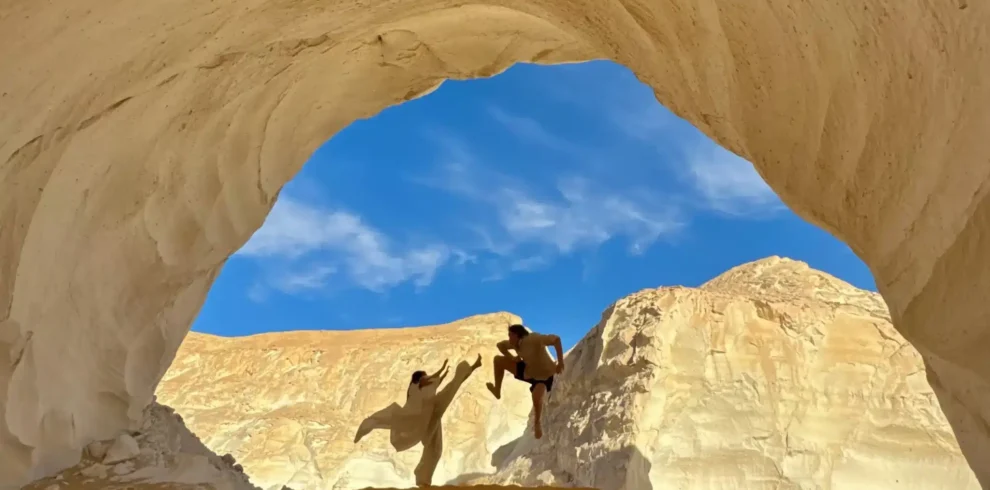
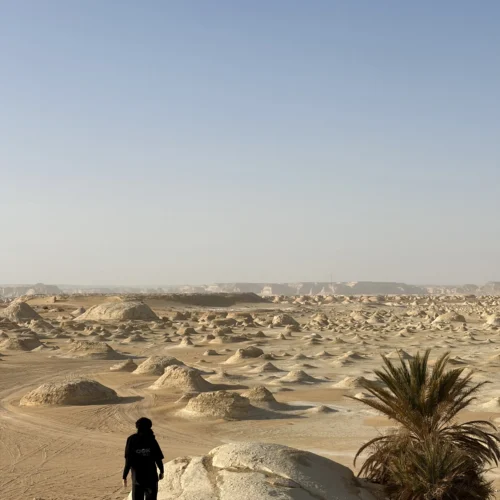
The chalk formations look like a natural playground, but they are fragile and may have unstable or sharp surfaces. Children should not climb formations, jump from ledges, carve names or remove pieces.
Walking routes can include uneven sand, stones and slopes. Use closed shoes with grip. Adults should position themselves below a child on a descent and stop an activity when footing is poor.
Turn conservation into part of the experience: photograph shapes, identify colors, track shadows and collect rubbish—never rocks.
Animals, insects and bites
Do not allow children to approach or feed foxes, dogs, cats or other animals, even if they appear calm. A bite or scratch requires immediate washing and urgent medical advice because rabies exists in Egypt.
Use a light before putting hands near rocks, camp gear or shoes. Shake shoes before wearing them. Ask a clinician about suitable insect repellent for the child’s age and apply it according to the label.
Food should remain sealed. A child who wants a close animal photograph should use zoom and stay beside an adult.
Helping children enjoy the drive and landscape
A child is less likely to become bored when the trip has understandable stages. Before departure, show a simple route:
- leave Cairo;
- stop on the road;
- reach Bahariya;
- change to the desert vehicle;
- see the Black Desert and other formations;
- watch sunset;
- eat and sleep at camp;
- explore after sunrise;
- return through Bahariya to Cairo.
Give each child a small role: refill their day bag with an adult, count water breaks, photograph different rock shapes, find constellations or check that no rubbish remains.
Download entertainment before Cairo, but encourage looking outside on the off-road section to reduce motion sickness. Bring headphones for shared travel and a power bank; electricity should not be assumed at camp.
A family-friendly two-day structure
The two-day White Desert itinerary from Cairo is the simplest common overnight format, but it should be adapted.
Day one
Use an early but realistic pickup after the child has slept. Stop for a toilet and movement break before Bahariya. Have a familiar meal at the oasis, transfer carefully to the 4×4 and keep the afternoon stops shorter than an adult photography itinerary.
Reach the camp area before dark. Let the child understand the boundaries while there is light, arrange bedding early and serve dinner before exhaustion creates a difficult bedtime.
Day two
Keep warm clothing accessible for sunrise. Offer breakfast and water before packing. Use a moderate morning route with breaks, return to Bahariya and allow time for a proper toilet and meal before the long drive to Cairo.
A three-day trip offers a slower pace but adds another night of basic facilities. Compare the practical trade-offs in two days versus three days in the White Desert.
When a Bahariya hotel is the better choice
A hotel-based version may suit families who want the desert without the overnight camp. It can provide a conventional bathroom, easier sleep, electricity, more food flexibility and a faster response when a child is uncomfortable.
Consider it when:
- the child is under school age;
- this is the first long road trip;
- nighttime cold is a concern;
- toilet training is recent;
- sleep disruption triggers health or behavior problems;
- medication storage needs power or refrigeration;
- a parent is uncertain about camping;
- the weather forecast is marginal.
The family can still experience Bahariya and an authorized daytime route with a licensed team. Ask for a customized plan rather than forcing a standard camping product.
Packing list for children
In addition to the general White Desert packing checklist, bring:
Health and hygiene
- prescribed medicine and written plan;
- child-safe sunscreen;
- age-appropriate insect repellent;
- oral rehydration supplies recommended by a clinician;
- tissues, wipes and sanitizer;
- nappies or travel potty supplies;
- thermometer if normally used;
- motion-sickness supplies;
- copies of insurance and medical information.
Clothing
- breathable daytime layers;
- warm nighttime layers;
- wind-resistant outer layer;
- spare socks and underwear;
- closed shoes;
- sun hat;
- warm hat when seasonally appropriate;
- a complete spare outfit in the vehicle.
Comfort and logistics
- correctly compatible child restraint;
- refillable bottle;
- familiar stable snacks;
- small backpack;
- comfort item;
- headlamp;
- downloaded entertainment and headphones;
- power bank;
- sealable bags for dirty clothes and waste.
Keep critical items in the same vehicle as the child.
Questions parents should ask before paying
- Is every stage private or shared?
- What are the exact Cairo-to-Cairo timings?
- Which vehicles are used, and what restraints can be fitted?
- Can the off-road pace be kept gentle?
- Are permits and an official guide included?
- How many children has the team hosted on this route?
- What is the sleeping setup for the family?
- What toilet and washing arrangement is provided?
- Which meals and drinks are included?
- Can the stated allergy or diet be handled safely?
- How much water is carried?
- What happens if the child becomes ill?
- Where is the nearest practical medical facility?
- How does the team communicate without phone signal?
- Can the family switch to a Bahariya hotel?
- What happens if weather or authorities change the route?
- Is medical and evacuation insurance required?
- What equipment must the parents bring?
A useful answer is specific. “Do not worry, children always love it” is not enough.
Related family planning guides: Review the White Desert safety guide, the camping guide, and the packing checklist before deciding whether the trip suits your children.
Planning for a family: Start with the White Desert destination and compare the 3 Days / 2 Nights White Desert Adventure; ask for a private adapted itinerary when children need a slower pace.
Frequently asked questions
What is the best age for the White Desert?
There is no universal best age. School-age children who tolerate long drives, follow instructions and communicate discomfort are often easier to plan for than infants or toddlers. The child’s health, temperament and the exact itinerary matter more than a birthday alone.
Can a baby go to the White Desert?
It is physically possible for families to travel with babies, but remote overnight camping creates substantial feeding, sleep, hygiene, restraint and temperature challenges. Obtain medical advice and consider a private daytime trip with a Bahariya hotel.
Do children need a car seat?
Children need an appropriate restraint in every moving vehicle. Confirm that the family’s seat or booster can be installed correctly in both the road vehicle and 4×4. Never plan for a child to ride on an adult’s lap.
Are there toilets in the desert?
Do not expect a permanent bathroom at a mobile camp. Ask the operator for the exact privacy and waste setup and consider a travel potty for younger children.
Will there be phone signal?
Not reliably. Share the itinerary before departure, keep the phone charged and explain the expected offline period to family contacts.
Can children sleep under the stars?
Only when conditions, the child and the guide’s arrangement make it appropriate. A protected private tent should be confirmed as the practical fallback.
Is the food child-friendly?
Meals are usually simple, but “child-friendly” is subjective. Share foods the child reliably eats and bring stable familiar snacks. Disclose allergies in detail.
What if my child gets carsick?
Tell the operator, request gentle driving and breaks, and ask the child’s clinician about appropriate prevention. Store sick bags, water, wipes and spare clothes within reach.
Is summer suitable for a family trip?
High heat raises the burden and risk, particularly for young children. Choose the season carefully, check the forecast and do not rely on air conditioning at outdoor stops or camp.
Should we book two or three days?
Two days reduces the number of remote nights but can feel compressed. Three days can slow the pace but adds another night of basic facilities. Base the choice on the child’s sleep, road tolerance and camping experience.
Final decision checklist
Proceed only if the family can answer yes to these questions:
- We have checked current official travel advice.
- We are using a licensed operator and official guide.
- Permits will be arranged.
- The child can travel in an appropriate restraint.
- The itinerary can be modified for the family.
- We understand the drive time and off-road conditions.
- We accept the actual toilet and sleeping setup.
- We have a heat, cold and hydration plan.
- Food and allergy needs are addressed.
- Medicine stays accessible and stable.
- Insurance covers the route and activities.
- A trusted contact has the operator and itinerary.
- We are willing to change or cancel for health, weather or official restrictions.
A White Desert family trip is most successful when adults design it around the child rather than asking the child to tolerate an adult itinerary. With honest preparation, a slower private route and clear limits, school-age children in particular can learn from the landscape and enjoy the camp without the schedule becoming a test of endurance.
Sources checked
- CDC: Infants and Children and Heat
- CDC: Heat-related Illnesses
- CDC: Egypt Traveler View
- CDC Yellow Book: Egypt
- UK FCDO: Egypt Regional Risks
- Experience Egypt: Natural Wonders in Al-Bahariyya
To request a private, family-adapted itinerary and confirm vehicle, bedding, meals and current permits, contact Elzaghandi Travel on WhatsApp.