Best Place to See the 2027 Total Solar Eclipse: Wadi Agabat vs Luxor, Tunisia & Spain
Last reviewed: 13 August 2026
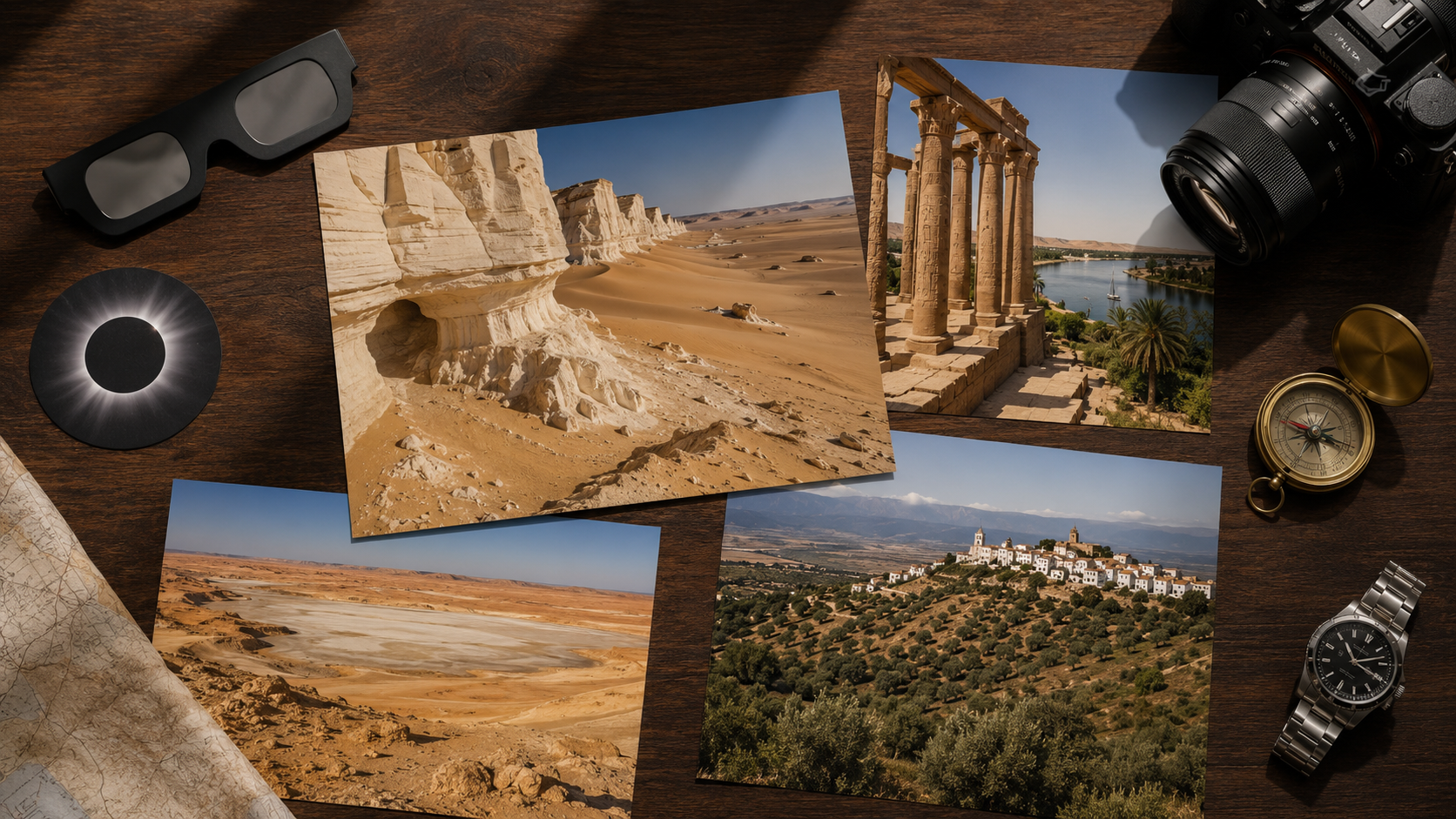
The total solar eclipse of 2 August 2027 will be one of the most important astronomical travel events of the decade. Its path of totality will cross southern Spain and North Africa before continuing through Egypt, the Red Sea region and the Arabian Peninsula. For travelers comparing where to stand when the Moon fully covers the Sun, four options repeatedly rise to the top: Egypt’s Western Desert and White Desert, Luxor, Tunisia, and southern Spain.
The numbers alone do not tell the whole story.
Luxor is one of the strongest places on Earth for sheer duration, with about 6 minutes 22 seconds of totality. Sfax in Tunisia receives roughly 5 minutes 41 seconds. Cádiz in southern Spain receives about 2 minutes 56 seconds, while Málaga receives about 1 minute 57 seconds. Egypt’s maximum centerline duration reaches roughly 6 minutes 23 seconds.
The White Desert offers a different proposition. The likely eclipse camp location being evaluated by the Elzaghandi Group is Wadi Agabat in the White Desert region. A commonly mapped Agabat Valley reference point lies at approximately 27.46977° N, 28.4359° E. Comparing that reference coordinate with NASA’s published path-limit data places it inside the path of totality. The exact camp position, however, still needs to be finalized before an exact local duration should be published.
That distinction is important. A professional eclipse plan should never claim the maximum centerline duration for a camp until the final GPS coordinate has been checked against reliable astronomical calculations.
Direct answer: For the 2027 total solar eclipse, Luxor is stronger if your only goal is to maximize totality duration. Southern Spain is stronger for conventional European transport and independent mobility. Sfax is an excellent compromise between long totality and favorable climatology. A Wadi Agabat eclipse camp in Egypt’s White Desert stands out for a different reason: a verified totality location in an extremely dry desert climate, a broad natural horizon, lower local density, controlled camp logistics and a landscape built around the sky rather than a city.
For travelers who want the event to become a complete desert journey rather than a few minutes at a roadside viewing point, the White Desert deserves serious consideration.
2027 total solar eclipse at a glance
For the official event overview, see the 2027 Eclipse in Egypt guide and NASA’s 2027 eclipse path data.
What actually happens during a total solar eclipse?
A solar eclipse occurs when the Moon passes between Earth and the Sun. During a total solar eclipse, observers standing inside the Moon’s umbral shadow see the Moon completely cover the Sun’s bright visible surface for a short period.
That period is totality.
Before totality, the Moon gradually covers more of the Sun. The light may become subtly strange, shadows sharpen and the landscape begins to feel different. As totality approaches, the final bright points of sunlight can break through valleys along the Moon’s edge. The last intense flash can create the famous diamond-ring appearance.
Then the photosphere disappears.
For observers inside the path, the sky darkens dramatically and the solar corona becomes visible around the black lunar disk. Bright planets or stars may appear. The horizon can take on twilight colors in multiple directions because observers are standing inside a relatively narrow moving shadow while sunlight remains visible beyond it.
NASA explains that the corona—the Sun’s outer atmosphere—is normally hidden by the brilliance of the photosphere and becomes directly visible during totality. Total eclipses therefore matter not only as travel experiences but also as scientific opportunities to study the corona, solar magnetic structure and the interaction between the Sun and the surrounding space environment.
Read NASA’s explanation of types of solar eclipses and its overview of future eclipses.
Why the 2 August 2027 eclipse is exceptional
Many total solar eclipses last only a few minutes at their best locations. The 2027 event is remarkable because totality becomes exceptionally long across North Africa.
NASA Goddard Space Flight Center’s path table shows centerline totality rising beyond six minutes across Libya and Egypt, reaching approximately 6 minutes 23 seconds near the maximum-eclipse region. The totality corridor is also broad—roughly 257 to 258 kilometers near maximum.
Across Egypt, the Sun will be very high in the sky during the event. A high-altitude Sun has important practical advantages:
- mountains or buildings near the horizon are less likely to block the event;
- photographers can plan around a high solar position rather than a low sunrise or sunset eclipse;
- the changing illumination spreads across the surrounding landscape rather than being concentrated near one horizon;
- a broad desert viewing area can give thousands of square meters of usable setup space without needing an exact horizon window.
The combination of long totality, a high Sun and exceptionally dry North African climatology is why serious eclipse travelers are already comparing Egypt with Tunisia and Spain.
Where will the 2027 eclipse travel?
NASA lists the 2 August 2027 total eclipse as visible from parts of southern Spain, Morocco, Algeria, Tunisia, Libya, Egypt, Saudi Arabia, Yemen and other regions farther along the shadow path.
For tourism planning, the western portion of the track produces a clear set of trade-offs:
- Spain offers easy transport and major hotel infrastructure but generally shorter totality.
- Tunisia offers long totality and excellent weather prospects.
- Egypt offers the longest durations in the comparison and some of the driest climatology on the path.
- Within Egypt, Luxor and the Western Desert represent very different styles of eclipse experience.
The candidate White Desert viewing site: Wadi Agabat
The likely location being evaluated for the Elzaghandi Group eclipse camp is Wadi Agabat, also known as Agabat Valley or El Aqabat in different maps and travel references.
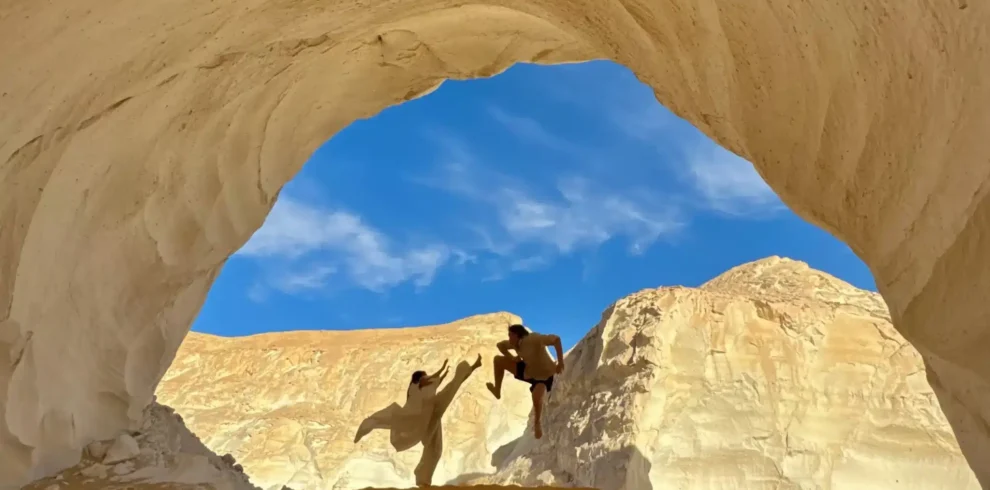
Agabat is part of the wider Western Desert journey between Bahariya and the White Desert. The landscape is known for pale cliffs, sculpted formations, open sand and wide lines of sight. On normal desert trips, it is already one of the most memorable stops between Crystal Mountain and the deeper White Desert.
Elzaghandi Travel’s standard White Desert routes pass through or near Agabat. You can see how the valley fits into the normal desert geography in the Agabat Valley travel guide, the White Desert Egypt travel guide and the 2-day White Desert Adventure.
Is Wadi Agabat inside the path of totality?
Using a commonly mapped Agabat Valley tourist point at approximately 27.46977° N, 28.4359° E as a geographic reference, the answer is yes: that reference point falls inside the NASA totality corridor.
This conclusion comes from comparing the reference coordinate with NASA GSFC’s published north limit, south limit and centerline positions for the eclipse shadow as it crosses the corresponding longitudes in western Egypt. At longitudes around 28–29° E, NASA’s southern totality boundary lies south of the Agabat reference latitude, while the centerline lies farther north.
That makes the Wadi Agabat region a valid totality candidate.
However, Wadi Agabat is a region, not one mathematical point. A camp may be several kilometers from a commonly mapped attraction marker. The final duration of totality, contact times, solar altitude and exact distance from the centerline must therefore be calculated only after the event team confirms the final GPS location.
This is the standard we recommend for all eclipse tours: publish the exact GPS coordinate and then publish the exact astronomical circumstances for that coordinate.
Location reference: Agabat Valley map data. Astronomical reference: NASA GSFC 2027 eclipse path table.
Why Wadi Agabat could be a powerful eclipse site
A strong eclipse site needs more than totality. It needs a combination of astronomy, weather, terrain and operations.
Wadi Agabat scores well on several of those dimensions.
1. A genuine desert environment
Agabat is not a city park, hotel roof or roadside pull-off. It is part of the Western Desert landscape. That means the eclipse can be experienced against pale rock, sand and open sky rather than dense urban structures.
2. A naturally open horizon
A wide field of view matters during a total solar eclipse because the experience is not limited to the solar disk. The entire sky and landscape change. A broad desert environment allows observers to notice the approaching shadow, the horizon glow and the rapid shift in ambient light.
3. Space for controlled setup
A managed desert camp can separate general guests, photographers and scientific equipment more easily than a crowded public square. Tripods and telescopes need stable space. Long lenses need room. Scientific teams may need tables, power and several days of controlled access.
4. Limited camp capacity
Solar Eclipse Tours currently plans a maximum event-camp capacity of 100 guests, with dedicated sleeping, dining, seating and viewing areas. The project describes the camp as purpose-built for the eclipse rather than a normal campsite with extra visitors added at the last minute.
See the White Desert Eclipse Camp plan for the current concept and facilities.
5. An existing desert operating route
The same region is already used by the local team for White Desert trips. Standard journeys travel from Cairo or Giza to Bahariya Oasis, change to locally operated 4×4 vehicles, then continue into the desert.
The Bahariya Oasis travel guide explains the oasis as the logistical gateway, while How to Get to Bahariya Oasis from Cairo covers the road stage in more detail.
Weather may be the White Desert’s strongest statistical advantage
No tour operator, meteorologist or eclipse planner can guarantee a clear sky more than a year in advance. The useful comparison is climatology, not certainty.
Meteorologist and eclipse-climatology specialist Jay Anderson’s analysis for the 2027 eclipse is unusually favorable toward Libya and western Egypt. The Eclipsophile review of satellite cloud records describes parts of the path over Libya and western Egypt as having exceptionally little August cloud. It notes that summer cloud is almost unknown over much of Libya and Egypt before cloud fractions begin to increase farther east near Luxor.
That makes western Egypt one of the most compelling weather-climatology regions on the entire path.
The analysis also highlights the Bahariya and Siwa oasis regions as particularly attractive eclipse bases from a cloud perspective. That matters for Wadi Agabat because Bahariya is the operational gateway used by many White Desert routes.
Read the full Eclipsophile 2027 eclipse weather analysis.
Cloud climatology is not a weather forecast
A historical average answers a question such as: “How often has this type of sky occurred in the past?” It does not answer: “Will 2 August 2027 definitely be clear?”
The final forecast will need to be monitored during the days before the eclipse using multiple weather models and satellite products.
A professional plan should therefore use climatology to choose the region, then use real-time forecasting to manage the final event.
Cloud is not the only atmospheric risk: dust matters
The Western Desert can be cloudless and still have reduced transparency.
Mineral dust can create haze, lower contrast in the corona and reduce the clarity of long-lens photographs. Eclipsophile specifically discusses dust as a separate North African risk even where ordinary cloud is rare.
For serious eclipse imaging, the final monitoring plan should include:
- high-, mid- and low-level cloud forecasts;
- surface wind speed and direction;
- visibility;
- dust and aerosol forecasts;
- aerosol optical depth when available;
- regional dust transport imagery;
- temperature;
- road and access conditions.
A dusty but cloudless sky may still allow totality to be seen, but it can affect photographic quality and the visibility of the outer corona.
The biggest operational challenge in Egypt: August heat
The eclipse crosses Egypt during one of the hottest parts of the year.
Eclipsophile’s climatology notes very high temperatures along the North African path, with the Egyptian segment capable of reaching the mid-40s Celsius during severe heat. Luxor is also extremely hot in early August.
Heat therefore has to be treated as an operational issue, not merely a comfort issue.
A properly planned eclipse base should provide:
- reliable shade before and after totality;
- cooled rest areas;
- abundant drinking water;
- cold drinks and electrolyte options;
- toilets;
- protected food storage;
- medical support;
- seating away from direct sun;
- shaded charging and electronics areas;
- a plan for children and older guests;
- reduced unnecessary exposure during the long partial phase.
Solar Eclipse Tours’ current White Desert Eclipse Camp plan includes climate-controlled sleeping and hospitality areas, water, meals, toilets, charging, Wi-Fi and medical support. Final equipment and layout should always be rechecked closer to the event.
Wadi Agabat vs Luxor for the 2027 total solar eclipse
Luxor is the benchmark against which almost every Egyptian eclipse site will be compared.
Timeanddate calculates approximately 6 minutes 22 seconds of totality in Luxor, with maximum eclipse around 1:05 p.m. local time on 2 August 2027.
See the Luxor 2027 eclipse circumstances.
Where Luxor is stronger
Luxor is stronger if totality duration is your overriding priority.
Its advantages include:
- near-maximum totality duration;
- conventional hotels;
- airport access;
- restaurants and city services;
- the Nile;
- Karnak and Luxor Temple;
- the Valley of the Kings and the West Bank;
- mature mainstream tourism infrastructure.
For a traveler visiting Egypt for the first time, combining a six-minute total eclipse with the monuments of ancient Thebes is extraordinarily compelling.
Explore the wider region through Elzaghandi Travel’s Luxor & Aswan destination page.
Where Wadi Agabat may be stronger
Wadi Agabat is not being positioned as a way to beat Luxor’s duration. Its strength is the viewing environment.
A purpose-managed desert site may offer:
- a low-density viewing zone;
- controlled access;
- no need to fight eclipse-day city traffic to reach the observing area;
- arrival before eclipse morning;
- space for tripods and telescopes;
- a naturally broad horizon;
- western-Egypt cloud climatology;
- a landscape in which the changing light becomes part of the event.
The choice can therefore be summarized simply:
Luxor for maximum totality and ancient monuments; Wadi Agabat for a managed desert eclipse experience with open terrain and a stronger sense of isolation.
Wadi Agabat vs Sfax, Tunisia
Tunisia is a serious alternative, not a secondary option.
Timeanddate calculates about 5 minutes 41 seconds of totality in Sfax, with maximum eclipse around 10:11 a.m. local time.
See the Sfax 2027 eclipse circumstances.
The historical cloud signal is also excellent. Timeanddate reports only about 2% average cloud occurrence for 2 August in its Sfax historical record, while Eclipsophile describes southern Tunisia as one of the clearer parts of the western path.
Where Sfax is stronger
Sfax provides:
- long totality;
- excellent historical cloud statistics;
- morning rather than early-afternoon totality;
- conventional urban accommodation;
- road-based access;
- a strong balance between astronomy and ordinary travel logistics.
Where Wadi Agabat may be stronger
The White Desert offers a more immersive landscape and a camp built around the event. Travelers can combine totality with Bahariya Oasis, the Black Desert, Crystal Mountain, Agabat and the White Desert rather than treating eclipse day as a single city excursion.
The Black Desert travel guide and Crystal Mountain guide show how those landscapes connect to the wider route.
Wadi Agabat vs southern Spain
Southern Spain is likely to be the easiest destination for many European eclipse travelers.
Timeanddate lists approximately:
- Cádiz: 2 minutes 56 seconds of totality;
- Marbella: 3 minutes 21 seconds;
- Málaga: 1 minute 57 seconds.
See the Spain 2027 eclipse overview.
Where Spain is stronger
Spain offers:
- major international airports;
- rental cars;
- highways;
- extensive hotel inventory;
- easier independent travel;
- a strong ability to relocate in response to short-range weather forecasts.
That last point is important. A traveler with a rental car can sometimes change observing locations on eclipse morning far more easily than a large desert camp can be relocated.
Spain’s weather trade-off
Southern Spain is still a favorable eclipse region, but its climatology is more complex than western Egypt’s. Eclipsophile discusses the possibility of coastal marine stratus and fog, particularly near some Atlantic and Mediterranean coastal zones, while inland locations can have lower cloud fractions.
Timeanddate’s representative historical cloud figures list approximately 13% for Cádiz, 9% for Málaga and 7% for Marbella on 2 August.
Those are still encouraging numbers—but they are not as close to cloud-free as the strongest desert climatology in western Egypt.
Where Wadi Agabat is stronger
Wadi Agabat offers a more remote environment, extremely low ordinary summer cloud climatology and, because it is farther east along the eclipse track, potentially substantially longer totality than common Spanish coastal examples—subject to the final camp coordinate.
The trade-off is clear: Spain offers flexibility and convenience; Wadi Agabat offers desert immersion and a purpose-built event environment.
Comparison table: Wadi Agabat, Luxor, Tunisia and Spain
Important: A city value calculated for a precise coordinate should not be treated as directly equivalent to an unfinalized regional camp. The exact Wadi Agabat camp value will be added after its final GPS coordinate is confirmed.
Which location is best for experienced eclipse chasers?
Experienced eclipse chasers usually think in terms of risk rather than tourism labels.
Before choosing, rank these questions:
- Is the exact site definitely inside totality?
- How far is it from the centerline and path limits?
- How much totality does the precise coordinate receive?
- What is the historical cloud climatology?
- What is the dust and aerosol risk?
- Can the observer relocate if forecasts deteriorate?
- Is the viewing site accessible the day before?
- Is there secure space for equipment?
- Are power, shade and water available?
- Is crowd movement controlled during critical observing minutes?
For maximum duration, Luxor and nearby centerline sites have the advantage.
For independent weather chasing, Spain has the advantage.
For long duration plus conventional logistics, Sfax is extremely strong.
For a controlled desert base in one of the driest cloud-climatology regions on the path, Wadi Agabat is highly competitive.
Totality is fundamentally different from 99%
A common eclipse-planning mistake is assuming that a 99% partial eclipse is almost the same as 100% totality.
It is not.
At 99%, a thin part of the solar photosphere remains exposed. The Sun is still dangerously bright. Safe solar filters remain necessary. The corona is not revealed with the same dramatic contrast.
At 100% totality, the bright photosphere is fully covered. The visual environment changes rapidly and the corona becomes visible.
This is why exact site selection matters so much. Being inside the path of totality is more important than being merely close to it.
NASA’s Types of Solar Eclipses guide explains the distinction.
What can observers see during totality?
Weather and solar activity permitting, totality can reveal several phenomena.
The solar corona
The corona is the Sun’s outer atmosphere. During totality it appears around the black lunar disk in structures shaped by the Sun’s magnetic field.
Prominences
Bright pink or red structures can sometimes be visible along the solar limb, depending on solar activity.
Baily’s beads
Immediately before and after totality, sunlight can shine through valleys along the Moon’s irregular edge, producing isolated beads of intense light.
The diamond ring
One last bright photospheric point beside the emerging corona creates the visual effect called the diamond ring.
A rapid change in the landscape
The sky darkens quickly, shadows change, the temperature may fall and the distant horizon can retain twilight-like colors because sunlight remains outside the umbral shadow.
Why the White Desert landscape could amplify the visual experience
Wadi Agabat and the wider White Desert are highly sensitive to changing light even on an ordinary day. Pale cliffs, chalk formations and sand take on different tones as the Sun moves.
During a total solar eclipse, that effect is compressed into minutes.
Possible visual changes include:
- reduced contrast before totality;
- unusually cool or metallic ambient light;
- a darkened overhead sky with brighter distant horizon bands;
- rapid changes in the apparent texture of pale formations;
- a sudden return of harsh desert brightness after third contact.
For landscape photographers, this gives the site a major creative advantage: the story can include both the corona and the transformed desert environment.
For normal White Desert scenery and route context, see the White Desert destination and Agabat Valley guide.
Photography planning for Wadi Agabat
A total solar eclipse is easy to underestimate photographically because the event changes faster than most first-time observers expect.
The safest approach is to rehearse before eclipse day.
For serious photographers:
- use a proper front-mounted solar filter during the partial phases;
- remove the filter only for full totality;
- pre-focus and lock focus where appropriate;
- use a stable tripod;
- bracket corona exposures;
- carry spare batteries and memory cards;
- protect equipment from direct desert heat;
- protect lenses and camera bodies from dust;
- use a second wide-angle camera if you want the changing landscape as well as the eclipsed Sun;
- automate part of the sequence if your workflow is reliable;
- leave time to look at the eclipse with your own eyes instead of spending every second operating a camera.
Dark camera bodies and long lenses can become extremely hot after hours in direct August sunlight. Use shade whenever practical and keep backup batteries cooler than the exposed equipment.
The White Desert also supports a second kind of eclipse image: a wide environmental frame showing the darkened sky over pale desert formations. This is one reason a broad Wadi Agabat viewing area can be photographically distinctive even if it is not exactly on the centerline.
Scientific and advanced observing teams
A scientific observing team may judge an eclipse site very differently from a tourist.
Common requirements can include:
- access several days before the eclipse;
- precise GPS and elevation data;
- stable power;
- reliable charging;
- internet connectivity;
- secure overnight storage;
- controlled pedestrian movement;
- controlled vehicle movement;
- tables and work surfaces;
- shade for computers and cameras;
- an unobstructed solar view;
- backup power;
- emergency and medical support.
Solar Eclipse Tours’ current camp concept includes distributed charging, Wi-Fi and dedicated viewing areas. Teams with substantial telescopes or multi-station experiments should still discuss their footprint separately because scientific installations can require a larger controlled zone than normal guest photography.
The exact final camp coordinate and layout should be shared with scientific teams as early as possible so they can calculate local circumstances and test their observing sequence.
Getting from Cairo to Wadi Agabat
A White Desert eclipse journey normally has two transport stages.
Stage 1: Cairo or Giza to Bahariya Oasis
The road journey to Bahariya takes around four hours in the current Solar Eclipse Tours plan, depending on pickup location, traffic, stops and road conditions.
Bahariya is the local operating base and the practical transition point between paved-road travel and desert vehicles.
For more detail, read How to Get to Bahariya Oasis from Cairo and the Bahariya Oasis Egypt Travel Guide.
Stage 2: Bahariya to the eclipse camp by 4×4
In Bahariya, travelers change to locally operated four-wheel-drive vehicles prepared for the desert route.
This is the same basic logistical structure already used for regular White Desert journeys, including the 2 Days / 1 Night White Desert Adventure and 3 Days / 2 Nights White Desert Adventure.
For the eclipse, however, the transport plan must serve a larger purpose-built camp and a fixed astronomical schedule. That requires controlled arrivals, luggage management, vehicle sequencing and enough time for guests to settle before the critical observing period.
The planned White Desert eclipse camp
Solar Eclipse Tours describes the 2027 camp as a fully serviced eclipse base rather than a minimal wild camp.
The current plan includes:
- air-conditioned sleeping tents;
- climate-controlled seating and hospitality areas;
- climate-controlled eclipse viewing areas;
- solo, twin and triple sleeping arrangements;
- camp-wide Wi-Fi;
- distributed charging points;
- dedicated toilets;
- fresh meals;
- vegetarian options;
- drinking water and cold drinks throughout the day;
- medical professional and first-aid support;
- maximum planned capacity of 100 guests.
Shower facilities are planned at the Bahariya hotel rather than as conventional permanent showers inside the desert camp.
These details are current planning information and may be refined before August 2027. Always review the latest White Desert Eclipse Camp page before making a booking decision.
Three current ways to experience the White Desert eclipse
Solar Eclipse Tours currently offers three main journey formats.
2 Day White Desert Total Solar Eclipse Tour 2027
A focused route for travelers who want to reach the White Desert, stay at the eclipse camp and experience totality without adding several extra travel days.
View the 2-day White Desert eclipse tour.
3 Day White Desert Total Solar Eclipse Tour 2027
A longer camp-focused itinerary with additional time to settle into the desert environment before or after the eclipse.
View the 3-day White Desert eclipse tour.
4 Day Bahariya Oasis & White Desert Total Solar Eclipse Tour 2027
The fullest current standard program, combining Bahariya Oasis with the White Desert and giving travelers more time in the region around eclipse day.
View the 4-day Bahariya and White Desert eclipse tour.
You can compare the current programs on the Eclipse Tours & Packages page.
Travelers with scientific equipment, private-vehicle requirements, additional Cairo nights or other special needs can use Check Availability to discuss a customized plan.
Who operates the White Desert eclipse project?
Solar Eclipse Tours is operated by Elzaghandi Group, the same local group behind Elzaghandi Travel.
The group is based in Bahariya Oasis and operates journeys through Bahariya and the White Desert with local guides, drivers and trip supervisors. Its existing work already includes the road and off-road geography used to reach the White Desert.
That does not remove the need for special eclipse planning. A 100-person astronomical event has different demands from a normal safari. But it means the underlying desert route, vehicle changeover and local operating environment are not new to the host team.
Read About Elzaghandi Group for the group’s background.
Heat safety on eclipse day
The best eclipse location is not useful if guests cannot remain comfortable and safe long enough to experience it.
Travelers should plan to:
- drink regularly before becoming thirsty;
- spend as much of the long partial phase as practical in shade or cooled areas;
- wear light, breathable clothing;
- use a sun hat;
- apply sunscreen;
- avoid unnecessary physical exertion around midday;
- carry personal medication;
- inform the event team of relevant dietary or medical needs in advance;
- supervise children closely;
- keep electronics out of direct sun when possible.
Travelers with medical conditions that can be worsened by severe heat should seek personalized medical advice before committing to a remote August desert event.
Safe solar viewing: essential rules
Solar eclipse eye safety does not change because the location is remote or because totality will occur later in the event.
NASA states that ordinary sunglasses are not safe for looking directly at the Sun. During the partial phases, observers need safe solar viewing glasses or a safe handheld solar viewer. Safe solar viewers should comply with the ISO 12312-2 international standard.
Cameras, telescopes and binoculars require a proper solar filter secured over the front of the optics. Wearing eclipse glasses while looking through an unfiltered telescope, binoculars or camera does not make the setup safe because magnified sunlight can damage the filter and the eye.
Only during full totality—when the bright photosphere is completely covered—is direct unaided viewing safe. Eye protection must go back on immediately when the bright Sun begins to reappear.
Read NASA’s Eclipse Viewing Safety guidance before the event.
Which destination is best for families?
Families should rank comfort and logistics ahead of an extra few seconds of totality.
Southern Spain offers the simplest conventional infrastructure and easiest independent mobility.
Luxor offers hotels and established tourism services but will be extremely hot.
Sfax offers long totality from a city-based environment.
Wadi Agabat can be attractive to families who want a managed desert experience, but only if the child is comfortable with the road journey, 4×4 travel, desert conditions and strict solar-viewing rules.
The current eclipse-camp plan addresses many practical family concerns through cooled spaces, toilets, food, water and medical support. Parents still need to consider each child individually.
For general desert family planning, read White Desert Egypt with Kids.
Which destination is best for first-time eclipse viewers?
First-time observers often benefit from removing as much uncertainty as possible.
Luxor is straightforward astronomically: it is deeply inside totality and provides an exceptionally long total phase.
Spain is straightforward logistically: travelers can use familiar European road and hotel infrastructure.
Sfax combines an easy-to-understand city base with long totality.
Wadi Agabat is attractive when the traveler wants the difficult logistics handled as one package: Cairo welcome, Bahariya transfer, 4×4 transport, camp, meals and viewing-site organization.
Which destination is best for astrophotographers?
The answer depends on the photograph you want.
Luxor: strongest for long totality and more time to change exposure settings.
Wadi Agabat: strongest for a purpose-managed setup area and unusual desert foregrounds.
Sfax: an excellent balance of long totality and favorable climatology.
Southern Spain: strongest for mobility if forecasts require a change of site.
Which destination is best for a scientific team?
A scientific team should decide only after reviewing the exact site specification.
Wadi Agabat can be attractive because a camp can allocate controlled areas and provide advance access, but teams should verify:
- exact GPS and elevation;
- exact local contact times;
- available electrical load;
- backup generation;
- internet bandwidth;
- equipment security;
- vehicle restrictions around the instruments;
- setup dates;
- teardown schedule;
- emergency procedures.
Luxor, Tunisia or Spain may be better for some experiments if conventional logistics or centerline duration is more important than isolation.
Decision matrix: which destination fits you?
Choose Wadi Agabat / White Desert if you prioritize:
- totality in a remote desert setting;
- exceptionally low ordinary cloud climatology;
- wide horizons;
- a controlled camp;
- local hosting;
- a multi-day Western Desert journey.
Choose Luxor if you prioritize:
- near-maximum totality;
- the longest possible observing window in this comparison;
- ancient Egyptian monuments;
- hotels and airport access.
Choose Sfax / Tunisia if you prioritize:
- about five and a half minutes of totality;
- excellent historical cloud statistics;
- city accommodation;
- conventional North African logistics.
Choose southern Spain if you prioritize:
- European accessibility;
- rental-car mobility;
- conventional hotels;
- independent travel;
- flexibility to respond to short-range weather forecasts.
Final verdict: what is the best place to watch the 2027 total solar eclipse?
There is no honest universal winner.
Luxor is the strongest choice for totality duration.
Southern Spain is the strongest choice for easy independent mobility.
Sfax is one of the strongest balanced choices for long totality plus excellent climatology.
Wadi Agabat is one of the most distinctive choices for travelers who want a verified totality location in Egypt’s Western Desert, very low ordinary cloud climatology, a wide natural horizon and a purpose-managed camp away from a dense city environment.
The case for the White Desert should not depend on pretending that it beats Luxor in every astronomical number.
Its strength is the combination:
totality + desert climatology + open terrain + controlled capacity + local operations + a complete Western Desert journey.
Once the final Wadi Agabat camp GPS coordinate is fixed, the event team should publish:
- exact latitude and longitude;
- first contact (C1);
- second contact / start of totality (C2);
- maximum eclipse;
- third contact / end of totality (C3);
- fourth contact (C4);
- exact totality duration;
- solar altitude and azimuth;
- distance from the centerline and path limits;
- an observing-site plan for guests, photographers and scientific teams.
Publishing those details will be far more useful—and more credible—than simply repeating Egypt’s maximum figure of 6 minutes 23.2 seconds for every location.
Related eclipse planning: Read the complete 2027 total solar eclipse in Egypt guide, then compare desert context with the Agabat Valley guide and the White Desert travel guide.
Frequently asked questions
Is Wadi Agabat inside the 2027 path of totality?
Using the commonly mapped Agabat Valley reference point near 27.46977° N, 28.4359° E, comparison with NASA’s published north and south path limits places that point inside the totality corridor. The final eclipse-camp coordinate must still be checked separately because Wadi Agabat covers a broader area.
How long will totality last at the Wadi Agabat eclipse camp?
The exact duration should be published only after the final camp GPS is fixed. Totality duration changes according to distance from the eclipse centerline and path limits.
Will Wadi Agabat get 6 minutes 23 seconds of totality?
Not necessarily. NASA gives 6 minutes 23.2 seconds as the greatest duration anywhere along the 2027 path. That is not a universal duration for Egypt or the White Desert.
How long is totality in Luxor?
Timeanddate calculates approximately 6 minutes 22 seconds of totality in Luxor.
How long is totality in Sfax, Tunisia?
Timeanddate calculates approximately 5 minutes 41 seconds in Sfax.
How long is totality in Cádiz, Spain?
Approximately 2 minutes 56 seconds at the Cádiz reference location used by Timeanddate.
How long is totality in Málaga, Spain?
Approximately 1 minute 57 seconds at the Málaga reference location used by Timeanddate.
Is Egypt better than Spain for the 2027 eclipse?
Egypt generally offers longer totality and exceptionally favorable dry-season cloud climatology. Spain offers easier independent mobility, conventional hotels and a road network that can make last-minute weather relocation easier. The better choice depends on your priorities.
Is Tunisia better than Egypt for the eclipse?
Tunisia—particularly the Sfax region—is a very strong eclipse destination with long totality and excellent historical cloud statistics. Egypt offers the longest durations on the path and some exceptionally dry desert climatology. Neither country is universally better for every traveler.
Is Luxor better than Wadi Agabat?
Luxor is better if your main goal is to maximize totality duration and combine the eclipse with major archaeological sites. Wadi Agabat may be more attractive if you prioritize a controlled desert environment, wide horizons, lower immediate density and a multi-day White Desert experience.
Why not simply watch from any place in the White Desert?
Because totality depends on exact coordinates. The White Desert is a large region, and a place associated with the White Desert can be inside, near or outside a path boundary. The exact viewing site must be verified.
Why is the exact GPS coordinate so important?
The edges of the totality path are geographically precise. Moving several kilometers can materially change totality duration near a path limit. Exact coordinates also determine contact times, solar altitude and azimuth.
Will clouds be a problem in the White Desert?
Historical August cloud climatology is exceptionally favorable across western Egypt, but no location is guaranteed to be clear on a specific future date. The final short-range forecast will still matter.
What is the main atmospheric risk in Wadi Agabat?
Heat, dust, haze and wind may be more important operational concerns than ordinary summer cloud.
Can the camp relocate if weather changes?
A large purpose-built camp cannot be assumed to have the same last-minute mobility as an individual traveler with a rental car. Any relocation plan would depend on permits, terrain, forecast confidence, camp infrastructure and transport capacity.
Is Spain better for weather chasing?
In practical terms, yes. Southern Spain’s roads, hotels and rental-car network generally make independent relocation easier than moving a large desert event camp.
Is Wadi Agabat suitable for telescopes and scientific equipment?
Potentially. The site can offer open terrain and controlled space, but scientific teams should confirm power, setup areas, equipment security, access dates and exact GPS details directly with the event organizers.
Will there be electricity at the eclipse camp?
The current camp plan includes distributed charging and powered camp infrastructure. Teams with substantial electrical requirements should provide their load specifications in advance.
Will there be internet at the camp?
The current Solar Eclipse Tours plan includes Wi-Fi coverage. Remote connectivity should still be treated as managed event infrastructure rather than assumed public mobile coverage.
Will there be toilets?
Yes. Dedicated toilet facilities are part of the current camp plan.
Will there be showers?
The current plan lists showers at the Bahariya hotel rather than conventional permanent showers at the desert camp.
Will the eclipse camp be air-conditioned?
The current plan includes air-conditioned or climate-controlled sleeping tents, seating areas, hospitality/dining spaces and dedicated viewing areas. Final equipment should be reconfirmed before travel.
Are eclipse glasses included in the package?
Current Solar Eclipse Tours information says special-purpose eclipse glasses will be available separately and are not included in the standard package price. Guests should verify the latest package inclusions before travel.
Can I use normal sunglasses to watch the eclipse?
No. NASA states that regular sunglasses are not safe for direct solar viewing.
Can I look directly at the Sun during totality?
Only during the brief full-totality phase when the bright photosphere is completely covered. Proper solar protection is required before and after that phase.
Do cameras and telescopes need filters?
Yes. During the partial phases, cameras, telescopes and binoculars require a special-purpose solar filter secured over the front of the optics.
What should an eclipse photographer bring?
At minimum, consider a proper solar filter, tripod, spare batteries, spare memory cards, dust protection, heat protection, a remote release or tested automation workflow and a rehearsed exposure sequence.
How do travelers reach Wadi Agabat from Cairo?
The normal operating structure is Cairo or Giza to Bahariya Oasis by road, followed by locally operated 4×4 transport into the White Desert region.
Who operates Solar Eclipse Tours?
Solar Eclipse Tours is operated by Elzaghandi Group in Bahariya Oasis, the same group behind Elzaghandi Travel.
How many guests are planned for the eclipse camp?
The current stated maximum capacity is 100 guests.
Where can I compare the 2027 eclipse packages?
Use the Eclipse Tours & Packages page.
Can I request a custom plan or discuss scientific equipment?
Yes. Use Check Availability to discuss group size, transport, equipment, accommodation and other requirements.
Recommended internal reading from Solar Eclipse Tours
- Solar Eclipse Tours – 2027 White Desert Eclipse
- 2027 Total Solar Eclipse Egypt: Complete Guide
- Eclipse Tours & Packages
- The White Desert Eclipse Camp
- About Elzaghandi Group
- 2 Day White Desert Total Solar Eclipse Tour 2027
- 3 Day White Desert Total Solar Eclipse Tour 2027
- 4 Day Bahariya Oasis & White Desert Total Solar Eclipse Tour 2027
- Check Availability / Custom Planning
Recommended internal reading from Elzaghandi Travel
- White Desert Destination
- White Desert Egypt Travel Guide
- Agabat Valley Egypt Travel Guide
- Bahariya Oasis Egypt Travel Guide
- How to Get to Bahariya Oasis from Cairo
- Black Desert Egypt Travel Guide
- Crystal Mountain Egypt Travel Guide
- White Desert Egypt Camping Guide
- Is the White Desert Egypt Safe?
- What to Pack for the White Desert Egypt
- White Desert Egypt with Kids
- 2 Days / 1 Night White Desert Adventure
- 3 Days / 2 Nights White Desert Adventure
External research and verification sources
Astronomy and eclipse geometry
- NASA GSFC – Path of the Total Solar Eclipse of 2 August 2027
- NASA GSFC – Interactive 2027 Eclipse Path Map
- NASA Science – Types of Solar Eclipses
- NASA Science – Eclipse Viewing Safety
Weather and climatology
Local eclipse circumstances
- Timeanddate – Luxor, Egypt, 2 August 2027
- Timeanddate – Sfax, Tunisia, 2 August 2027
- Timeanddate – Spain, 2 August 2027
Geographic reference
Editorial verification note before publication
This article is intentionally kept in Draft until the final Wadi Agabat eclipse-camp GPS coordinate is confirmed.
Before changing the article to Ready or Published:
- verify the final camp latitude, longitude and elevation;
- calculate exact C1, C2, maximum, C3 and C4 times for that coordinate;
- calculate exact totality duration;
- calculate solar altitude and azimuth;
- calculate distance from the centerline and both path limits;
- replace any regional wording with the final precise local circumstances;
- verify the latest camp facilities and package inclusions;
- recheck NASA eye-safety guidance;
- update short-range weather and dust-planning language closer to the event;
- do not describe the camp as receiving 6m23.2s unless the final coordinate independently calculates that duration.
Planning your White Desert eclipse journey
If a managed desert setting is the right fit for you, compare the current 2027 eclipse packages or contact the local team to check availability and discuss a custom plan.

Things to Do in Cairo Egypt: 15 Best Attractions & Experiences

Cairo Egypt Travel Guide: Itinerary, Attractions & Practical Tips
Dahshur Pyramids Guide: Bent Pyramid, Red Pyramid & Visiting Tips
Recent Posts

Things to Do in Cairo Egypt: 15 Best Attractions & Experiences

Cairo Egypt Travel Guide: Itinerary, Attractions & Practical Tips
Dahshur Pyramids Guide: Bent Pyramid, Red Pyramid & Visiting Tips