2027 Total Solar Eclipse in Egypt: Complete Guide
Last reviewed: 13 August 2026
The 2027 total solar eclipse in Egypt will take place on Monday, 2 August 2027, when the Moon’s dark central shadow crosses part of the country and turns day into a brief, dramatic twilight. For observers standing inside the path of totality, the Moon will completely cover the Sun’s bright surface, revealing the solar corona and producing one of the longest total eclipses of the 21st century.
Egypt is especially important for this event because the eclipse reaches its greatest duration in Egypt, where NASA calculations give a maximum of about 6 minutes 23.2 seconds on the centerline. The path is roughly 257–258 kilometers wide near maximum eclipse, and the Sun will be more than 80 degrees above the horizon near the point of greatest duration. NASA GSFC’s 2027 eclipse calculations place greatest duration near 26°49′N, 31°08′E.
But “Egypt” is not one eclipse location. Some places—including Luxor, Asyut, Siwa Oasis and Marsa Alam—will experience totality. Other major destinations—including Cairo, Alexandria, Hurghada and Aswan—will see only a partial eclipse. That difference is fundamental: a 99% partial eclipse is not the same event as totality.
Direct answer: The 2 August 2027 eclipse will be total across a broad corridor through Egypt. Luxor will receive about 6 minutes 22 seconds of totality, Asyut about 6 minutes 7 seconds, Siwa Oasis about 5 minutes 33 seconds and Marsa Alam about 5 minutes 28 seconds. Cairo, Alexandria, Hurghada and Aswan are outside the path of totality and will experience a partial eclipse. Egypt’s Western Desert is especially attractive because historical August cloud is exceptionally rare, and the candidate Solar Eclipse Tours camp area in Wadi Agabat is being evaluated inside the totality corridor. Exact camp contact times and duration will be published after the final GPS coordinate is confirmed.
For travelers considering a locally hosted White Desert experience, begin with the Solar Eclipse Tours 2027 homepage, compare the eclipse packages and review the current White Desert eclipse camp concept.
2027 total solar eclipse in Egypt: quick facts
Primary astronomical references: NASA GSFC Besselian elements, NASA eclipse path map and Timeanddate’s Egypt eclipse overview.
What is a total solar eclipse?
A total solar eclipse occurs when the Moon passes directly between Earth and the Sun and appears large enough in the sky to cover the Sun’s bright visible disk completely for observers inside a narrow shadow path.
The event develops in stages.
First contact and the partial phase
The Moon begins to move across the Sun. At first the change is subtle. Over the next hour or more, a progressively larger part of the Sun disappears.
During this entire stage, safe solar eye protection is essential. NASA says eclipse glasses or safe handheld solar viewers should be used whenever any part of the bright Sun remains visible. Ordinary sunglasses are not sufficient.
Approaching totality
As the remaining crescent of sunlight becomes thin, the character of daylight changes. Shadows can become unusually sharp, ambient light falls quickly, temperatures begin to drop and the landscape may take on a muted, metallic appearance.
Just before totality, tiny points of sunlight can shine through valleys along the Moon’s edge. These are commonly called Baily’s beads. The last brilliant point of sunlight creates the famous diamond-ring effect.
Totality
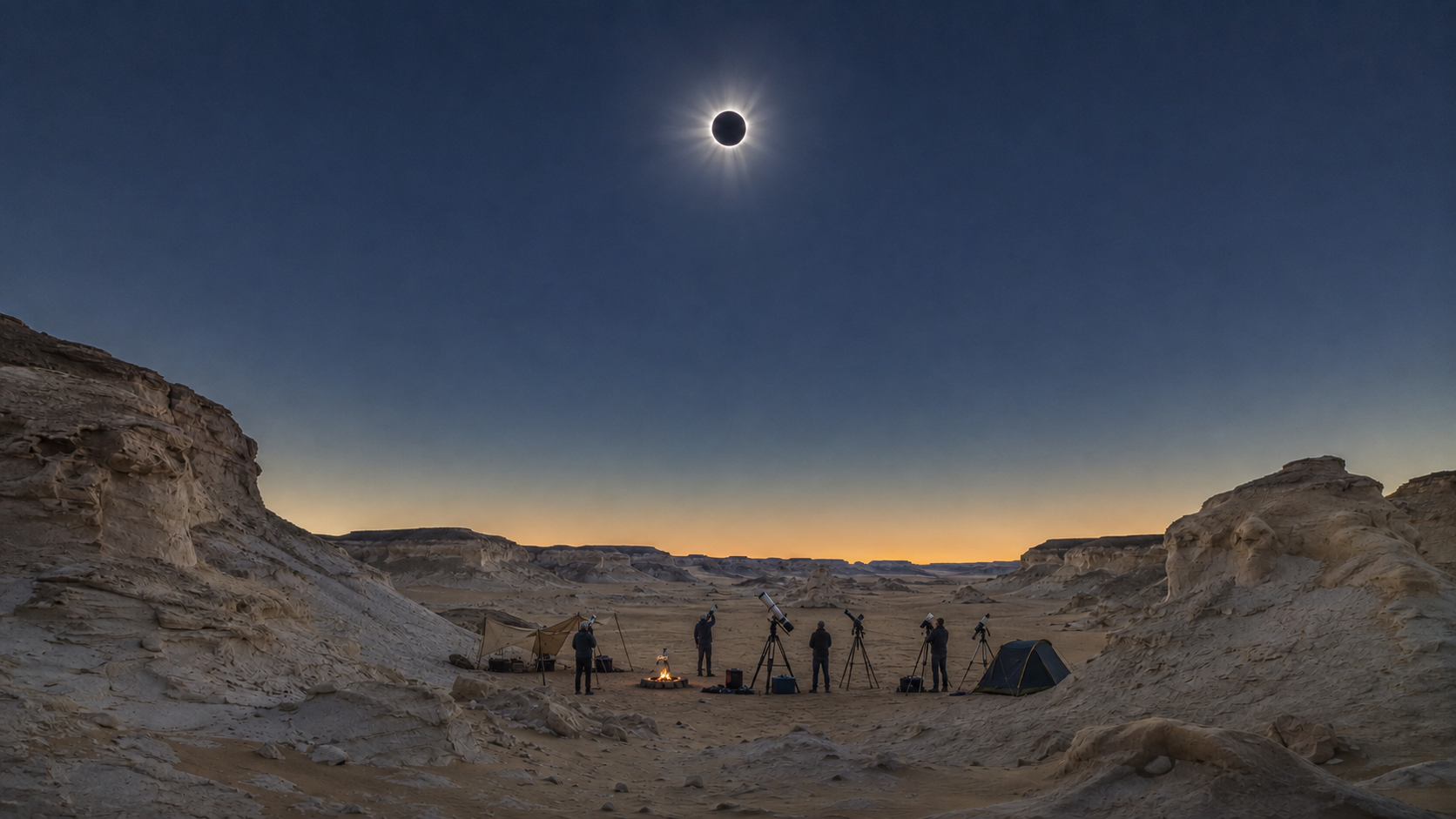
When the Moon completely covers the photosphere, the solar corona becomes visible around the black lunar disk. The sky darkens dramatically. Bright planets and some stars may appear. The horizon may glow in multiple directions because sunlight is still reaching areas outside the Moon’s relatively narrow umbral shadow.
Only during this brief period of complete totality is it safe to look directly at the eclipsed Sun without eclipse glasses. The moment even a tiny part of the bright photosphere reappears, eye protection must go back on immediately. NASA’s full guidance is available in its Eclipse Viewing Safety guide.
The eclipse reverses
After totality, the stages occur in reverse. The bright Sun reappears, the corona vanishes from naked-eye view, daylight strengthens and the partial phase continues until the Moon completely leaves the solar disk.
Why the 2 August 2027 eclipse is so rare
The 2027 eclipse is not simply another total eclipse.
NASA’s catalog gives it a maximum duration of about 6 minutes 23 seconds, making it one of the longest total solar eclipses of the modern era. NASA’s long-eclipse catalog shows the 2027 event is longer than every total solar eclipse between 2009 and 2114 except the 2009 eclipse. The next total eclipse with a longer maximum duration is in 2114, when totality reaches roughly 6 minutes 32 seconds.
The event belongs to Saros 136, the same eclipse family that produced the famous total eclipses of 1991 and 2009. The 1991 eclipse reached 6 minutes 53 seconds, the 2009 eclipse 6 minutes 39 seconds, and the 2027 member reaches about 6 minutes 23 seconds.
The reason the 2027 eclipse becomes so long involves several favorable geometric factors: the Moon is large enough in apparent diameter to cover the Sun substantially, the shadow axis passes relatively close to Earth’s center, and the greatest-duration point occurs where the Sun is very high in the sky.
NASA calculates the eclipse magnitude as 1.0790. In simple terms, the Moon’s apparent diameter will be significantly larger than the Sun’s along the central path, producing a broad and long-lasting umbral shadow.
Where does the 2027 eclipse path cross Egypt?
The path enters Egypt from the west after crossing Libya, then travels across the Western Desert and southern/central parts of the country before moving toward the Red Sea and Arabian Peninsula.
Timeanddate lists the total phase somewhere within Egypt from approximately 12:39 pm to 1:22 pm EEST, while the broader partial eclipse over Egypt begins around 11:19 am and ends around 2:39 pm. These are national path times, not the contact times for one specific city.
NASA’s path is roughly 257–258 km wide near maximum, so the totality corridor covers a substantial band of Egypt. However, the edge is sharp in astronomical terms. Move outside that corridor and totality disappears completely.
This is why eclipse planning must be based on exact coordinates, not simply a governorate, hotel name or the statement that a city is “close” to the path.
2027 solar eclipse times in Egypt by location
The following locations illustrate how dramatically the experience changes across Egypt. Times and durations are based on Timeanddate calculations and should be checked again closer to the event.
Sources: Luxor, Asyut, Siwa Oasis, Marsa Alam, Cairo, Alexandria, Hurghada and Aswan.
Why Aswan’s 99.6% is still not totality
Aswan is a useful example of why percentages can mislead travelers. Timeanddate gives the city a magnitude close to 1.0, yet Aswan is still outside the path of totality. The Sun’s bright photosphere never becomes completely hidden there.
That means no true glasses-off totality phase, no fully revealed corona and no complete transformation into the characteristic total-eclipse twilight.
The same principle applies to Hurghada, Cairo and Alexandria. A deep partial eclipse can be impressive, but it is not a substitute for totality.
Luxor: the famous near-maximum eclipse destination
Luxor will be one of the most internationally discussed locations for the 2027 eclipse, and for good reason.
Timeanddate calculates about 6 minutes 22 seconds of totality in Luxor, with maximum eclipse near 1:05 pm local time. The city lies very close to the longest-duration region and combines the eclipse with one of the world’s greatest concentrations of ancient monuments.
The appeal is obvious: Karnak, Luxor Temple, the West Bank and the wider Theban landscape provide an extraordinary cultural context.
But eclipse travelers should distinguish between the astronomical strength of Luxor and the operational experience of viewing there. Luxor is already a major tourism center. Demand for hotels, transport and organized viewing areas is unusually high for 2027. A city site may therefore be ideal for travelers who want hotels, monuments and near-maximum duration, but less attractive to people prioritizing solitude, large equipment zones or a controlled low-density viewing camp.
Historical cloud statistics are excellent. Timeanddate reports 0% cloud occurrence on 2 August in its Luxor historical dataset since 2000. Eclipsophile also describes Egypt and Libya as having exceptionally favorable summer cloud climatology, while noting occasional transparent cirrus and dust as remaining considerations.
Asyut: more than six minutes of totality
Asyut is another strong Egyptian eclipse location that receives less international attention than Luxor.
Timeanddate calculates about 6 minutes 7 seconds of totality, with maximum eclipse near 1:00 pm. Like Luxor, its historical 2 August cloud figure is listed as 0% in Timeanddate’s dataset since 2000.
For travelers comparing purely astronomical duration, Asyut is therefore a serious option. It does not provide the same iconic tourism package as Luxor, but it demonstrates how broad the high-duration zone is inside Egypt.
Siwa Oasis: long totality and desert climatology
Siwa Oasis will experience approximately 5 minutes 33 seconds of totality, with maximum eclipse near 12:45 pm.
That is shorter than Luxor but still exceptionally long by total-eclipse standards. Siwa also sits in the Western Desert, where cloud climatology is extremely favorable.
Eclipsophile’s 2027 analysis specifically identifies Siwa Oasis and Bahariya Oasis as among the strongest candidates from a cloud-and-dust perspective, stating that these desert locations show almost no historical prospect of cloud and appear relatively resistant to major dust events compared with some other parts of the path.
Siwa’s challenge is logistics. It is far from Cairo and requires longer road travel or more complex routing than many Nile Valley destinations.
Marsa Alam and the Red Sea
Marsa Alam is inside totality and receives approximately 5 minutes 28 seconds, with maximum eclipse near 1:10 pm.
This makes the southern Red Sea coast a genuine total-eclipse alternative. Travelers can combine the event with resorts, diving and marine tourism.
By contrast, Hurghada is outside totality. Its eclipse magnitude is about 0.980, meaning the event will be extremely deep but still partial.
This distinction is important when marketing “Red Sea eclipse” trips. Marsa Alam and points farther south can deliver totality; Hurghada itself cannot.
Cairo and Alexandria: partial eclipse only
Cairo will see a deep partial eclipse with maximum around 12:56 pm and a magnitude of about 0.946. Alexandria will also see a partial eclipse, with maximum around 12:51 pm and magnitude around 0.934.
Both cities will experience a striking reduction in sunlight, but neither will enter totality.
Travelers staying in Cairo or Alexandria who want the full event must travel into the totality corridor before eclipse day. This should not be treated as a casual same-day decision. Eclipse-day traffic, limited accommodation and the need for a verified viewing location make advance planning far safer than trying to relocate at the last minute.
Egypt’s Western Desert: why eclipse chasers are paying attention
The Western Desert offers a different type of eclipse experience from Luxor or the Red Sea.
Its strongest advantages are environmental and operational:
- extremely low historical cloud frequency in August;
- broad open landscapes with minimal urban obstruction;
- large areas suitable for tripods and observing equipment;
- fewer city-light and building distractions;
- the possibility of arriving before eclipse day and staying at the viewing base;
- locally organized 4×4 access through Bahariya Oasis;
- a landscape that remains part of the experience before and after totality.
Eclipsophile’s climatology is particularly important. Its satellite analysis says parts of Libya and western Egypt have shown almost no August cloud in the historical datasets examined. It describes cloud over Egypt as nearly absent in summer until farther east near Luxor, while identifying heat and occasional dust as the more important practical challenges.
For broader desert context, read Elzaghandi Travel’s White Desert Egypt Travel Guide and Bahariya Oasis Egypt Travel Guide.
The candidate eclipse camp: Wadi Agabat in the White Desert
The current candidate area being evaluated by Elzaghandi Group for the eclipse camp is Wadi Agabat, also called Agabat Valley or El Aqabat, within the wider White Desert journey.
Agabat is known for pale cliffs, dramatic desert forms, broad sand corridors and long sightlines. On ordinary White Desert routes, it sits within the journey from Bahariya toward Crystal Mountain and the deeper White Desert landscapes.
A commonly mapped Agabat Valley reference point near 27.47°N, 28.44°E falls inside NASA’s published totality corridor when compared with the north and south path limits at similar longitudes. That supports Wadi Agabat as a valid totality candidate.
However, the camp must be treated as an exact-coordinate astronomical site, not simply as a named valley.
The final GPS coordinate will determine:
- first contact (C1);
- second contact and start of totality (C2);
- maximum eclipse;
- third contact and end of totality (C3);
- fourth contact (C4);
- exact totality duration;
- solar altitude and azimuth;
- distance from the centerline.
Until the final coordinate is fixed and verified, the camp should not be advertised as receiving Egypt’s maximum 6m23.2s simply because it lies inside the path.
For the landscape itself, read the Agabat Valley Egypt Travel Guide. For the current event setup, see the White Desert Eclipse Camp.
Why choose a White Desert eclipse camp instead of a city?
The answer depends on what kind of eclipse traveler you are.
A city provides conventional hotels, paved access, hospitals, restaurants and easier public infrastructure. A managed desert eclipse camp can provide something else: control over the immediate viewing environment.
That matters because a successful eclipse trip is not only about standing inside the path. It is also about what happens during the hours before totality.
A purpose-built camp can potentially offer:
- a dedicated observing area;
- controlled guest capacity;
- shade and cooling;
- toilets;
- drinking water and cold drinks;
- charging points;
- Wi-Fi or communications support;
- equipment setup space;
- food prepared on site;
- overnight accommodation near the viewing area;
- separation between general guests and serious observers.
Solar Eclipse Tours currently plans a maximum camp capacity of 100 guests and describes the 2027 setup as climate controlled, with air-conditioned sleeping tents, seating areas and dedicated eclipse-viewing areas, plus toilets, charging, internet, meals and drinking water. These are planned event facilities and should be reconfirmed in the final operational plan. See the camp details.
How do you reach the White Desert eclipse camp?
The normal route begins in Cairo or Giza and travels by road to Bahariya Oasis.
Solar Eclipse Tours currently describes the transfer as around four hours, depending on pickup location, traffic, stops and operating conditions. In Bahariya, travelers change to locally operated 4×4 vehicles for the off-road desert journey.
This two-stage transport model is already used for regular White Desert operations:
- Cairo/Giza → Bahariya Oasis: paved-road transfer.
- Bahariya → White Desert / Agabat region: 4×4 desert transport.
Travelers should not assume a normal rental car can replace the desert stage. Remote access, route knowledge, protected-area requirements and operational permissions make a local desert team essential for this type of trip.
For the existing route, read How to Get to Bahariya Oasis from Cairo.
Who is operating the White Desert eclipse experience?
Solar Eclipse Tours is operated by Elzaghandi Group, based in Bahariya Oasis. The group says its guides, drivers and trip supervisors come from the region and that it has seven years of experience hosting journeys across Bahariya and the White Desert.
The eclipse project is designed around the same local operating area rather than importing a temporary team unfamiliar with the route.
The current plan includes Cairo airport or hotel pickup, Bahariya accommodation according to the selected package, local 4×4 transfers and the purpose-built eclipse camp.
Read more about the operating team on About Elzaghandi Group.
Weather prospects for the 2027 eclipse in Egypt
No location can guarantee clear sky more than a year in advance, but climatology is one of Egypt’s strongest arguments.
Eclipsophile’s analysis of satellite data finds exceptionally low August cloud across Libya and western Egypt. It notes that some parts of the track in Libya and western Egypt have shown no August cloud in the historical eclipse-day datasets examined.
Timeanddate’s city-level historical data also reports 0% cloud occurrence on 2 August since 2000 for Luxor, Asyut and Siwa Oasis.
These numbers are historical climatology, not a forecast.
The real forecast will become useful only much closer to eclipse day. Timeanddate states that actual weather forecasts are available within roughly two weeks of the event.
Cloud is not the only atmospheric risk
In Egypt, observers also need to think about:
- airborne dust;
- haze;
- strong wind;
- local sand movement;
- heat shimmer;
- transparent cirrus;
- extreme temperature stress on people and equipment.
Eclipsophile notes that dust is only an occasional major problem in much of the Egyptian path but can affect contrast, especially for deep-corona photography.
The biggest practical challenge: extreme heat
The 2027 eclipse crosses Egypt near midday in early August.
That means heat planning is not optional.
Eclipsophile reports that afternoon temperatures in Egypt can reach the mid-40s Celsius and occasionally approach 50°C. For Luxor, its historical analysis gives an average high of about 42°C on 2 August over the studied years, with a maximum of 46°C.
The risk affects both humans and equipment.
For travelers
A serious viewing site should provide or plan for:
- shade;
- climate-controlled rest areas where possible;
- continuous drinking water;
- electrolytes;
- hats and sun-protective clothing;
- sunscreen;
- reduced unnecessary exposure before totality;
- a buddy system for heat monitoring;
- first-aid capability;
- special planning for children, older travelers and people who need extra protection from heat.
For cameras and electronics
Cameras can overheat when exposed to direct August sun for long periods. Video is especially demanding.
Practical preparation includes:
- keeping equipment shaded until needed;
- using light-colored covers;
- carrying spare batteries out of direct heat;
- avoiding unnecessary live-view or continuous recording before totality;
- testing the full setup in hot conditions before the trip;
- having backup equipment for critical imaging.
The drop in solar radiation as totality approaches will cool the environment, but observers must remain protected during the hours before and after the main event.
How to view the eclipse safely
NASA’s safety guidance is straightforward: during every partial phase, use proper solar-viewing protection. The only exception is the brief period of complete totality, when the Moon fully covers the Sun’s bright face.
Safe eclipse glasses or handheld viewers should comply with the ISO 12312-2 international standard. Ordinary sunglasses are not safe for direct solar viewing, regardless of how dark they appear.
Cameras, binoculars and telescopes
Optical equipment creates an additional hazard because it concentrates sunlight.
Do not look through a camera, telescope or binoculars while relying only on eclipse glasses. The optical device itself needs a special solar filter secured over the Sun-facing end. A filter placed only at the eyepiece is not an acceptable substitute for a properly designed front-mounted filter.
When can the glasses come off?
Only after full totality has begun and no part of the bright solar photosphere remains visible.
As soon as the bright Sun begins to reappear after totality, put the glasses back on immediately.
If you are watching from Cairo, Alexandria, Hurghada, Aswan or any other location outside the path of totality, there is no safe glasses-off phase at all.
Read the complete official guidance at NASA Eclipse Viewing Safety.
What will you see during totality?
The experience of totality is much richer than a simple darkening of the Sun.
The solar corona
The corona is the Sun’s outer atmosphere. It is normally overwhelmed by the brightness of the photosphere, but during totality it becomes visible as a luminous structure surrounding the black silhouette of the Moon.
Its shape changes with solar magnetic activity. Long streamers, loops and asymmetries may become visible depending on the state of the Sun in August 2027.
Prominences
Bright red or pink structures may be visible along the edge of the eclipsed Sun. These are prominences—huge structures of solar plasma suspended by magnetic fields.
Baily’s beads
Immediately before and after totality, tiny points of sunlight can shine through valleys along the irregular lunar limb, creating a chain of brilliant points.
The diamond ring
The final bright bead before totality—or the first bright point after it—can appear beside the corona like a diamond attached to a ring.
Shadow bands
In the seconds around totality, some observers see faint, rapidly moving bands of light and dark across pale surfaces. These are known as shadow bands and are influenced by atmospheric turbulence.
A 360-degree twilight
The observer is inside the Moon’s narrow shadow, while areas beyond the shadow remain sunlit. The horizon can therefore develop sunset-like colors in many directions at once.
Bright planets and stars
Depending on sky transparency and the positions of the planets, bright objects may become visible during the daytime darkness.
Why totality is fundamentally different from 99%
This is one of the most important facts for first-time eclipse travelers.
At 99% coverage, the remaining sliver of the Sun is still intensely bright. The photosphere is still visible. The corona does not appear in the same way, and solar eye protection remains necessary.
At 100% totality, the bright solar surface is completely hidden.
That final step produces the full corona, the glasses-off interval and the dramatic transformation of the surrounding landscape.
For that reason, a location with a 0.996 magnitude partial eclipse is still not a total-eclipse location. Aswan is a good example: its eclipse is extremely deep, but Timeanddate still classifies the event there as partial.
If experiencing a total solar eclipse is your goal, standing inside the path of totality is the defining requirement.
Best places in Egypt for the 2027 total solar eclipse
There is no single location that is best for every traveler. The strongest choice depends on duration, weather, infrastructure, landscape and the type of experience you want.
Luxor — best for near-maximum duration and ancient Egypt
Choose Luxor if you prioritize:
- about 6 minutes 22 seconds of totality;
- major archaeological sites;
- established hotel infrastructure;
- Nile Valley sightseeing;
- conventional tourism services.
Luxor is one of the strongest astronomical and cultural combinations anywhere on the 2027 path.
Siwa Oasis — best for long totality in an oasis setting
Choose Siwa if you prioritize:
- about 5 minutes 33 seconds of totality;
- Western Desert atmosphere;
- oasis scenery;
- exceptionally favorable cloud climatology;
- a more remote experience than Luxor.
Marsa Alam — best for a Red Sea totality trip
Choose Marsa Alam if you want:
- about 5 minutes 28 seconds of totality;
- resort accommodation;
- diving or marine activities before or after the eclipse;
- a coastal rather than desert-camp experience.
Wadi Agabat / White Desert — best for a controlled desert eclipse base
A verified Wadi Agabat camp is especially attractive for travelers who prioritize:
- open desert horizons;
- a purpose-built observing base;
- controlled event capacity;
- 4×4 desert access;
- low local density;
- strong historical cloud climatology;
- a full White Desert journey around the eclipse.
The separate comparison guide, Best Place to See the 2027 Total Solar Eclipse: Wadi Agabat vs Luxor, Tunisia & Spain, should be linked from this section once its final public URL is confirmed.
How many days should you allow for an Egypt eclipse trip?
Do not plan a once-in-a-lifetime eclipse around a same-day arrival.
A delayed flight, road closure, traffic problem or missed transfer can destroy the entire purpose of the trip. Arrive at your viewing base well before eclipse day.
For a White Desert event, a practical itinerary can include:
- Cairo and Giza;
- Bahariya Oasis;
- the Black Desert;
- Crystal Mountain;
- Wadi Agabat;
- White Desert formations;
- one or more nights in the desert or a serviced camp.
Serious photographers and scientific teams may want several days of access before 2 August to assemble, test and troubleshoot equipment.
Elzaghandi Travel’s normal 2-Day White Desert Adventure and 3-Day White Desert Adventure show how the standard route works outside the eclipse event. The dedicated 2027 programs are structured separately around eclipse-day logistics.
What to pack for the 2027 eclipse in Egypt
Your packing list has two layers: normal Egypt/desert travel and specialized eclipse equipment.
Personal essentials
- passport and travel documents;
- travel-insurance details;
- personal medication;
- high-SPF sunscreen;
- sun hat;
- breathable, loose clothing;
- closed shoes;
- sunglasses for normal use away from direct solar viewing;
- reusable water bottle;
- electrolytes;
- scarf or buff for dust;
- power bank;
- personal hygiene items;
- basic first-aid items appropriate to your needs.
Eclipse essentials
- reputable ISO-compliant eclipse glasses;
- spare eclipse glasses;
- safe handheld solar viewer if desired;
- proper solar filters for cameras or telescopes;
- tripod;
- spare batteries;
- memory cards;
- cable release or intervalometer;
- lens cloth and dust-cleaning supplies;
- light-colored cover for equipment;
- a written exposure sequence if you are photographing totality.
For a wider desert checklist, read What to Pack for the White Desert Egypt.
Photography planning for the 2027 eclipse
The biggest photography mistake is trying to learn your camera during totality.
Practice the complete sequence before you travel.
During the partial phases
Keep the proper solar filter on the front of the lens. Exposure depends on the filter, aperture, shutter speed and ISO. Test your exact equipment in advance rather than relying on generic settings copied from another photographer.
During totality
Remove the solar filter only after full totality has begun.
The corona spans a wide brightness range, so experienced eclipse photographers often bracket exposures to capture the bright inner corona and fainter outer structure.
Egypt’s long totality is a major photographic advantage. Around six minutes gives substantially more time to execute a planned sequence, recover from mistakes and still stop touching the camera long enough to experience the eclipse directly.
Heat and dust protection
Keep cameras shaded before totality. Avoid changing lenses in blowing dust unless necessary. Carry cleaning tools and backups.
Professional or scientific teams should confirm power, equipment security, table space, internet and advance site access before selecting a package.
Families and children
A total eclipse can be unforgettable for children, but adults must supervise solar viewing continuously during the partial phases.
Families should think about:
- whether the child can follow eye-safety instructions;
- tolerance for intense heat;
- long road transfers;
- food preferences and allergies;
- medication;
- toilets;
- sleeping arrangements;
- whether a remote camp or city hotel better fits the family.
A serviced camp can make remote travel more comfortable, but August desert conditions still require serious heat planning.
Accessibility and mobility
Remote desert travel is not the same as staying in an urban hotel.
Before booking, travelers with mobility requirements should ask specifically about:
- vehicle entry height;
- distance from vehicle to sleeping and viewing areas;
- sand firmness and ground surface;
- accessible toilet arrangements;
- seating;
- shade and cooling;
- medication refrigeration if required;
- emergency transport options.
Do not assume that the phrase “camp facilities” automatically means fully accessible infrastructure. Discuss individual requirements in writing before payment.
Travel planning and demand for 2027
The eclipse is already attracting international astronomy groups, tour operators and independent travelers.
Luxor has received particular attention because of its near-maximum duration and iconic archaeological setting. Other totality locations will also see increasing demand as the event approaches.
Secure the core elements early:
- flight strategy;
- accommodation or camp;
- verified totality viewing site;
- ground transport;
- eclipse glasses;
- travel insurance;
- heat and medical planning;
- clear cancellation terms.
Do not pay a premium only because a package uses the words “eclipse tour.” Ask what is operationally different from a normal Egypt itinerary.
Questions to ask any 2027 eclipse tour operator
Before booking, ask:
- What are the exact eclipse-day viewing coordinates?
- Is the site verified inside the path of totality?
- What is the calculated duration of totality at those coordinates?
- What are the C1, C2, maximum, C3 and C4 times?
- When can guests access the viewing site?
- Can photographers or scientific teams set up equipment before eclipse morning?
- What happens if the operating site must change?
- What shade and cooling are provided?
- How much drinking water is available?
- What toilet facilities are provided?
- Is power available for cameras or scientific equipment?
- Is Wi-Fi or another communication option available?
- Is there a medical and emergency-response plan?
- How are guests transported to and from the site?
- What is the maximum group size?
- Are eclipse glasses included, and what standard do they meet?
- What happens to the itinerary if weather or access conditions change?
- What cancellation and refund rules apply?
A serious eclipse operator should be comfortable answering these questions clearly and in writing.
Solar Eclipse Tours and Elzaghandi Group
Solar Eclipse Tours is operated by Elzaghandi Group in Bahariya Oasis. The project is focused on a locally operated Western Desert eclipse experience rather than reproducing a hotel-based Luxor itinerary.
The current concept is a journey from Cairo to Bahariya, followed by local 4×4 transport to a purpose-built camp inside the path of totality.
The event plan currently describes:
- air-conditioned sleeping tents;
- climate-controlled seating and viewing areas;
- toilets and washing facilities;
- charging and power access;
- internet connectivity;
- meals and drinking water;
- cold drinks;
- a maximum capacity of 100 guests.
Because this is a future event, final facilities, exact camp coordinates and operating arrangements should be reconfirmed before booking and again before travel.
Read About Elzaghandi Group, compare the 2027 Eclipse Tours & Packages and use Check Availability to discuss dates, accommodation and equipment requirements.
Related eclipse and Western Desert guides: Compare viewing destinations in the best place to see the 2027 total solar eclipse, and explore the surrounding desert with the Agabat Valley guide and White Desert travel guide.
Frequently asked questions about the 2027 total solar eclipse in Egypt
When is the 2027 total solar eclipse in Egypt?
The eclipse takes place on Monday, 2 August 2027.
Will Egypt see a total solar eclipse in 2027?
Yes. A broad corridor through Egypt lies inside the path of totality. Other parts of the country will experience only a partial eclipse.
How long will totality last in Egypt?
The maximum duration reaches approximately 6 minutes 23.2 seconds at the point of greatest duration. The duration is shorter at locations away from that point and the centerline.
Where is the longest totality in Egypt?
NASA places the point of greatest duration near 26°49′N, 31°08′E, where totality is calculated at roughly 6m23.2s. This is different from the point of greatest eclipse, which is a separate astronomical quantity.
What is the eclipse magnitude in 2027?
NASA gives a maximum eclipse magnitude of 1.0790 for the 2 August 2027 total solar eclipse.
What Saros series is the 2027 eclipse part of?
It belongs to Saros 136.
How long will totality last in Luxor?
Timeanddate calculates approximately 6 minutes 22 seconds of totality in Luxor, with maximum eclipse near 1:05 pm local time.
How long will totality last in Asyut?
Approximately 6 minutes 7 seconds, with maximum eclipse around 1:00 pm.
How long will totality last in Siwa Oasis?
Approximately 5 minutes 33 seconds, with maximum eclipse around 12:45 pm.
How long will totality last in Marsa Alam?
Approximately 5 minutes 28 seconds, with maximum eclipse around 1:10 pm.
Is Cairo inside the path of totality?
No. Cairo will see a partial eclipse, with maximum around 12:56 pm and magnitude about 0.946.
Is Alexandria inside the path of totality?
No. Alexandria will experience a partial eclipse rather than totality.
Is Hurghada inside the path of totality?
No. Hurghada will see a very deep partial eclipse, with magnitude around 0.980, but the Sun will not be completely covered.
Is Marsa Alam inside the path of totality?
Yes. Marsa Alam is inside the totality corridor.
Is Aswan inside the path of totality?
No. Timeanddate calculates a partial eclipse in Aswan with magnitude around 0.996. That is extremely close to 1.0, but it is still not totality.
Is Wadi Agabat inside the 2027 path of totality?
The commonly mapped Wadi Agabat reference area falls inside NASA’s published totality corridor and is therefore a valid candidate region. The exact circumstances for the Solar Eclipse Tours camp depend on the final GPS coordinate.
Will the Wadi Agabat camp receive 6 minutes 23 seconds of totality?
That should not be claimed until the final camp coordinate is confirmed. The 6m23.2s figure is the maximum duration at the point of greatest duration, not a universal duration across Egypt.
What will be the exact eclipse times at the White Desert camp?
The exact C1, C2, maximum, C3 and C4 times should be calculated and published after the final camp GPS coordinate is fixed.
What is the best place in Egypt to watch the 2027 eclipse?
There is no single best place for everyone. Luxor is exceptionally strong for maximum duration and archaeology. Siwa offers long totality and oasis scenery. Marsa Alam offers a Red Sea experience. A verified Wadi Agabat or White Desert site is attractive for open horizons, low-density surroundings, desert climatology and a controlled camp environment.
Why choose the White Desert instead of Luxor?
Choose the White Desert if the environment and operating style matter more than maximizing every second of totality. A desert camp can offer open space, controlled capacity, equipment setup and the ability to stay close to the viewing site. Luxor remains stronger for near-maximum duration, hotels and ancient monuments.
Will Egypt be cloudy on eclipse day?
No one can guarantee the weather. Historical August climatology is exceptionally favorable, especially across western Egypt, but cloud, cirrus, dust and haze are still possible.
What is the biggest weather risk in western Egypt?
Cloud is historically rare. Heat and occasional dust or haze are more important operational concerns.
How hot could it be during the eclipse?
Very hot. Eclipsophile notes that afternoon temperatures along the Egyptian path can reach the mid-40s Celsius and may occasionally approach 50°C. Heat protection must be part of the event plan.
Can I look at the eclipse without glasses?
Only during full totality, when the Moon completely covers the Sun’s bright surface. During all partial phases, proper solar viewing protection is required.
Are normal sunglasses safe for an eclipse?
No. NASA states that ordinary sunglasses are not safe for direct solar viewing.
What standard should eclipse glasses meet?
NASA says safe solar viewers should comply with the ISO 12312-2 international standard.
Can I use eclipse glasses with binoculars or a telescope?
Do not use eclipse glasses as a substitute for an optical solar filter. Cameras, binoculars and telescopes need a proper solar filter secured over the front of the optics.
Can I photograph totality without a solar filter?
During full totality, when the bright photosphere is completely covered, the front solar filter can be removed for corona photography. It must be replaced before the bright Sun reappears.
Should I arrive in Egypt on eclipse day?
No. Arrive well in advance. Flights, road delays and traffic should not determine whether you reach the path of totality in time.
Can I drive myself into the White Desert?
A remote White Desert eclipse camp should be treated as an organized desert operation using local 4×4 vehicles, current access procedures and experienced drivers—not as an unsupported rental-car excursion.
How many days should I spend in Egypt for the eclipse?
At minimum, allow enough time to reach your viewing base well before eclipse day. A week or longer gives more flexibility to combine the eclipse with Cairo, Bahariya, the White Desert, Luxor or other destinations without rushing.
Is the White Desert camp suitable for astrophotographers?
It can be, provided the final setup offers adequate space, power, shade, equipment security and advance access. Serious photographers should confirm these details before booking.
Can scientific teams arrive several days before the eclipse?
This should be arranged directly with the operator. Scientific teams often need advance access for instrument assembly, testing, alignment, power and communications.
Where can I book a White Desert eclipse trip?
Review the current 2027 Eclipse Tours & Packages or submit your requirements through Check Availability.
Final planning advice
The 2027 total solar eclipse in Egypt combines three extraordinary advantages: one of the longest totalities of the century, a high midday Sun and some of the most favorable historical cloud climatology on the entire eclipse path.
But those advantages do not remove the need for careful planning.
Verify that your exact location is inside totality. Check the viewing coordinates. Plan for extreme heat. Use correct eye protection. Arrive early. Understand how you will reach the site and what happens if operational conditions change.
Luxor will deservedly receive enormous attention for approximately 6m22s of totality and its ancient monuments. Siwa and Marsa Alam offer strong alternatives. Egypt’s Western Desert offers another type of experience: broad horizons, extremely dry climatology and the possibility of staying at a managed viewing base away from dense urban activity.
For Solar Eclipse Tours, the current plan is to develop that experience around a verified Wadi Agabat / White Desert site, using the local Bahariya operating team and purpose-built eclipse infrastructure.
Once the final camp GPS coordinate is confirmed, this guide should be updated with:
- exact latitude and longitude;
- C1 time;
- C2 / start of totality;
- maximum eclipse time;
- C3 / end of totality;
- C4 time;
- exact totality duration;
- solar altitude and azimuth;
- distance from the centerline.
Until then, the most accurate promise is also the most important one:
Choose an exact verified location inside the path of totality and prepare for 2 August 2027 as the astronomical event it is.
Authoritative sources and further reading
- NASA GSFC — Total Solar Eclipse of 2027 Aug 02
- NASA GSFC — Besselian Elements
- NASA GSFC — 2027 Eclipse Path Table
- NASA Science — Eclipse Viewing Safety
- Timeanddate — 2 August 2027 Eclipse in Egypt
- Timeanddate — Luxor
- Timeanddate — Siwa Oasis
- Timeanddate — Aswan
- Eclipsophile — Total Solar Eclipse 2027 August 2: Weather and Climatology
Continue planning your 2027 eclipse journey
Compare the 2027 Eclipse Tours & Packages, review the White Desert Eclipse Camp or contact the local team to discuss your dates, accommodation preferences, equipment requirements and travel plan.

Things to Do in Cairo Egypt: 15 Best Attractions & Experiences

Cairo Egypt Travel Guide: Itinerary, Attractions & Practical Tips
Dahshur Pyramids Guide: Bent Pyramid, Red Pyramid & Visiting Tips
Recent Posts

Things to Do in Cairo Egypt: 15 Best Attractions & Experiences

Cairo Egypt Travel Guide: Itinerary, Attractions & Practical Tips
Dahshur Pyramids Guide: Bent Pyramid, Red Pyramid & Visiting Tips