

Last reviewed: 19 November 2026
Egypt’s Western Desert covers roughly two thirds of the country, stretching from the Nile Valley to the Libyan border and from the Mediterranean coast down to Sudan. It is part of the Sahara, the largest hot desert in the world, and it holds some of Egypt’s most memorable landscapes: chalk towers, black volcanic hills, endless dune seas and green oases fed by underground water. This guide explains what the Western Desert is, which places are worth visiting, how the routes connect, and how to plan a trip that fits your time and budget.
Where is the Western Desert of Egypt?
The Western Desert lies west of the Nile and covers around 680,000 square kilometres. Geographers often call it the Libyan Desert, because it continues across the border into Libya, and it forms the north-eastern corner of the Sahara. On a map it looks empty, but it is broken by a chain of depressions where water rises close to the surface. Those depressions became the oases, and the oases became towns, farms and caravan stops that have been inhabited for thousands of years.
Five large oases form a rough curve through the desert: Siwa in the far north-west, then Bahariya, Farafra, Dakhla and Kharga running south. Fayoum, close to Cairo, is sometimes added as a sixth because it is also a depression in the desert, although its water comes from the Nile rather than from deep aquifers.
Is the Sahara Desert in Egypt?
Yes. Both the Western Desert and the Eastern Desert are part of the Sahara, although travellers usually mean the Western Desert when they talk about the Egyptian Sahara. The Eastern Desert, between the Nile and the Red Sea, is mountainous and rocky. The Western Desert is flatter and more varied, with plateaus, depressions, dune fields and sculpted rock. If your picture of the Sahara includes sand dunes, white rock pillars and camping under a sky full of stars, the Western Desert is where you will find it in Egypt.
The deserts inside the desert
One reason the Western Desert is so rewarding is that it is not one landscape but many. Within a few hours of driving you can pass through several completely different deserts.
The White Desert
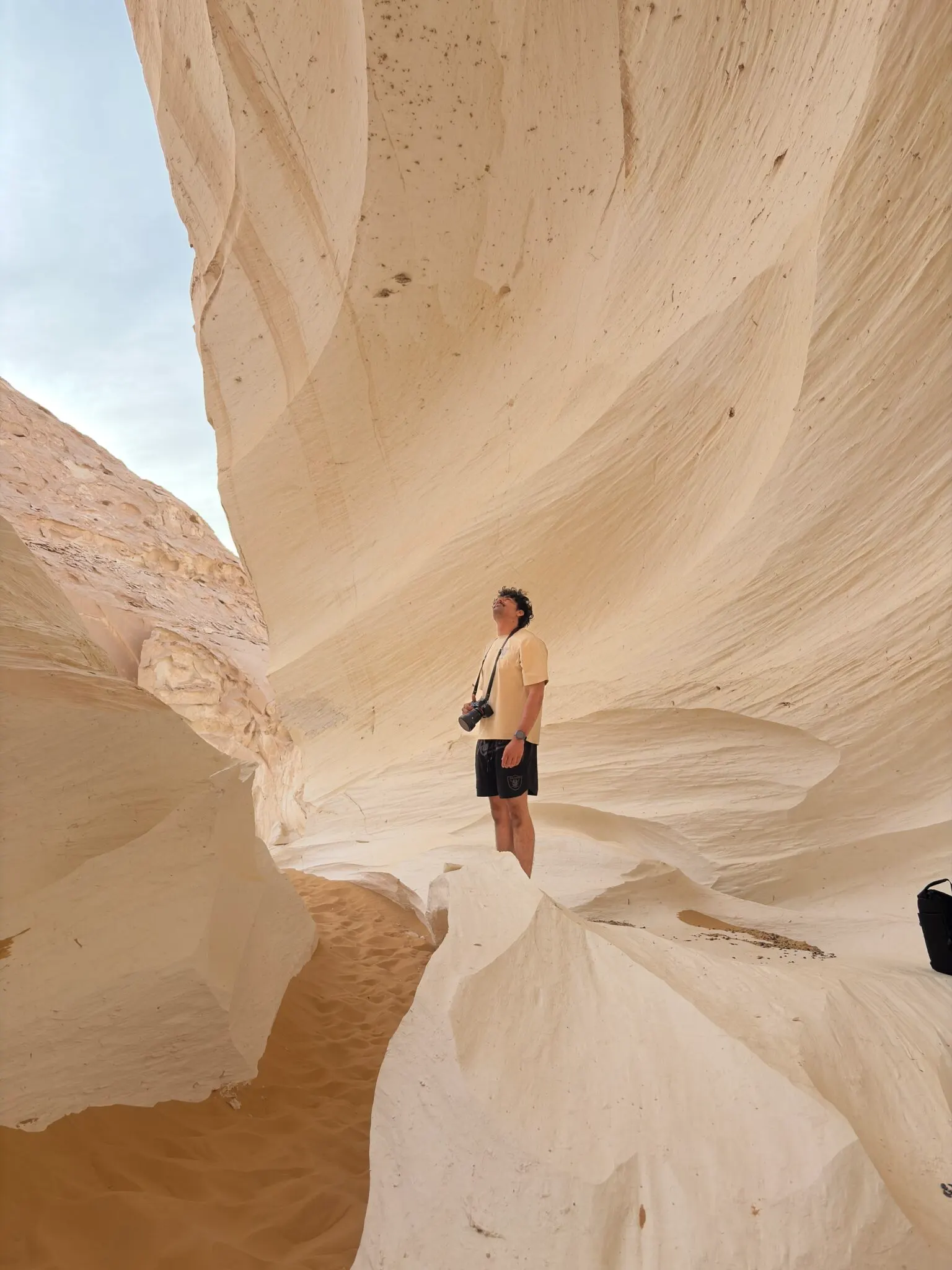
The White Desert is the most famous. Wind has carved the chalk plateau north of Farafra into towers, mushrooms and pillars that glow white at noon and pink at sunset. It was declared a protected area in 2002 and is the most popular place in Egypt for desert camping.
The Black Desert
North of the White Desert, the Black Desert is a field of orange sand covered with hills capped in dark volcanic and iron-rich stone. It is usually the first stop on the road south from Bahariya and a good place for a short climb with wide views.
Crystal Mountain and Agabat Valley
Between the two, the Crystal Mountain is a small ridge full of quartz and calcite crystals, and Agabat Valley is a dramatic basin of dunes and limestone cliffs. Most tours stop at both on the way to camp.
The Great Sand Sea
West of Siwa and Farafra, the Great Sand Sea is one of the largest dune fields on Earth, with long parallel dunes that can rise more than 100 metres. Trips from Siwa use 4×4 vehicles to reach hot and cold springs among the dunes and to watch sunset from the crests.
The Gilf Kebir and the far south-west
In the far corner near the Libyan and Sudanese borders lies the Gilf Kebir plateau, home to prehistoric rock art such as the Cave of Swimmers. It is remote, requires permits and expedition logistics, and is visited by very few travellers each year.
The oases of the Western Desert
Each oasis has its own character, history and way of life. Choosing which ones to visit is the key decision when planning a trip.
Bahariya Oasis
Bahariya is the closest of the big oases to Cairo, about 370 km to the south-west. Its town, Bawiti, sits among palm groves and natural springs, and it is the usual base for the Black Desert, Crystal Mountain and White Desert. The Valley of the Golden Mummies, the hot springs and the salt lake sunset make it worth a night on its own.
Farafra Oasis
Farafra is the smallest and quietest oasis, sitting at the southern edge of the White Desert. Few travellers stay in the town, but the White Desert National Park lies in its wider depression.
Dakhla Oasis
Dakhla is known for the medieval mud-brick village of Al-Qasr, Roman temples and painted tombs, and wide farmland framed by pink cliffs.
Kharga Oasis
Kharga is the largest oasis and the capital of the New Valley Governorate. The Temple of Hibis and the early Christian necropolis of Bagawat are its highlights, and the road east connects it to Luxor.
Siwa Oasis
Siwa stands apart in the north-west, close to the Libyan border. Its Amazigh culture, salt lakes, the ruined mud-brick fortress of Shali and the Oracle Temple of Amun make it one of the most distinctive places in Egypt.
Fayoum
Fayoum is the easiest oasis to visit from Cairo, about 100 km away. Lake Qarun, the waterfalls of Wadi El Rayan and the fossil whales of Wadi Al Hitan, a UNESCO World Heritage Site, make it a strong day trip or overnight.
How the routes connect
The desert roads form a loop that travellers often call the Western Desert circuit. From Cairo the road runs south-west to Bahariya, then south through the Black Desert and White Desert to Farafra, on to Dakhla and Kharga, and finally east to Luxor in the Nile Valley. Siwa is reached separately, usually from Cairo via the Mediterranean coast at Marsa Matruh, although a desert track links it to Bahariya with the right permits.
Approximate road distances help with planning:
- Cairo to Bahariya: about 370 km, roughly 4 to 5 hours
- Bahariya to the White Desert camping areas: about 1.5 to 2 hours with stops
- Bahariya to Farafra: about 180 km
- Farafra to Dakhla: about 300 km
- Dakhla to Kharga: about 190 km
- Kharga to Luxor: about 4 hours by road
- Cairo to Siwa: about 9 to 10 hours via Marsa Matruh
Travel times vary with checkpoints, stops and road works, so it is wise to treat these figures as a guide rather than a schedule.
How many days do you need?
The answer depends on how far you want to go.
- 1 day: a long White Desert day trip from Cairo reaches the northern formations and returns late at night, or a Fayoum day trip gives an easier first taste of the desert.
- 2 days: the classic 2-day White Desert tour with one night camping is the most popular choice.
- 3 days: adds a night in Bahariya or a visit to Djara Cave, and a slower pace in the desert.
- 4 to 6 days: lets you continue south through Farafra, Dakhla and Kharga, or combine Siwa with the White Desert.
If you have a week in Egypt and want one desert experience, two or three days is the sweet spot. If the desert is the main reason for your trip, the full loop to Luxor shows the variety of the Western Desert in a way a short trip cannot.
Best time to visit the Western Desert
The desert season runs from October to April. Days are warm and clear, and nights are cool to cold, especially from December to February, when temperatures in the White Desert can drop close to freezing. Spring and autumn are the most comfortable. From May to September daytime heat regularly passes 40°C, and while trips are still possible with early starts and long midday breaks, most travellers will enjoy the cooler months more. Late March to May can also bring the khamsin, a hot, dusty wind that lowers visibility for a day or two at a time.
Camping, safety and permits
Most desert trips include at least one night camping. Camps are set up by the guide team with mattresses, blankets, a campfire and a dinner cooked on site. In the White Desert, camping is allowed only in permitted zones, and a national park fee is paid at the entrance.
The main routes in the Western Desert, including Bahariya, the Black and White Desert, Farafra, Dakhla and Kharga, are regularly visited by tourists. Travelling with a licensed local operator matters for safety, permits and checkpoints. Remote areas such as the Gilf Kebir, the Great Sand Sea beyond Siwa and border zones require extra permits and sometimes an escort. Our guide to White Desert safety covers the details.
What to pack
Layers are the key. Bring a warm jacket, a hat and gloves for winter nights, along with sun protection, sunglasses, closed shoes for walking on rock and sand, a headlamp and a power bank. Our White Desert packing list covers everything in detail, from clothing to camera gear.
Planning your Western Desert trip
Start with three questions: how many days do you have, do you want to camp, and do you want to see oasis towns as well as open desert? With two days, focus on the White Desert. With three, add Bahariya or Djara. With five or six, add Siwa or the southern oases. If you are short on time, a private tour with a local team makes the long drives easier, because departure times, stops and pace can follow your plan rather than a fixed group schedule.
Elzaghandi Travel is run by a team born in Bahariya Oasis. We know the tracks, the springs and the quiet camp spots away from the crowds, and every trip can be adjusted. Browse our Egypt desert tours or plan a custom trip and tell us how many days you have.
Western Desert FAQ
Is the Western Desert part of the Sahara?
Yes. Egypt’s Western Desert, also called the Libyan Desert, is the north-eastern part of the Sahara and covers about two thirds of Egypt.
What are the oases of the Western Desert?
The five main oases are Siwa, Bahariya, Farafra, Dakhla and Kharga. Fayoum, near Cairo, is often added as a sixth.
How do I get to the Western Desert from Cairo?
The easiest way is by private 4×4 or car to Bahariya Oasis, about 370 km and 4 to 5 hours from Cairo, which is the gateway to the Black and White Desert.
What is the best month to visit the Western Desert?
October to April. March, April, October and November give warm days and comfortable nights, while December to February nights can be close to freezing.
Is the Western Desert safe for tourists?
The main tourist routes through Bahariya, the White Desert, Farafra, Dakhla and Kharga are regularly visited. Travel with a licensed operator, and note that remote border areas need special permits.

Born and raised in Bahariya Oasis, Eyad has guided travellers through the Western Desert for 7+ years. He drives the 4×4, cooks on the fire and sets up camp himself.
Read his story →

