Last reviewed: 4 October 2026.
Wadi Al-Hitan, better known as Whale Valley, is one of Egypt’s most important natural heritage sites. Hidden inside the wider Wadi El Rayan Protected Area in Fayoum, the site preserves extraordinary fossil evidence showing how early whales evolved from land-based mammals into fully marine animals.
This Wadi Al-Hitan Whale Valley guide explains why the site matters, what visitors actually see, how the fossils tell the story of whale evolution, how to reach the area from Cairo, how much time to allow, what current protected-area fees to check, and how to visit without damaging an irreplaceable scientific record.
For the broader regional context, read the Fayoum Egypt travel guide and the Wadi El Rayan guide.
Wadi Al-Hitan at a glance
- English name: Whale Valley.
- Location: within the Wadi El Rayan Protected Area in Fayoum, Egypt.
- World Heritage status: UNESCO World Heritage Site since 2005.
- Why it matters: exceptional fossil evidence of the transition of whales from land-based ancestors to ocean-going mammals.
- Main experience: fossil landscape, interpretive trails and museum/visitor interpretation.
- Typical visit: combined with Wadi El Rayan, Tunis Village, Magic Lake and a Fayoum desert route.
- Best for: geology, paleontology, natural history, families with science-minded children and photographers.
- Essential rule: do not touch, move or collect fossils or geological material.
What is Wadi Al-Hitan?
Wadi Al-Hitan is a fossil site in Egypt’s Western Desert. Today the landscape is dry, but the rocks and fossils record a period when the area formed part of an ancient marine environment.
The site contains remains of Archaeoceti, an extinct group of early whales. UNESCO describes Wadi Al-Hitan as the world’s most important place for demonstrating one of the major evolutionary transitions in the history of life: the emergence of whales as ocean-going mammals from ancestors that previously lived on land.
The scientific value comes from more than the age of the fossils. Their number, concentration, quality, accessibility and preservation in their geological setting allow researchers to reconstruct both the animals and the environment in which they lived.
Why is Whale Valley a UNESCO World Heritage Site?
UNESCO inscribed Wadi Al-Hitan in 2005 under the natural World Heritage criteria because the site provides exceptional evidence of whale evolution.
Early whales did not simply appear in the oceans in their modern form. Their ancestors were land mammals, and over millions of years their bodies changed as they adapted to marine life. Fossils from Wadi Al-Hitan show a late stage of that transition, including whales whose hind limbs were greatly reduced and no longer suitable for walking.
UNESCO emphasizes that the site exceeds comparable locations in the number, concentration, quality and accessibility of these fossils. That combination makes Whale Valley a global reference point rather than just a local fossil field.
What fossils can you see?
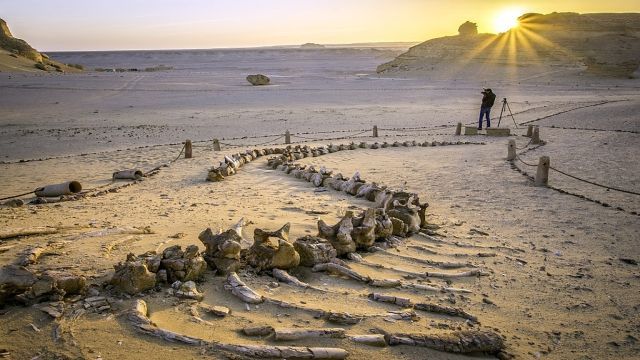
The best-known remains belong to early whales such as basilosaurids and dorudontines, but the wider fossil assemblage helps reconstruct a complete marine ecosystem.
Environmental and scientific interpretation of the site discusses whale skeletons alongside other marine animals and geological evidence. The fossils are important because they preserve anatomy that helps researchers understand how whales changed from animals with functional limbs into highly specialized marine mammals.
Visitors should not expect a dinosaur-style theme park. The experience is about seeing fossils in the landscape, understanding their context and using museum interpretation to make sense of what would otherwise look like bones and rock in a desert.
Were there really whales in the Egyptian desert?
Yes, but the desert was not a desert when those whales lived there. The rocks at Wadi Al-Hitan formed in an ancient marine environment tens of millions of years ago.
The key idea is geological change. Sea levels, climate, sedimentation and tectonic processes alter landscapes over enormous time scales. The fact that whale fossils are found in today’s Western Desert is evidence of how different the environment once was.
This is one of the most powerful parts of the visit: the modern visual setting and the ancient environmental story seem contradictory until the geology explains them.
What makes the whale fossils special?
Many fossil sites preserve isolated teeth or fragments. Wadi Al-Hitan is important because it includes numerous well-preserved skeletons in a setting that allows the evolutionary story to be understood clearly.
UNESCO specifically highlights the youngest archaeocetes at the site as showing the last stages of losing functional hind limbs. Those remains help illustrate the transition from terrestrial locomotion to a completely marine mode of life.
The fossils also preserve information about the surrounding ecosystem, making it possible to study not just individual whales but the world they inhabited.
How old are the fossils?
The whale fossils belong to the Eocene epoch, when this region was part of a marine environment. Public explanations often simplify this to “about 40 million years ago,” which is useful as a broad visitor reference but should not be treated as the precise date of every fossil.
Different specimens and sediment layers represent geological time, not one single event. The responsible interpretation is that Whale Valley preserves an Eocene marine ecosystem and an exceptionally important phase in whale evolution.
What is the Fossil and Climate Change Museum?
The visitor experience includes museum interpretation that helps explain the fossils, ancient environment and climate story. Egyptian environmental authorities have highlighted the museum as part of the site’s educational value.
This matters because the outdoor fossils are more meaningful when visitors understand what they are seeing. A skeleton in rock becomes evidence of anatomy, movement, diet, environment and evolutionary change when properly interpreted.
Visit the museum before or after the trail depending on the operating sequence. If you know little about whale evolution, seeing the interpretation first can make the outdoor route much easier to understand.
How do you get to Wadi Al-Hitan from Cairo?
Most travelers visit Whale Valley as part of a full Fayoum day or an overnight Fayoum trip. The route normally begins with a road transfer from Cairo or Giza toward Fayoum, followed by travel through Wadi El Rayan and deeper desert sectors.
Elzaghandi Travel’s current Fayoum itineraries plan roughly 2.5 to 3 hours from Cairo or Giza to the Fayoum region, with additional driving to the protected-area attractions.
Because the fossil site is not a short city excursion, an early departure matters. Trying to add Whale Valley after a late morning start usually forces the rest of the day into a rushed schedule.
Do you need a 4×4?
A suitable desert vehicle is the practical choice for a route combining Wadi El Rayan, Whale Valley, Magic Lake and dunes. Road conditions and the exact access arrangement can change.
Do not assume that a standard rental car is appropriate simply because map software displays a route. Protected-area tracks, sand and remote terrain require local knowledge and the right vehicle.
Can you visit Whale Valley independently?
Independent travel to the wider Fayoum region is possible, but Whale Valley is best treated as a protected natural heritage site rather than a casual self-drive stop.
A local operator can simplify:
- transport from Cairo or Giza;
- protected-area entry;
- desert navigation;
- timing between Wadi El Rayan and Whale Valley;
- meals and water;
- 4×4 transport;
- sunset routing.
If visiting independently, verify current access, fees and operating conditions using official Egyptian environmental sources rather than old travel forums.
How long should you spend at Wadi Al-Hitan?
Do not reduce the visit to a ten-minute photo stop. Allow enough time to understand the fossils and the evolutionary story.
A useful visit includes:
- visitor/museum interpretation;
- walking the approved fossil route;
- stopping at major skeletons;
- reading the geological context;
- photography without leaving the authorized path.
The exact time depends on weather, group pace and the current visitor route. Science-focused travelers may want longer than visitors treating Whale Valley as one stop in a full desert day.
What is the walking like?
The environment is open, dry and exposed. Expect desert ground rather than a fully paved urban museum route.
Bring:
- closed comfortable shoes;
- sun protection;
- water;
- a hat;
- lightweight clothing;
- a warmer layer in cooler weather if your day extends to sunset.
If mobility is limited, ask the operator how close the vehicle can approach the visitor facilities and which parts of the current route require walking.
Current entrance fees
Egypt’s Environmental Affairs Agency publishes protected-area visitor charges. At the time of this review, Wadi Al-Hitan has a separate entry category from Wadi El Rayan, with different fees for Egyptian and foreign visitors and additional charges listed for camping and vehicles.
Use the official EEAA fee page for the current rate rather than relying on copied prices that may become outdated.
Elzaghandi Travel’s published Fayoum itineraries currently list entrance tickets as included. Confirm that your final quote still includes them.
Is Whale Valley good for children?
It can be excellent for school-age children who like animals, fossils or science. The story is easy to grasp: whales once had land-living ancestors, and these fossils show part of the transition.
The challenges are heat, walking and road time. Parents should carry water, hats and snacks if not supplied, and should explain that fossils cannot be touched or collected.
Younger children may enjoy the museum and the idea of “whales in the desert” even if the full scientific interpretation is beyond them.
Is Whale Valley suitable for older travelers?
Age alone is not the deciding factor. Walking surface, heat, vehicle access and the length of the full Fayoum day matter more.
Ask for:
- current trail distance;
- availability of rest areas;
- shade;
- vehicle proximity;
- toilet access;
- the ability to shorten the outdoor section.
Best time to visit
Cooler months are generally more comfortable because the fossil landscape is exposed. Autumn through spring usually offers better walking conditions than peak summer.
Winter can be windy or cool, especially late in the day. Summer requires careful heat management and may make long outdoor interpretation less comfortable.
Visit early enough that you are not forced to rush the site before continuing to sunset activities elsewhere in Fayoum.
Photography at Whale Valley
The strongest images often show the relationship between fossil and landscape rather than only close-ups of bone.
Good practice:
- stay on the authorized visitor route;
- do not step over barriers for a cleaner angle;
- do not touch or reposition fossils;
- use a zoom rather than approaching restricted material;
- protect cameras from dust;
- avoid blocking narrow trail areas for long periods.
A wide lens can show how the fossils sit inside the desert environment; a moderate telephoto helps isolate details without physical intrusion.
Why touching fossils is harmful
Fossils are scientific evidence, not durable decorative stones. Repeated touching can damage surfaces, contaminate material and encourage increasingly intrusive visitor behavior.
More importantly, moving a fossil or fragment destroys contextual information. Paleontology depends not only on the object but on where it is found, its orientation and its relationship to surrounding sediment.
Never collect a “small piece” as a souvenir. Even something that looks unimportant may be scientifically meaningful.
What else can you see on the same day?
Wadi El Rayan waterfalls
The waterfalls make a strong visual contrast with Whale Valley and are usually visited before or after the fossil site.
Magic Lake
Commonly included for water-and-dune scenery, especially later in the day.
Sandboarding
A more active experience often included after the fossil visit.
Tunis Village
Pottery and village culture create a completely different atmosphere from the protected desert.
Sunset in the dunes
Many day trips finish with tea and sunset before returning to Cairo.
Whale Valley vs a normal archaeological site
Egypt is famous for human-built monuments, but Wadi Al-Hitan is natural heritage. There are no temples, royal tombs or hieroglyphic programs to interpret.
Instead, the “archive” is geological. Sediments and fossils preserve information about evolution and ancient environments over millions of years.
That makes Whale Valley a useful counterpoint to a Cairo itinerary dominated by pyramids and museums.
Whale Valley and climate interpretation
The site’s geological record demonstrates that environments change dramatically across deep time. A place that is now desert once supported marine life.
That does not mean the fossils are direct evidence of modern climate change. Visitors should distinguish ancient geological change from current human-driven climate change, even though the museum may use both subjects to explain how environments evolve and why conservation matters.
Responsible visiting rules
- Stay on approved trails.
- Do not touch fossils.
- Do not collect stones, shells or bone fragments.
- Do not carve or write on rock.
- Carry out all litter.
- Do not drive outside authorized tracks.
- Follow ranger and guide instructions.
- Do not use drones without all required permissions.
- Respect wildlife.
- Leave the site exactly as you found it.
Common myths and mistakes
“The whales died in a desert”
No. The area was marine when they lived there. The modern desert formed much later.
“Every fossil is exactly 40 million years old”
Use the age as a broad geological reference. Different fossils and layers are not all one exact date.
“The hind legs mean the whales still walked”
The famous fossils represent whales at an advanced marine stage. Reduced hind limbs are evidence of ancestry and transition, not normal land walking by those animals.
“You can take a small fossil fragment”
No. Removing material damages a protected World Heritage site and its scientific value.
“Whale Valley is the whole Wadi El Rayan reserve”
No. It is one internationally important zone within the wider protected landscape.
Day trip vs overnight
A Fayoum Day Trip can include Whale Valley, Wadi El Rayan, Tunis Village, Magic Lake, sandboarding and sunset in one long day.
The 2 Days / 1 Night Fayoum Adventure gives more space for an overnight and a second day around Lake Qarun and Qasr Qarun.
If fossils are your main interest, tell the operator so the schedule can protect enough time for Wadi Al-Hitan.
Frequently asked questions
Why is Wadi Al-Hitan called Whale Valley?
Because the site contains an exceptional concentration of early-whale fossils that document a major stage in whale evolution.
Is it really a UNESCO site?
Yes. Wadi Al-Hitan was inscribed on the UNESCO World Heritage List in 2005.
How far is it from Cairo?
It is normally visited as part of a full Fayoum day. Expect several hours of road and desert travel rather than a short city transfer.
Do I need a 4×4?
A suitable desert vehicle is the practical choice for the full route through the protected landscape.
Can I touch the fossils?
No. Observe them without contact.
Can children visit?
Yes, and the evolutionary story can be very engaging for children interested in science.
How long should I stay?
Allow enough time for museum interpretation and the fossil trail. Avoid treating it as a rushed photo stop.
Can I combine Whale Valley with Wadi El Rayan?
Yes. They are commonly combined on the same Fayoum itinerary.
Is there a museum?
Yes, visitor interpretation includes the fossil and climate-change story.
Is the site open year-round?
Protected-area operations can change. Confirm current opening and access before departure.
Plan your Whale Valley visit
If you have one day, the most efficient route is a full Fayoum Day Trip. If you want a slower pace and an overnight, choose the 2-day Fayoum route.
Browse the Fayoum destination page for the current tour collection.
Sources and further reading