Djara Cave History and Rock Art: What the Engravings Reveal
Last reviewed: 8 September 2026
Djara Cave is one of the most important prehistoric rock-art sites in Egypt's Western Desert. Its engravings show wild animals, human figures and abstract forms inside a limestone cave on the Egyptian Limestone Plateau, roughly between the Nile Valley at Asyut and Farafra Oasis. The images are valuable because they belong to a wider archaeological landscape that was used when this part of the Sahara was wetter and more habitable than it is today.
The most accurate answer to “what do the engravings reveal?” is also the most careful one. They reveal which animals prehistoric artists considered worth depicting, where people chose to make images inside the cave, and how engraving and pecking were combined. Together with hearths, animal bones, stone artefacts, plant remains, playa sediments and nearby camps, they help reconstruct human activity in a changing Holocene environment. They do not provide a literal written story, a complete catalogue of every species present, or an exact date for every figure.
Evidence note: This guide distinguishes between directly documented observations, contextual archaeological dating and interpretation. Djara's figures are prehistoric rock art, not hieroglyphs. The principal published study recorded 133 figures, but it explicitly stated that the images were not directly dated.
Djara Cave rock art: the short answer
The published archaeological corpus documents 133 figures distributed across several panels and spaces inside the cave. The main subjects are indeterminate cloven-hoofed animals, scimitar-horned oryx, addax, ostriches, gazelles and human figures. Researchers also recorded several unusual forms that they cautiously called “flambeau-shaped motifs,” plus zigzags, grids, bundles of vertical lines and irregular marks.
Most animal figures are shown from the side. The artists used incising, pecking and, in some cases, scratching. Sixteen figures showed a two-stage procedure in which an outline was first engraved and then the same area was pecked. That technical sequence is one of the clearest facts the surfaces preserve: at least some images were planned and executed through more than one physical action.
The cave's archaeological context points to repeated human use over a long period. Charcoal from a layer in the engraving gallery produced dates near 6970 and 6180 calibrated BC, while a sheep or goat tooth from the charcoal layer dated to about 4930 calibrated BC. Those dates establish activity inside the cave; they do not date each adjacent engraving automatically. The broader concentration of sites in Djara reached its greatest intensity in the mid-Holocene, particularly between about 6500 and 5200 calibrated BC, before increasing aridity greatly reduced occupation.
Key evidence at a glance
| Evidence | What the published research shows |
|---|---|
| Documented figures | 133 figures in the principal 2009 corpus |
| Main subjects | Cloven-hoofed animals, scimitar-horned oryx, addax, ostriches, gazelles, human figures and abstract motifs |
| Techniques | Incising, pecking and scratching; 16 figures show engraving followed by pecking |
| Direct dating of the art | No single direct radiocarbon date exists for the full corpus |
| Activity dates inside the cave | Charcoal and faunal contexts include dates around 6970, 6180 and 4930 calibrated BC |
| Wider occupation peak | Most intensive mid-Holocene use falls broadly around 6500–5200 calibrated BC |
| Giraffes | Absent from the published Djara corpus |
| Why it matters | The cave links rock art, activity deposits, palaeoenvironment and settlement evidence in one place |
Where Djara Cave fits in the Western Desert
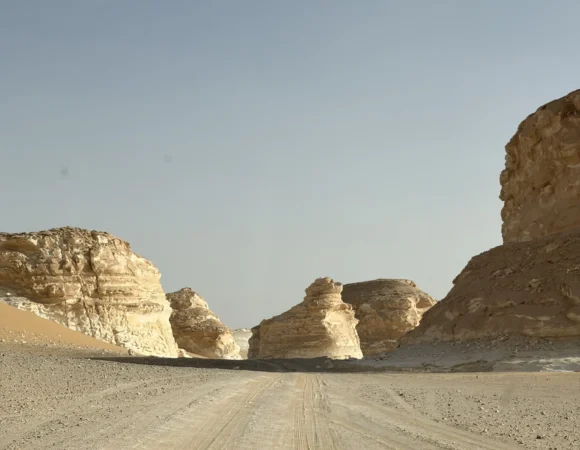
Djara lies on the Egyptian Limestone Plateau, in an isolated sector of the Western Desert between Asyut and Farafra Oasis. The surrounding terrain is mainly hamada: a stony desert surface cut by shallow depressions, dry drainage lines and limestone relief. Today the region is extremely arid, but geomorphology and archaeological evidence preserve a record of earlier periods when rainfall and runoff were more frequent.
This location matters. Djara is not an oasis settlement and it is not part of the Nile Valley monument circuit. It occupies an interior plateau landscape where reliable travel now requires experienced desert navigation, suitable four-wheel-drive vehicles and the correct permissions. For practical access information, read how to visit Djara Cave from Cairo and the broader Djara Cave travel guide.
The cave itself formed through karst processes in limestone. A narrow opening created by ceiling collapse leads down a sand slope. Archaeologists divided the accessible system into distinct spaces, including the “Hall of the Gazelles,” the “Gallery of the Engravings” and a larger hall. Some sectors receive daylight while others are much darker. That transition from light to shade is essential to understanding the art, because the artists did not choose a flat outdoor rock face. They selected surfaces within a three-dimensional underground space.
Why cave art at Djara is unusual
Rock art is widespread across parts of the Sahara, but much of it appears in shallow rock shelters or on exposed surfaces. Djara is different because substantial areas are no longer lit by natural daylight. The location therefore permits questions that go beyond identifying animals: Which spaces were used? Which panels could be seen from an activity area? Did light levels affect placement? Were certain motifs kept together?
The 2009 archaeological publication emphasized this spatial context. The Hall of the Gazelles contains the most extensive concentration, while other panels occupy different parts of the cave. Ostriches, gazelles and antelopes are not distributed randomly across every surface. Panel A is especially important because it combines gazelles and antelopes with ostriches. Researchers also observed that certain unusual flambeau-shaped motifs occur in more than one group, which may indicate that at least some figures were made within a broadly related period.
Spatial pattern is not a translation. It tells us that image placement was deliberate, not exactly what the placement meant. A panel may have marked a meeting place, a memory, a hunting concern, a ritual act, a route or several of these at once. Archaeology can define relationships and probabilities more reliably than it can recover a prehistoric person's unspoken intention.
A responsible history of discovery and research
Prehistoric knowledge came first
The cave was known and used thousands of years before European travel accounts or modern archaeology. Hearths, bones, artefacts and engraved surfaces demonstrate prehistoric presence. It is therefore misleading to describe any nineteenth- or twentieth-century traveller as the first person to “discover” Djara.
The language of discovery matters because desert places were often known to guides, caravan leaders and local travellers long before they entered published maps. The surviving scholarly history begins with a written record, but the site's human history begins much earlier.
Gerhard Rohlfs recorded Djara in 1873
Explorer Gerhard Rohlfs mentioned the cave in his travelogue Drei Monate in der libyschen Wüste. On Christmas Eve 1873, the headman of his caravan led him near a place called Djara. Rohlfs described a spacious dripstone cave with impressive stalactites, but he did not report the rock art.
This is best described as the first well-known modern written record, not an isolated “discovery.” The account itself shows that the caravan headman already knew the place. Because Rohlfs gave no description of the engravings, the rock art remained outside sustained archaeological discussion for more than a century.
Carlo Bergmann reported the engravings in 1989
In 1989, desert traveller Carlo Bergmann relocated the cave and described engravings in its interior. He also reported worked stone near the entrance. That observation helped bring Djara back into archaeological attention and led to systematic investigation.
Archaeological surveys began in the 1990s
Interdisciplinary teams from Cologne, Berlin and Cairo carried out initial surveys and test excavations in 1990 and 1993. Research intensified between 1998 and 2002 under the University of Cologne's ACACIA project—Arid Climate, Adaptation and Cultural Innovation in Africa—which was funded by the German Research Foundation.
The rock art was documented in detail during campaigns in 1999 and 2000. The complete corpus and spatial analysis were later published by Erich Claßen, Karin Kindermann and Andreas Pastoors in Archéo-Nil in 2009. Their work remains the central reference for the number, placement, subjects and techniques of the engravings.
Engravings, pecking and scratching: how the images were made
Djara's rock art is sometimes described casually as cave paintings. That is inaccurate. The published corpus is principally made through the removal or modification of the rock surface.
Incising or engraving creates lines by cutting or scratching into the surface with a hard tool. The resulting grooves define an outline or interior detail.
Pecking forms a figure through repeated blows that roughen or remove small pieces of the surface. In documentation drawings, pecked areas can appear broader and more textured than fine engraved lines.
Areal scratching modifies a wider patch of surface rather than producing only a single outline. It was recorded as another element in the technical repertoire.
The important point is that technique can reveal sequence. On 16 of the 133 figures—about 12 percent of the corpus—the researchers identified a two-stage process: a figure was engraved and then pecked over the same area. They could not determine whether a long interval separated those stages, but the close overlap shows that engraving and pecking were not always unrelated marks made by chance.
This evidence also warns against judging the figures only from casual photographs. Shallow incisions can disappear under flat light, dust or compression. A shape that looks incomplete on a phone screen may become clearer when illuminated from an angle. Conversely, shadows can create false lines. Archaeological drawings, scale photographs and close surface inspection are more dependable than a single dramatic image.
What animals appear in the Djara engravings?
The 133 documented figures are dominated by animals adapted to desert or dry-savannah environments. The published classification gives the following approximate shares:
- Indeterminate cloven-hoofed animals: 23.3 percent
- Scimitar-horned oryx: 19.5 percent
- Ostriches: 16.5 percent
- Addax antelope: 15.8 percent
- Dorcas or dama gazelles: 6.8 percent
- Human figures: 6.0 percent
- Flambeau-shaped motifs: 3.8 percent
- Zigzags: 2.3 percent
- Grid patterns, vertical line bundles and irregular lines: smaller shares
Percentages reflect archaeological identifications, not absolute biological certainty. A weathered outline may preserve enough features for a broad “cloven-hoofed animal” category but not enough to separate species. Even the gazelle category combines more than one possible identification. Responsible interpretation keeps that uncertainty visible.
Oryx
Scimitar-horned oryx form one of the largest identifiable groups. Their long, curved horns create a distinctive profile. Oryx were important large mammals in North African drylands, and their prominence at Djara suggests that they held practical, visual or cultural significance for the image makers.
That does not prove a particular hunting story. An animal can be depicted because it was hunted, admired, feared, remembered, associated with a place or used symbolically. The image records selection; it does not record the artist's explanation.
Addax
Addax are also frequent. Like oryx, they are well adapted to arid environments. Their presence fits the wider faunal and environmental evidence for a landscape that was dry but more productive than today's hyper-arid plateau during parts of the Holocene.
Ostriches
Ostriches account for a substantial share of the documented figures. Their distribution within the cave is especially interesting: the principal publication observed ostriches in the Hall of the Gazelles, with Panel A providing the only composition that combines ostriches with gazelles and antelopes.
This pattern may reflect a deliberate visual organization. It cannot tell us whether the composition represented a real scene, a remembered landscape or a symbolic grouping.
Gazelles and unidentified animals
Gazelles are less numerous than oryx, addax and ostriches in the published corpus. Many other animals remain deliberately classified as indeterminate. That restraint is valuable. It prevents a damaged horn, back line or leg from being forced into a species identification that the surface cannot support.
Giraffes are absent from the documented corpus
Many Western Desert rock-art sites are associated in popular writing with giraffes. Djara is a notable exception. Claßen, Kindermann and Pastoors explicitly stated that giraffes are absent from the cave's published corpus. A claim that Djara contains giraffe engravings should therefore be treated with caution unless new, peer-reviewed documentation demonstrates otherwise.
This absence may be environmentally meaningful. The researchers proposed that giraffes did not range this far north under the local conditions that supported the animals actually shown. It may also reflect artistic choice. Absence in art is not identical to proof of biological absence, but it is still an important contrast with sites farther south and west.
Human figures and abstract motifs
Human figures make up a small but significant portion of the corpus. Some are shown frontally as line drawings; others have outstretched arms or are connected visually with another form. Their simplicity does not make them unimportant. A human figure transforms a panel from a list of animals into a possible statement about relationships between people, animals and the cave.
The unusual flambeau-shaped motifs deserve even greater caution. Researchers used the label because the elongated, inverted triangular form has an upper element that bends and ends in a roof-like shape. They did not claim that it literally represents a torch. The name is descriptive, not a translation.
Zigzags, grids, vertical bundles and irregular lines also appear. Abstract marks are often tempting targets for speculative explanations: water, traps, maps, counting systems or ritual symbols. None of those meanings can be demonstrated from shape alone at Djara. The strongest archaeological statement is that these forms were made intentionally, appear in particular places and belong to the cave's visual repertoire.
Are the Djara engravings 10,000 years old?
There is no single direct date for all of the rock art. A headline such as “10,000-year-old engravings” compresses a complicated archaeological argument into a level of certainty the evidence does not support.
Rock engravings are difficult to date because the groove itself usually contains no organic material suitable for radiocarbon dating. Archaeologists therefore build a chronological framework from several forms of context:
- Dated charcoal and animal remains from activity layers inside the cave.
- Stone tools, pottery and settlement evidence in the Djara depression.
- The period when the local environment supported repeated occupation.
- Technical and thematic comparison with other Western Desert rock art.
- The spatial relationship between images, surfaces and excavated activity areas.
The cave's charcoal layer produced dates around 6970 and 6180 calibrated BC. A domesticated sheep or goat tooth from the layer dated to around 4930 calibrated BC. These dates show repeated activity inside the cave across a long span. They do not prove that a particular oryx or human figure was created on the same day as a dated fire.
The wider Djara area contains early Holocene evidence beginning before the main occupation peak. Most surveyed sites and dates cluster in the mid-Holocene, particularly around 6500–5200 calibrated BC. Large habitation sites declined quickly after about 5200 calibrated BC as the region dried. Shorter, more sporadic activity continued in a final phase around 5000–4500 calibrated BC.
The 2009 study used this sequence as a contextual limit and argued that the art was most plausibly associated with the period when people could still use the plateau. That is a reasoned archaeological frame, not direct laboratory dating of every line. The safest summary is: the engravings are prehistoric and probably belong within the Holocene occupation history of Djara, but no single exact age has been established for the full corpus.
What the engravings reveal about the ancient environment
Djara is now hyper-arid, yet its archaeological record belongs to a different environmental setting. The strongest case for a wetter past does not depend on animal pictures alone. It comes from the agreement of several independent records.
Playa sediments and drainage
Shallow depressions around Djara contain playa sediments deposited when water accumulated after rainfall and runoff. A network of palaeochannels directed water toward the depression. Djara's position at the end of this catchment made it locally more favourable than the surrounding plateau.
“Wetter” should not be confused with permanently lush. The interdisciplinary reconstruction describes a semi-arid environment with alternating humid and dry phases. Water was still seasonal and unpredictable. This helps explain why researchers concluded that highly mobile lifeways were more likely than permanent settlement.
Plant remains
Charcoal and plant remains recovered from archaeological contexts included taxa associated with semi-arid vegetation. The combination led researchers to propose an overlap between winter rainfall influence from the north and west and summer monsoonal influence from the south.
Rather than an endless grassland, the reconstruction suggests dry shrub vegetation on the plateau and more productive patches along channels and temporary pools. Those local differences would have mattered to both animals and people.
Animal remains
Bones from small bovids or gazelles were recovered in the cave, many darkened by ash or charcoal. Some showed burning, and at least one fragment had cut marks consistent with butchery. This is direct archaeological evidence of animal processing, not simply an inference from pictures.
The wider faunal record and the engraved species together support a landscape capable of sustaining animals that are absent from the immediate plateau today. The images add a human perspective: they show which animals were selected for depiction.
Human mobility and connections
Prehistoric sites concentrate near drainage lines and playa deposits, indicating repeated use of locally favourable ground. Nile bivalve shells found in the Djara record demonstrate connections with the Nile Valley. Such material does not necessarily represent direct travel by one individual, but it shows that Djara was not culturally isolated from wider movement and exchange.
The environmental picture is therefore dynamic. People used routes between the Nile, oases and plateau; returned to locations where temporary water and resources were available; and changed their movements as aridity increased.
The cave formations and the engravings are not the same age
Djara's stalactites, stalagmites and other speleothems formed through geological processes under wetter conditions. Some scientific work places major phases of speleothem formation far earlier than the Holocene human occupations. The limestone formations are therefore not simply decorations created at the same time as the rock art.
This distinction prevents a common error. A cave can preserve evidence from several different time scales:
- The limestone bedrock belongs to deep geological history.
- Karst cavities and speleothems developed during earlier wet phases.
- Prehistoric people used the cave during parts of the Holocene.
- Engravings were made within that human history, but are not directly dated one by one.
- Modern visitors and tourism create the most recent layer of interaction.
Reading those layers separately makes Djara more interesting, not less. The site is both a geological archive and an archaeological place.
What happened inside Djara Cave?
Excavation in the Gallery of the Engravings uncovered a layer of ash and charcoal beneath one panel, evidence for repeated fires. A small collection of stone artefacts was found, along with animal bones and botanical remains. Researchers also identified objects placed or wedged in crevices, including a burin and a core.
One interpretation proposed in the 2009 study is that the cave was not an ordinary residential camp. The relatively small number of stone artefacts compared with repeated hearth evidence, the image panels and the location of some objects led the authors to suggest a more specialized or possibly ritual role. But they also acknowledged practical alternatives: an object placed in a known niche could simply be easier to retrieve in a dark cave.
This is an excellent example of how archaeological interpretation should work. Evidence may make one explanation plausible without excluding all others. “Ritual cave” is a hypothesis grounded in context, not a proven label.
The Gallery itself offered practical advantages. It lies near the boundary between light and shade, has relatively level ground and provides views toward other cave areas. People could orient themselves and perform tasks there. Its suitability for activity may have been practical, social and symbolic at the same time.
Myth versus evidence
| Common claim | Evidence-based correction |
|---|---|
| Djara contains hieroglyphs | The figures are prehistoric rock art, not a written hieroglyphic text. |
| All engravings are exactly 10,000 years old | The art is not directly dated as one group; archaeologists use dated activity layers and the wider Holocene occupation sequence as context. |
| Giraffes are shown in Djara | The principal published corpus specifically notes their absence. |
| The cave was definitely a temple | A specialized or ritual role has been proposed, but practical explanations remain possible. |
| The cave proves a permanently green Sahara | The evidence supports wetter and more habitable phases, but with semi-arid conditions and strong environmental variability. |
| The rock art tells a complete story | The images preserve selected subjects, techniques and spatial choices, not a directly translatable narrative. |
Why exact language improves the visitor experience
Careful history does not make Djara less dramatic. It gives visitors more to look for. Instead of searching for a fictional “message,” you can notice the relationship between the surface and the figure, the transition from daylight to shade, the repeated choice of large desert animals and the contrast between the present landscape and its Holocene record.
A knowledgeable guide can also help distinguish natural cracks from incised lines without touching the panel. Many figures are shallow and difficult to see under direct light. The best viewing may depend on the angle of illumination. Flash photography and aggressive lighting are not substitutes for trained interpretation.
Before travelling, use the complete Djara Cave travel guide to understand access, landscape and trip planning. If you are comparing a cave visit with a wider desert route, the White Desert Egypt travel guide explains how the main regions fit together.
Conservation: how to visit without damaging the record
Djara's heritage is vulnerable precisely because it is remote and physically exposed. Speleothems can break. Fine engraved lines can be damaged by rubbing, tracing or adding moisture. Archaeological artefacts lose most of their research value when removed from their location.
Follow these rules inside and around the cave:
- Never touch, rub, wet or chalk an engraving.
- Do not trace figures with fingers, pencils or light tools.
- Do not climb on stalagmites or hang equipment from formations.
- Do not collect pottery, stone tools, bones or shells.
- Keep backpacks and tripods away from decorated surfaces.
- Use only the lighting method permitted by the guide and authorities.
- Leave no food, tissue, plastic or battery waste.
- Do not scratch names, dates or symbols anywhere in the cave.
- Follow the guide's route rather than searching unsupported side passages.
- Share locations and images responsibly if a sensitive panel could attract unmanaged traffic.
A 2021 geoheritage evaluation proposed Djara as a geosite of national significance and highlighted risks from tourism stress, damaged formations, artefact collection and waste. Conservation is therefore not an optional courtesy. It is part of keeping the site scientifically useful and physically intact.
Photographing the engravings responsibly
Rock art photography is an exercise in patience. The goal is to document without altering the surface.
Use a camera or phone that performs well in low light, but avoid placing the device against rock. A modest side light handled by the guide may reveal shallow lines better than a frontal flash. Keep feet and tripods on established ground. Do not move stones or brush away sediment for a cleaner composition.
Take one wider image to show the panel's location, then closer photographs only from a safe distance. Record the direction of light if you want to compare details later. Remember that a photograph can exaggerate both certainty and ambiguity. Do not publish a species identification solely because one shadow resembles a horn.
For general desert equipment, see what to pack for a Djara Cave tour. A headlamp, spare power, dust protection and footwear with reliable grip are more useful than heavy studio equipment.
How Djara fits into a White Desert itinerary
Djara is remote enough that it is usually included in a multi-day four-wheel-drive expedition rather than treated as a conventional day trip. A practical route combines Bahariya Oasis and major Western Desert landscapes with a dedicated Djara day.
Elzaghandi Travel's active 3-day, 2-night White Desert and Djara Cave adventure begins with the Cairo-to-Bahariya transfer and visits the Black Desert, El Hez, Crystal Mountain, the Agabat area and a desert camp. The second day is dedicated to Djara before returning toward the White Desert for another camp. The final day covers additional formations and the return journey.
That sequence is operationally sensible because Djara requires a much deeper approach than the standard White Desert circuit. It also creates a useful historical contrast: the cave's Holocene occupation record, the present hyper-arid plateau and the younger travel infrastructure of Bahariya can all be understood as parts of one changing desert landscape.
Read the White Desert and Djara Cave 3-day itinerary from Cairo for a day-by-day planning breakdown. For seasonal conditions, compare the best time to visit the White Desert with your preferred travel dates.
Practical access and safety notes
Djara is not a self-drive attraction. Routes cross remote desert terrain where mobile coverage, fuel, water and recovery support are limited. Access conditions and permission procedures can change, so a responsible operator confirms the route and paperwork before departure.
Your trip should include:
- An experienced local desert driver and guide
- A suitable, maintained four-wheel-drive vehicle
- Required permits and identity details arranged in advance
- Sufficient drinking water, food and emergency reserves
- Vehicle recovery and communication equipment
- A realistic schedule that avoids rushed night driving
- Clear confirmation of camping gear, meals and pickup arrangements
Check current official travel advice shortly before departure, especially if your route or nationality creates additional requirements. The guide is the White Desert in Egypt safe? explains the difference between ordinary desert risks, changing access rules and wider regional advisories.
Frequently asked questions
What is the history of Djara Cave?
Djara is a natural limestone cave with evidence of prehistoric use during the Holocene. Its modern written history includes Gerhard Rohlfs’s 1873 description, Carlo Bergmann’s report of the engravings in 1989, surveys in the 1990s and detailed ACACIA documentation published in 2009.
Who discovered Djara Cave?
No modern traveller can reasonably be called the first person to discover it. Prehistoric people used the cave, and Rohlfs’s own account depended on local caravan knowledge.
How many engravings are in Djara Cave?
The principal complete scholarly publication documented 133 figures.
What animals are engraved in Djara Cave?
Identified subjects include scimitar-horned oryx, addax, ostriches and gazelles. Human figures and abstract motifs are also present.
Are there giraffes in the Djara rock art?
The 2009 corpus specifically notes the absence of giraffes.
Is Djara rock art painted?
The known corpus is mainly engraved and pecked, with some scratched areas. Calling it cave painting is imprecise.
Are the figures ancient Egyptian hieroglyphs?
No. They are prehistoric rock art rather than a hieroglyphic writing system.
How old are the Djara Cave engravings?
They have not been directly dated as one group. Archaeologists use dated activity layers and the wider Holocene occupation sequence to frame their likely age.
Does Djara prove the Sahara was green?
Djara supports evidence for wetter early- and mid-Holocene conditions, but the local reconstruction is better described as semi-arid with alternating wetter and drier phases.
Were prehistoric people permanently settled at Djara?
The evidence favours highly mobile land use rather than permanent sedentary settlement.
Was Djara Cave used for rituals?
Possibly, but not certainly. A specialized or ritual role has been proposed, while practical explanations remain possible.
Can visitors see the engravings easily?
Some figures are shallow and can be difficult to recognize without angled light and informed guidance.
Can I visit Djara Cave independently?
No independent visit should be assumed. The route is remote and requires current permissions, experienced desert navigation and a suitable licensed operation.
How many days are needed for Djara Cave?
Three days from Cairo is the practical minimum for the active combined route with Bahariya and the White Desert.
Why is Djara important for archaeology?
Djara combines rock art, dated activity deposits, cave space, fauna, palaeoenvironment and a wider prehistoric settlement landscape in one site.
Related Djara guides: For the complete destination overview, read the Djara Cave travel guide. For logistics, see how to visit Djara Cave from Cairo; for preparation, use the Djara Cave packing list; and for trip structure, see the 3-day itinerary.
Evidence-based takeaway
Djara's engravings reveal a selective prehistoric image world dominated by wild desert and dry-savannah fauna, accompanied by human and abstract forms. Their placement inside a real cave, the use of engraving and pecking, and the association with repeated fires and wider settlement make the site exceptional in Egypt's Western Desert.
The art should not be reduced to a sensational age claim. Its real value lies in the relationship between image, cave and landscape. Archaeology shows that people repeatedly used Djara while rainfall and runoff made the plateau more habitable. As drying intensified, large camps disappeared. The engraved animals remained, preserving choices made by people whose language and exact intentions are lost.
That is why the most honest interpretation includes uncertainty. We can identify many figures, reconstruct techniques and define a plausible chronological context. We cannot translate the panels as a written story or assign every mark to a precise year. Protecting that boundary between evidence and imagination is essential to both good history and responsible tourism.
Sources and further reading
- Claßen, E., Kindermann, K. and Pastoors, A. (2009), “Djara – Cave Art in Egypt's Western Desert,” Archéo-Nil 19, 47–66. The principal publication of the complete rock-art documentation.
- Kindermann, K. et al. (2006), “Palaeoenvironment and Holocene land use of Djara, Western Desert of Egypt,” Quaternary Science Reviews 25, 1619–1637. Interdisciplinary reconstruction of climate, ecology and occupation.
- Abdel Maksoud, K. M., Baghdadi, A. H. A. and Ruban, D. A. (2021), “Caves as geoheritage resource in remote desert areas: a preliminary evaluation of Djara Cave in the Western Desert of Egypt”. Geoheritage significance and conservation risks.
- Egyptian Tourism Authority, Natural Wonders of Egypt. Official destination context for Western Desert landscapes.
- UK Foreign, Commonwealth & Development Office, Egypt regional risks. Check shortly before travel because advisories and access conditions can change.
Plan a Djara Cave expedition
To ask about current access, permits, group size, camping arrangements and the 3-day route, message Elzaghandi Travel on WhatsApp. Share your preferred dates, number of travellers and Cairo pickup location so the team can confirm a realistic itinerary and price.
Djara Cave History and Rock Art: What the Engravings Reveal
Recent Posts
Djara Cave History and Rock Art: What the Engravings Reveal
What to Pack for a Djara Cave Tour in Egypt
Black Desert vs White Desert Egypt: What’s Different?