Last reviewed: 19 November 2026
The rock formations of the White Desert are some of the strangest landscapes on Earth. Bright white towers rise out of the sand in the shapes of mushrooms, birds, tents and giant ice cream cones, and the whole scene changes colour from white to gold to pink as the sun moves. This guide explains how the formations were created, which ones are the most famous, where to find them inside the White Desert National Park, and how to see and photograph them at their best.
What are the White Desert rock formations?
The formations are free-standing blocks and pillars of chalk and limestone, scattered across a wide plain north of Farafra Oasis in Egypt’s Western Desert. Some are only as tall as a person, others rise more than ten metres. Geologists call the larger isolated hills inselbergs, meaning island mountains, and the long wind-shaped ridges yardangs. Together they form the core of the White Desert National Park, a protected area since 2002.
How were the formations made?
The story begins under the sea. Around 80 million years ago, during the Late Cretaceous, a shallow sea covered this part of North Africa. Countless microscopic sea creatures with chalky shells settled on the sea floor, and over millions of years their remains hardened into thick layers of white chalk and limestone.
When the sea retreated, the chalk plateau was exposed to the desert climate. Three forces then shaped it:
- Wind and sand. The prevailing north wind carries sand grains low along the ground. They sandblast the base of each rock faster than the top, which is why so many formations are narrow at the bottom and wide on top, like mushrooms.
- Rare rain. Occasional heavy rain dissolves the soft chalk along cracks, splitting the plateau into blocks and pillars.
- Heat and cold. Big swings between day and night temperatures make the rock expand and contract, so flakes break away and edges round off.
The harder layers survive as caps on top of softer chalk, producing the balanced shapes that make the White Desert famous. The process is still going on, and the formations are slowly changing shape year after year.
The most famous formations
The Mushroom and the Chicken
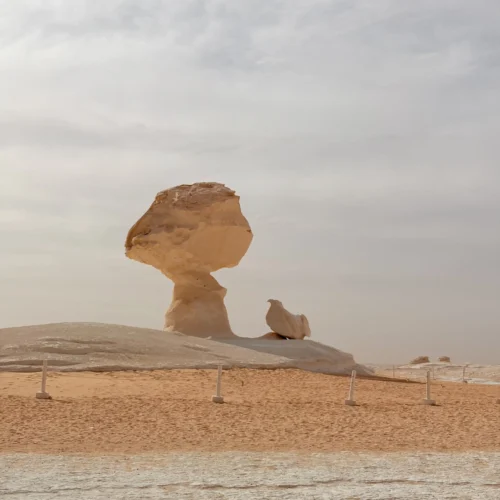
The best-known pair in Egypt stands side by side in the southern part of the park: a chalk mushroom on a slim stem and, next to it, a rock that looks like a chicken or hen sitting on a nest. Almost every tour stops here, and it is the classic photo of the White Desert. Come early in the morning or close to sunset for softer light and fewer people.
The Ice Cream Cones and the Tent
Several tall conical formations with pointed white tops are nicknamed ice cream cones, and a broad rock with a sloping roof is often called the tent. Guides use names like these to help visitors navigate, and every driver seems to have his own favourites.
The Inselberg field
Away from the famous pair, wide fields of smaller formations spread across the sand like a frozen crowd. These are often the best areas to camp, because you can walk out among the rocks at night and watch them glow under the moon.
The Old and New White Desert
Guides often divide the park into two areas. The Old White Desert, in the south, is the plain of mushrooms, chickens and inselbergs. The New White Desert, further north, is a landscape of large white cliffs, plateaus and canyons, with sweeping views from the top. A good tour visits both, usually with a sunset at one and sunrise at the other.
Fossils and other details to look for
Look closely at the ground and the rock surfaces. You may see:
- Marine fossils such as small shells and sea urchins, reminders of the ancient sea.
- Iron concretions, small dark balls and flower-like clusters of iron minerals that weather out of the chalk.
- Quartz and calcite crystals, especially on the way through the Crystal Mountain.
- Fennec fox tracks around camp in the morning. These small desert foxes often visit at night.
Please leave fossils and stones where you find them. The park is protected, and collecting damages it for future visitors.
How the formations compare to other desert rock formations
Desert rock formations exist all over the world, from the sandstone arches of Utah to the granite domes of Wadi Rum in Jordan. What makes the White Desert unusual is the material. Most famous formations are sandstone or granite, but here they are soft white chalk, which gives a brightness and a strange, almost snowy look that you rarely see elsewhere. The contrast becomes even stronger when you arrive from the Black Desert, where the hills are capped with dark volcanic stone, a pairing explained in our Black Desert vs White Desert guide.
When to see the formations
The formations look completely different through the day:
- Sunrise: soft pink and orange light, cool air and long shadows.
- Midday: bright white, very high contrast, best for the snowy look but harsh for portraits.
- Sunset: warm gold and pink, the most popular time for photos.
- Night: under a full moon the chalk glows silver; on a moonless night the stars take over.
This is why an overnight stay matters. A day trip sees the formations in the flattest light, while a camping trip sees them at their best. The season matters too: October to April is most comfortable, and our guide to the best time to visit the White Desert covers each month.
Photography tips
- Shoot low and wide to make the formations look taller against the sky.
- Use people for scale; a figure beside the Mushroom shows how big it really is.
- At sunset, place the sun behind a formation for a glowing outline.
- For night photos, bring a tripod and a wide lens; the low light pollution makes the Milky Way easy to capture from spring to autumn. See our White Desert stargazing and photography guide.
- Protect your camera from sand by changing lenses inside the vehicle.
How to visit the White Desert formations
The formations are about 4.5 to 6 hours by road from Cairo, via Bahariya Oasis. The most popular way to see them is the 2-day White Desert tour, which reaches the park in the afternoon, camps among the rocks and returns the next day. A 3-day tour leaves more time to explore both the Old and New White Desert. If your time is very short, a White Desert day trip is possible, but you will see the formations only briefly.
Inside the park, driving off the tracks requires a 4×4 and an experienced driver. Camping is allowed in permitted zones, and a park entrance fee applies. A licensed local operator handles both.
What a night among the formations feels like
After sunset the wind usually drops and the desert becomes very quiet. The team sets up camp beside a group of rocks that act as a windbreak, lights a fire and cooks dinner while the formations turn from pink to grey. Later, when the moon rises, the chalk reflects so much light that you can walk between the rocks without a torch. On moonless nights the opposite happens: the formations become dark shapes against a sky packed with stars. Many travellers say this night is the part of their Egypt trip they remember most, more than any temple or museum. Read our White Desert camping guide to see what to expect, from bedding to toilets.
Responsible visiting
The formations are fragile. Chalk breaks easily, and graffiti or climbing can damage them permanently. Do not climb on thin pillars, do not carve names, and take all rubbish back with you. Choose operators who camp in permitted areas and leave no trace. If everyone follows these simple rules, the White Desert will look as magical for the next generation as it does today.
Plan your trip
Our team was born in Bahariya Oasis and has been guiding in the White Desert for years. We know where to camp away from other groups and when the light is best at each formation. Read our ultimate White Desert guide for more detail, browse our desert tours, or ask us to plan a route around the formations you most want to see.
White Desert Rock Formations FAQ
How were the White Desert formations formed?
They are chalk and limestone laid down in a shallow sea about 80 million years ago, later carved by wind-blown sand, rare rain and big temperature swings into mushrooms, pillars and towers.
Where are the Mushroom and Chicken rocks?
In the southern part of the White Desert National Park, often called the Old White Desert, north of Farafra Oasis. Most White Desert tours stop there.
What is the difference between the Old and New White Desert?
The Old White Desert has the famous mushroom and chicken formations on a sandy plain. The New White Desert, further north, has large white cliffs, plateaus and canyons.
Can you camp near the White Desert formations?
Yes, in permitted camping zones inside the national park. Camping among the formations is the highlight of most 2 and 3-day tours.
Can I take fossils or stones from the White Desert?
No. The White Desert is a protected area, and collecting fossils, crystals or rocks is not allowed.

Born and raised in Bahariya Oasis, Eyad has guided travellers through the Western Desert for 7+ years. He drives the 4×4, cooks on the fire and sets up camp himself.
Read his story →