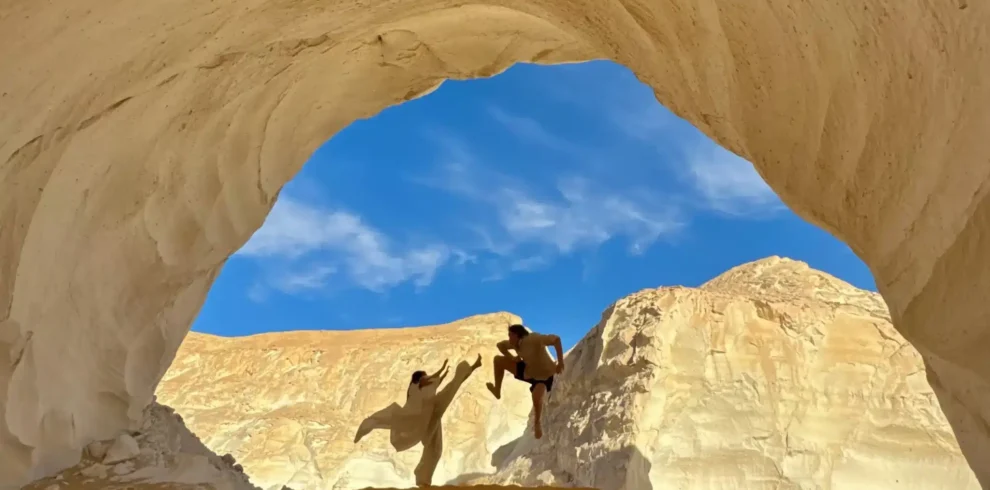
Fayoum Egypt Travel Guide: Things to Do, Wadi El Rayan & Whale Valley
Last reviewed: 4 October 2026.
Fayoum is one of the easiest places to leave Cairo behind and enter a completely different landscape without committing to a long Western Desert expedition. Within a single region, travelers can move between farming villages, pottery workshops, Lake Qarun, desert dunes, Wadi El Rayan waterfalls, the UNESCO-listed fossil landscape of Wadi Al-Hitan and sunset viewpoints around the desert lakes.
This Fayoum Egypt travel guide is designed for independent trip planning and for travelers comparing a day trip with an overnight stay. It explains what Fayoum is, how far it is from Cairo, which places are worth prioritizing, how Wadi El Rayan and Whale Valley fit together, what to expect from 4×4 travel, and when one day is enough versus when two days is the better choice.
For bookable options, compare the Fayoum Day Trip, the 2 Days / 1 Night Fayoum Adventure, or browse the Fayoum destination page.
Fayoum at a glance
- Best for: nature, geology, fossil heritage, village culture, photography, desert driving and a change of pace from Cairo.
- Typical starting point: Cairo or Giza.
- Common trip length: one full day or two days with one overnight.
- Main highlights: Tunis Village, Wadi El Rayan, Wadi Al-Hitan, Magic Lake, dunes, Lake Qarun and Qasr Qarun.
- Protected areas: Wadi El Rayan and Lake Qarun are protected areas managed within Egypt’s environmental system.
- World Heritage: Wadi Al-Hitan, also called Whale Valley, is a UNESCO World Heritage Site.
- Transport reality: normal road vehicles can reach the wider Fayoum region, but desert sectors and Whale Valley routes are better approached with an experienced local operator and suitable 4×4.
- Best planning rule: choose one day for the essential highlights, two days if you want a slower pace, sunset, an overnight and Lake Qarun/Qasr Qarun on the second day.
What is Fayoum?
Fayoum is a depression southwest of Cairo with a long history of agriculture, settlement and interaction between the Nile Valley and the Western Desert. It is often described as an oasis, but it differs from remote oases such as Bahariya or Siwa because its cultivated landscape is connected to Nile water through the Bahr Youssef system rather than depending only on isolated desert springs.
For visitors, the important point is that Fayoum is not one attraction. It is a region containing several very different travel experiences. Lake Qarun belongs to a large wetland landscape. Wadi El Rayan combines artificial lakes, waterfalls, dunes and protected desert. Wadi Al-Hitan preserves fossil evidence from a period when this part of Egypt was under an ancient sea. Tunis Village adds contemporary local craft culture. Desert sectors add sandboarding, 4×4 driving and sunset stops.
That variety is why Fayoum works well as a short extension from Cairo. A traveler can leave the capital in the morning and spend the rest of the day in landscapes that feel very different from Giza’s monuments and Cairo’s urban density.
How far is Fayoum from Cairo?
The practical driving time depends on where you start, traffic in Greater Cairo, the first stop in Fayoum and the route used inside the governorate. On Elzaghandi Travel’s current Fayoum itineraries, the road transfer from Cairo or Giza is planned at roughly 2.5 to 3 hours before the deeper desert stops.
Do not treat that as a fixed Google Maps promise. Cairo traffic can change quickly, and the travel day usually includes more than the initial road journey. Reaching Tunis Village is different from reaching Wadi El Rayan, and reaching Wadi Al-Hitan requires additional desert travel.
If your main goal is Whale Valley, budget for a full-day experience rather than imagining it as a short stop outside Cairo. The fossil site is part of a wider protected desert landscape and is best visited as part of a planned route.
Is Fayoum a good day trip from Cairo?
Yes, especially if your priorities are Wadi El Rayan, Wadi Al-Hitan, Tunis Village, desert scenery and sunset. A day trip is efficient because the strongest attractions can be connected in one route.
A typical full-day structure is:
- Early pickup from Cairo or Giza.
- Tunis Village and pottery area.
- Wadi El Rayan and the waterfalls zone.
- Wadi Al-Hitan / Whale Valley.
- Lunch.
- Magic Lake and dunes.
- Sandboarding or 4×4 activity where included.
- Sunset and tea.
- Dinner or return journey, depending on the program.
The trade-off is pace. A day trip covers a lot and usually means a long return to Cairo after sunset. If you dislike compressed sightseeing, want more photography time or want Lake Qarun and Qasr Qarun without rushing, an overnight stay is better.
One day vs two days in Fayoum
Choose one day when:
- you are based in Cairo or Giza;
- you have limited time in Egypt;
- your priority is Wadi El Rayan, Whale Valley and the desert;
- you are comfortable with a long day;
- you do not need an overnight desert or eco-lodge experience.
Choose two days when:
- you want sunset without immediately returning to Cairo;
- you want Lake Qarun and Qasr Qarun on a separate morning;
- you prefer a slower pace;
- you want more village or photography time;
- you want one night in Fayoum before returning to the city.
Compare the live Fayoum day trip with the 2-day Fayoum adventure before deciding.
Best things to do in Fayoum
1. Visit Wadi El Rayan Protected Area
Wadi El Rayan is one of Fayoum’s most important protected landscapes. Egypt’s Environmental Affairs Agency lists it as a protected area established in 1989 and describes an integrated desert environment with dunes, natural springs, large water bodies, plant life, wildlife and marine fossils.
The area is large, so “visiting Wadi El Rayan” can mean different things depending on the route. Most tourist itineraries focus on the lakes, waterfalls zone and desert areas that connect toward dunes, Magic Lake and Whale Valley.
Read the dedicated Wadi El Rayan Egypt travel guide for a more detailed breakdown of the lakes, waterfalls, desert activities and visitor planning.
2. See the Wadi El Rayan waterfalls
The waterfalls are among Fayoum’s most photographed natural-looking features, but their origin is important. The Wadi El Rayan lakes were created as part of a drainage-water system, and the waterfalls formed where water moves between the two lake levels.
That does not make the area less interesting. It makes it a good example of how modern water management created a new wetland environment inside an arid landscape. The waterfalls are normally a relatively short stop within a much larger day.
3. Explore Wadi Al-Hitan, the Valley of the Whales
Wadi Al-Hitan is the scientific highlight of a Fayoum desert trip. UNESCO describes it as the world’s most important site for demonstrating a key stage in whale evolution, showing the transition from land-based ancestors toward fully marine whales.
The significance is not just one skeleton. UNESCO emphasizes the number, concentration, quality and accessibility of the fossils and the way the site helps reconstruct the environment in which those animals lived.
This is why Whale Valley should not be treated as a novelty stop. It is a globally important natural heritage site. Follow marked routes, do not touch or collect fossils, and allow enough time to understand the landscape rather than only taking photographs.
For deeper planning, see our Wadi Al-Hitan Whale Valley guide.
4. Stop at the fossil and climate-change museum
The visitor experience at Wadi Al-Hitan includes interpretation of the fossils and the ancient environment. Egyptian environmental authorities have highlighted the site’s fossil and climate-change museum as part of the visitor experience.
The museum helps explain why whale fossils are found in the desert, what ancient whales looked like and how the region’s geology records a very different environment from today’s arid landscape.
5. Visit Tunis Village
Tunis Village provides the cultural counterpoint to the protected areas. It is best known to travelers for pottery workshops, handmade ceramics and a quieter rural atmosphere overlooking the wider Fayoum landscape.
A village visit works especially well early in the day before the desert route. It lets travelers see a lived-in community and contemporary craft tradition rather than spending the entire day inside protected areas.
If you want to buy pottery, ask before photographing artisans at work and choose pieces based on what can be packed safely for the rest of your trip.
6. Experience Magic Lake and the surrounding dunes
Magic Lake is commonly included in Fayoum desert programs because the surrounding dunes create a strong visual contrast between sand and water. It is often combined with 4×4 driving, sandboarding and sunset.
Water level, access and the exact route can vary. Treat the stop as part of the wider Wadi El Rayan desert experience rather than assuming one fixed viewpoint or activity setup year-round.
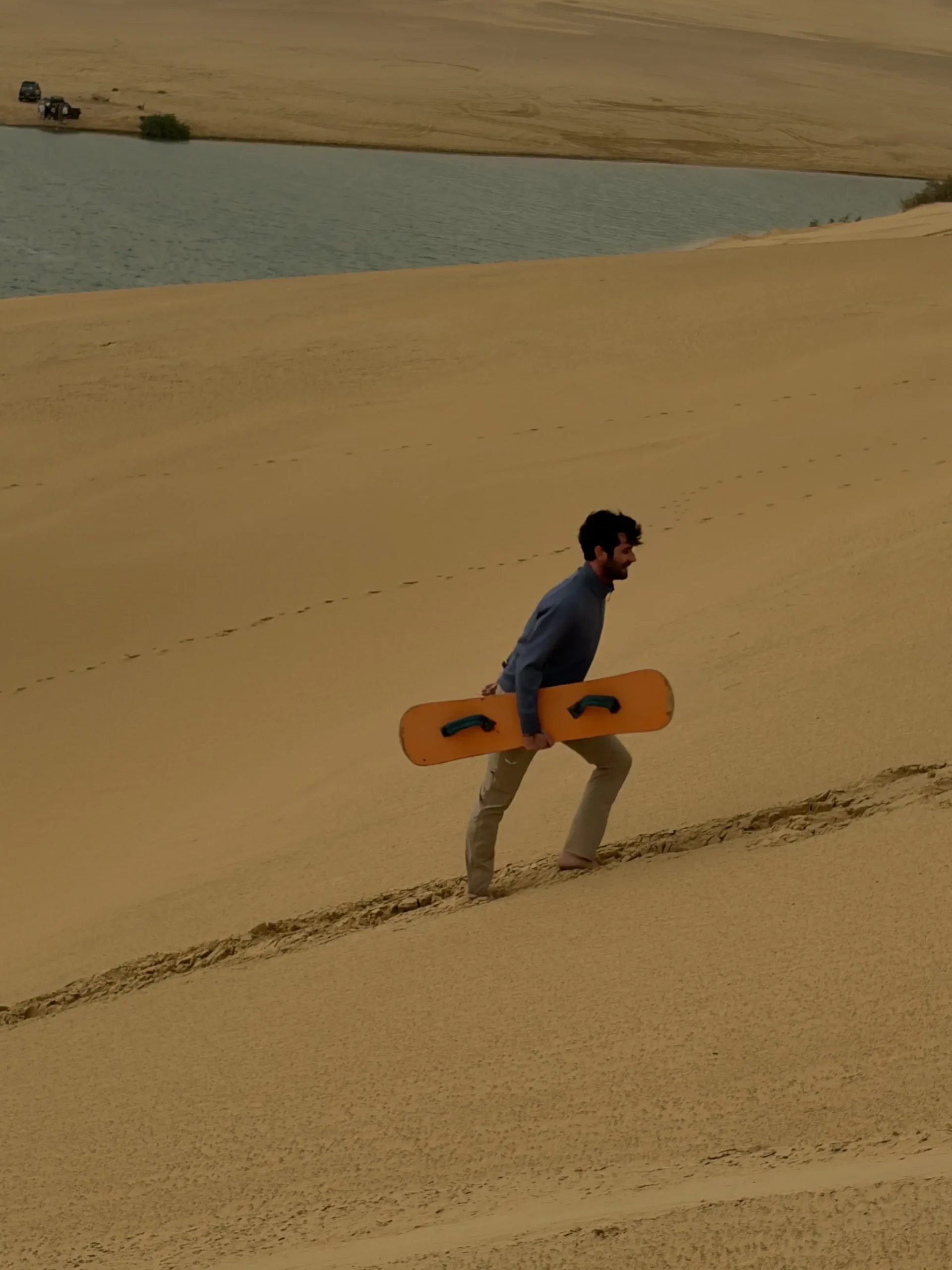
7. Try sandboarding
Sandboarding is one of the easier active experiences to add to a Fayoum day. The guide chooses a suitable dune based on surface and conditions. It does not require the same technical skill as snowboarding, but falls are common and sand can become extremely hot in warm weather.
Wear clothing that can handle sand, protect phones and cameras, and avoid carrying loose objects in pockets. If you have knee, ankle or back issues, watching from the dune is completely reasonable.
8. Watch sunset in the desert
Sunset is often the emotional high point of a Fayoum trip because the temperature drops, the dunes change color and the day’s movement slows. Many organized programs combine sunset with tea.
Do not build a tight evening commitment in Cairo after a sunset-based tour. The return drive begins after the light fades, and traffic can add uncertainty.
9. Visit Lake Qarun
Lake Qarun lies in a separate protected landscape north of the main Wadi El Rayan route. Egypt’s Environmental Affairs Agency describes it as one of the world’s oldest natural lakes and the surviving remnant of ancient Lake Moeris.
It is also an environmentally sensitive site. Current environmental reporting in 2026 continues to discuss restoration and ecological-balancing work at the lake. Visitors should therefore avoid assuming that every shoreline activity, swimming claim or fishing experience is appropriate everywhere around the lake.
The lake works best as a landscape, birding and cultural stop, especially on a two-day itinerary.
10. Visit Qasr Qarun
Qasr Qarun is an archaeological stop commonly paired with Lake Qarun on overnight Fayoum itineraries. It adds a historical dimension to the second day after a first day focused on fossils, dunes and protected desert.
Opening arrangements can change, so confirm access on the travel date rather than building the entire itinerary around one fixed schedule.
Wadi El Rayan vs Wadi Al-Hitan: what is the difference?
The names are often used together, which can confuse first-time visitors.
Wadi El Rayan is the broader protected area containing lakes, waterfalls, dunes, springs and desert habitat.
Wadi Al-Hitan is the UNESCO World Heritage fossil site located within the wider Wadi El Rayan protected landscape.
In practical trip planning, you can visit both on the same day because they form part of one connected desert route. But they are not the same attraction. Wadi El Rayan is about a wider protected ecosystem and landscape; Whale Valley is primarily about fossils, geology and evolutionary history.
How important is Whale Valley?
Very. UNESCO’s World Heritage listing identifies Wadi Al-Hitan as an exceptional global reference site for understanding the evolution of whales. Fossils found there preserve evidence of early whales at a stage when the hind limbs were still present but becoming reduced as the animals adapted to marine life.
This is one reason the site should be visited with more respect than a normal photo stop. Fossils, rock and sediment context are part of the scientific record. Never remove fragments, climb onto exposed fossil material or move stones to create a cleaner photograph.
Current protected-area fees
Egypt’s Environmental Affairs Agency publishes visitor fees for protected areas. At the time of this review in October 2026, the official fee page lists separate visitor charges for Wadi El Rayan, the Wadi Al-Hitan area and Lake Qarun, with different rates for Egyptian and foreign visitors. The same page also lists camping and vehicle fees.
Because fees and implementation can change, do not rely on a copied number from an old blog post. Check the official EEAA protected-area fee page or confirm with your operator shortly before travel.
On Elzaghandi Travel’s current Fayoum tours, entrance tickets are listed as included, but you should always verify the exact inclusions for your departure date.
Do you need a 4×4 in Fayoum?
Not for every part of the governorate. Main roads can take you to villages and developed areas. But a 4×4 is appropriate for the desert sectors included in many tourist itineraries, especially routes combining dunes, Magic Lake and protected-area tracks.
Do not assume a normal sedan or rental car should be driven onto sand because another vehicle has left tracks there. Surface conditions change quickly, and protected areas may have route controls.
An organized route also reduces the risk of wasting the day navigating between distant stops.
Can you visit Fayoum independently?
Yes for many town, village and lake-side experiences. The question becomes more complicated when the itinerary moves into protected desert zones.
If your plan includes Whale Valley, desert tracks, sandboarding and remote sunset stops, a local guided route is the more practical option. It combines transport, protected-area procedures, desert navigation and timing.
Independent travelers should still verify opening times, fees and access rules directly with official sources rather than assuming old travel-blog information remains current.
Best time to visit Fayoum
For most travelers, the cooler part of the year is easier for outdoor sightseeing, desert driving and walking at Whale Valley. Autumn through spring generally provides more comfortable daytime conditions than peak summer.
Winter can still produce cool evenings and wind. Summer requires serious heat planning, earlier starts, more water and realistic expectations about sand and exposed walking.
There is no single perfect month for every visitor. Photographers may prioritize softer light and clear air; families may prioritize moderate temperatures; birders may care about seasonal wetland activity; travelers combining Fayoum with a larger Egypt itinerary may simply choose the most practical day within their schedule.
What to wear in Fayoum
- comfortable closed shoes or sturdy trainers;
- lightweight breathable clothing;
- sun hat;
- sunglasses;
- sunscreen;
- light scarf or buff for dust;
- a warmer layer for sunset in cooler months;
- clothes suitable for sandboarding if included.
Avoid planning the desert section in delicate city clothing or open footwear. Sand, dust and uneven ground are normal parts of the day.
What to pack for a Fayoum day trip
- passport or identification as requested;
- water, unless clearly provided by the operator;
- personal medication;
- sun protection;
- power bank;
- camera protection from dust;
- small towel or wipes;
- cash for pottery, snacks or tips;
- a light evening layer;
- a small bag rather than large luggage.
If your tour includes meals and water, confirm quantities and dietary arrangements before departure rather than discovering limitations after entering the desert.
Fayoum with children
Fayoum can work well for families because the day includes variety: village stops, waterfalls, fossils, dunes and sandboarding. The challenge is the length of the road travel and the heat or sun exposure.
Parents should ask about:
- child restraints in the road vehicle and 4×4;
- how much walking is required at Whale Valley;
- shade and rest opportunities;
- sandboarding suitability;
- meal timing;
- toilet access;
- how late the return to Cairo is expected.
An overnight itinerary may actually be easier for some families because it removes the late-night drive after sunset.
Fayoum for older travelers or limited mobility
The region is not one uniform accessibility experience. Tunis Village and some lake-side stops may be relatively easy; fossil trails, sand and getting in and out of a 4×4 can be more demanding.
Ask for functional details rather than a simple “easy” or “difficult” label:
- vehicle step height;
- walking distance;
- surface type;
- availability of seating;
- toilet access;
- whether a stop can be shortened;
- whether sandboarding can simply be skipped.
Photography in Fayoum
Fayoum offers several very different visual environments in one day: pottery workshops, waterfalls, fossil desert, dunes, lake reflections and sunset.
Good practice includes:
- ask before photographing people in Tunis Village;
- do not move fossils, pottery fragments or rocks;
- protect cameras from sand;
- keep spare batteries accessible;
- avoid climbing unstable dune edges for a photograph;
- allow enough time at Whale Valley for interpretation, not only wide-angle shots.
Responsible travel in Fayoum’s protected areas
The protected landscape is the reason people visit, so conservation should shape behavior.
- Stay on authorized routes.
- Do not collect fossils, shells, stones or plants.
- Carry out all waste.
- Do not drive independently across untouched surfaces.
- Do not disturb birds or wildlife around wetlands.
- Use designated facilities where available.
- Follow local guide and ranger instructions.
- Respect community spaces in Tunis Village.
How Fayoum compares with the White Desert
Fayoum and the White Desert are both reached from Cairo, but they offer different experiences.
Choose Fayoum for:
- a shorter trip from Cairo;
- Whale Valley fossils;
- water-and-desert contrast;
- Tunis Village;
- day-trip feasibility;
- sandboarding and sunset without a long Western Desert expedition.
Choose the White Desert for:
- deeper Western Desert immersion;
- chalk formations;
- Bahariya Oasis;
- overnight desert camping;
- a stronger expedition feeling.
If you want both, consider a longer combined itinerary such as the 5 Days Giza, Fayoum, Bahariya Oasis & White Desert Adventure.
Common planning mistakes
Trying to treat Whale Valley as a quick roadside stop
It requires additional desert travel and deserves time for the fossil story.
Leaving Cairo too late
A late start compresses every stop and can eliminate a relaxed sunset experience.
Assuming every lake means safe swimming
Water conditions and access differ. Follow current local guidance.
Depending on an old ticket-price blog
Protected-area fees can change. Use the official EEAA page or confirm with the operator.
Booking a tight evening plan in Cairo
Sunset tours return after dark, and traffic creates uncertainty.
Collecting fossils or stones
Whale Valley and the surrounding protected areas are not souvenir sources.
Suggested Fayoum itineraries
One-day essential route
Cairo/Giza → Tunis Village → Wadi El Rayan → Wadi Al-Hitan → lunch → Magic Lake → dunes/sandboarding → sunset → return.
Two-day balanced route
Day 1: Tunis Village → Wadi El Rayan → Wadi Al-Hitan → lunch → Magic Lake → sandboarding → sunset → overnight.
Day 2: breakfast → Lake Qarun → Qasr Qarun → relaxed local stop → lunch → Cairo/Giza.
Longer combined Egypt route
Giza/Cairo → Fayoum → Bahariya Oasis → White Desert → return to Cairo. This is the logic behind our 5-day combined tour.
Frequently asked questions
Is Fayoum worth visiting from Cairo?
Yes if you want a nature- and desert-focused contrast to Cairo. The combination of Whale Valley, Wadi El Rayan, dunes and village culture makes it substantially different from a normal city day tour.
Can I see Wadi El Rayan and Whale Valley in one day?
Yes. Organized day trips commonly combine them, but the day is long and requires an early start.
Is Wadi Al-Hitan the same as Wadi El Rayan?
No. Wadi Al-Hitan is the UNESCO fossil site within the wider Wadi El Rayan protected landscape.
How many days do I need in Fayoum?
One day covers the main desert highlights. Two days is better for a slower pace, sunset, an overnight and Lake Qarun/Qasr Qarun.
Do I need a 4×4?
Not for every road in Fayoum, but a suitable 4×4 is appropriate for the desert sectors used in many safari itineraries.
Can children visit Whale Valley?
Yes, but parents should consider heat, walking, road time and the child’s interest. The fossil story can be especially engaging for school-age children.
Can I swim in the lakes?
Do not assume every lake or shoreline is suitable. Conditions, salinity, access and local guidance vary.
Are protected-area tickets included in Elzaghandi Travel tours?
The current Fayoum tour pages list entrance tickets as included. Reconfirm before booking because inclusions can change.
Is Fayoum hot in summer?
Yes. Summer desert conditions can be demanding. Earlier starts, hydration, shade planning and shorter exposed stops become more important.
Is Fayoum good for photography?
Very. It combines architecture and craft in Tunis Village with water, dunes, fossils and sunset landscapes.
Plan your Fayoum trip
Start with your available time. If you have one free day in Cairo and want maximum variety, use the Fayoum Day Trip. If you want a slower experience with an overnight, choose the 2 Days / 1 Night Fayoum Adventure. If Fayoum is one part of a bigger Western Desert journey, compare the 5-day Giza, Fayoum, Bahariya and White Desert route.
For a route built around your dates, pace, children, photography or accommodation preferences, use the custom trip form.
Sources and further reading
- UNESCO World Heritage Centre: Wadi Al-Hitan (Whale Valley)
- Egyptian Environmental Affairs Agency: Wadi El Rayan and Lake Qarun protected areas
- Egyptian Environmental Affairs Agency: protected-area visitor fees
- Egyptian Environmental Affairs Agency: 2026 Lake Qarun environmental restoration update
- Elzaghandi Travel: Fayoum Day Trip
- Elzaghandi Travel: 2 Days / 1 Night Fayoum Adventure

Things to Do in Cairo Egypt: 15 Best Attractions & Experiences

Cairo Egypt Travel Guide: Itinerary, Attractions & Practical Tips
Dahshur Pyramids Guide: Bent Pyramid, Red Pyramid & Visiting Tips
Recent Posts

Things to Do in Cairo Egypt: 15 Best Attractions & Experiences

Cairo Egypt Travel Guide: Itinerary, Attractions & Practical Tips
Dahshur Pyramids Guide: Bent Pyramid, Red Pyramid & Visiting Tips