Last reviewed: 4 October 2026.
Memphis was one of ancient Egypt’s most important cities and the political and religious center connected with the huge cemetery zone stretching from Giza through Saqqara to Dahshur. Today, the archaeological remains around modern Mit Rahina are far quieter than the pyramids, but they help explain the city that once stood behind some of Egypt’s most famous royal necropolises.
This Memphis Egypt travel guide explains why the city mattered, what survives today, what to expect from the open-air archaeological displays, why Ramesses II is so prominent at the site, how Memphis connects to Ptah, Saqqara and Dahshur, and how to include it efficiently in a day trip from Cairo or Giza.
For a practical route, see the Saqqara, Memphis & Dahshur Day Tour, or browse the Cairo & Giza destination page.
Memphis at a glance
- Modern location: around Mit Rahina, south of Cairo.
- Historical role: major capital and religious center of ancient Egypt.
- World Heritage: part of the UNESCO-listed Memphis and its Necropolis property.
- Main deity: Ptah.
- Best-known remains: colossal royal sculpture, temple blocks and open-air archaeological displays.
- Best combined with: Saqqara and Dahshur.
- Typical visit length: about 45–90 minutes for most first-time visitors.
Why Memphis matters
The Ministry of Tourism and Antiquities describes Memphis as a city traditionally founded around the beginning of dynastic Egyptian history and as a capital during the Early Dynastic Period and Old Kingdom. It remained important for more than three thousand years.
Its location near the apex of the Nile Delta made it strategically important. The city could connect Upper and Lower Egypt, oversee administration and trade, and support the royal cemeteries that developed along the desert edge to the west.
Memphis therefore helps answer a basic question: why are so many major pyramids located where they are? These cemeteries served a living capital and its royal court.
Memphis and the god Ptah
Memphis was especially associated with Ptah, a creator god and patron of craftsmen. The great temple of Ptah was one of the city’s most important institutions.
The Ministry notes that the Greek name “Aigyptos,” which later became “Egypt,” is connected with the ancient name of Ptah’s temple complex, often rendered as Hikuptah or Hut-ka-Ptah.
This linguistic connection is one reason Memphis has significance far beyond the visible remains.
Why so little of the ancient city survives above ground
Visitors sometimes expect a standing temple complex on the scale of Karnak. Memphis is different.
Centuries of rebuilding, stone reuse, agriculture, groundwater and settlement affected the site. Many structures survive only as foundations, scattered blocks or sculptures recovered through excavation.
This makes Memphis a site where historical context is especially important. Without explanation, the remains can feel fragmentary. With a guide, they become evidence of a city that endured across multiple dynasties.
The colossal statue of Ramesses II
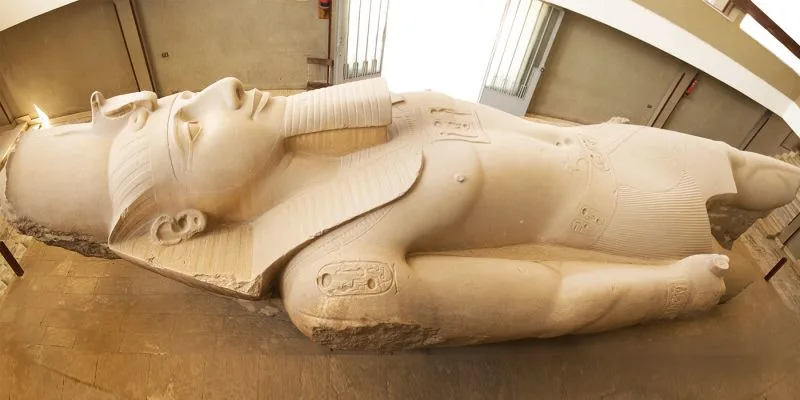
One of the best-known objects associated with Memphis is the colossal statue of Ramesses II. Ramesses ruled much later than the Old Kingdom kings buried at Saqqara and Dahshur, but his monuments show how important Memphis remained long after the pyramid age.
Royal sculpture of Ramesses II was part of the city’s later monumental landscape and helps demonstrate the continued significance of Ptah’s cult center.
The statue is often the visual highlight of a modern Memphis visit.
Other royal sculpture and temple remains
Excavations at Mit Rahina have recovered granite and limestone blocks bearing royal names, scenes and references to Ptah. Ministry reports on rescue excavations have documented blocks associated with the temple area and a rare royal ka-statue of Ramesses II.
These finds remind visitors that the visible open-air display represents only part of a much larger archaeological landscape.
What is the Memphis open-air museum?
The term “open-air museum” describes the display of sculptures and architectural pieces in the archaeological area rather than a conventional indoor museum with long gallery sequences.
Expect:
- large royal sculpture;
- temple blocks;
- inscribed stone fragments;
- objects connected with Ptah’s temple area;
- interpretation of the ancient capital.
The exact display can change as restoration and archaeological work continue.
How Memphis connects to Saqqara
Saqqara was one of the city’s great necropolises. Kings, officials and elites were buried on the desert plateau west of the cultivated valley, while Memphis itself functioned as a living administrative and religious center.
This relationship is one of the strongest reasons to combine the sites. At Saqqara, you see the funerary landscape; at Memphis, you learn about the city that supported it.
Read the Saqqara Egypt travel guide before planning the combined day.
How Memphis connects to Dahshur
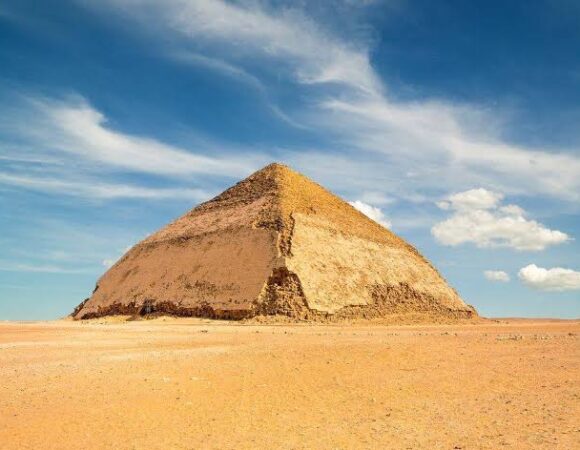
Dahshur formed the southern part of the Memphite cemetery zone. Sneferu’s Bent and Red Pyramids stand there, along with later Middle Kingdom pyramids.
By combining Memphis and Dahshur, you can connect royal power in the capital with the architectural experiments that led toward the classic pyramid form.
See the Dahshur Pyramids guide for a deeper look at the site.
Memphis and UNESCO World Heritage
Memphis and its necropolis were added to the UNESCO World Heritage List in 1979. The listed cultural landscape includes the city and the long chain of cemeteries associated with it, including Giza, Saqqara and Dahshur.
This means the famous pyramid fields should be understood as connected parts of a wider ancient metropolitan and funerary landscape.
How long do you need at Memphis?
Most first-time visitors do not need several hours. Roughly 45 to 90 minutes is usually enough to see the main displays and understand the city’s historical role.
That makes Memphis ideal as the middle stop between Saqqara and Dahshur.
Best order for a combined day
A practical route is:
- Saqqara in the morning.
- Memphis around late morning or midday.
- Lunch.
- Dahshur in the afternoon.
This sequence follows geography and historical development reasonably well.
Can you visit Memphis independently?
Yes, but the site benefits from interpretation more than many larger attractions. Because the visible remains are fragmentary, an Egyptologist can explain what belonged to temples, what comes from later periods and why individual sculptures matter.
What to wear and bring
- comfortable shoes;
- sun protection;
- water;
- hat;
- sunglasses;
- camera or phone;
- small amount of cash.
The visit is usually shorter and less physically demanding than Saqqara or Dahshur, but much of it is outdoors.
Memphis with children
The colossal sculpture can be visually engaging for children, and the city provides a simple way to explain the difference between a capital and a cemetery.
Keep the visit concise. Children are more likely to remain interested when Memphis is used as a short historical bridge between larger archaeological sites.
Photography
Large sculpture works well for scale photography, but do not climb, sit on or touch monuments. Follow current site rules and staff instructions.
Common mistakes
Expecting a complete standing city
Memphis survives as an archaeological landscape with fragmentary remains and recovered objects.
Skipping it because it looks smaller than Saqqara
The historical connection between the capital and necropolises makes it valuable in a combined itinerary.
Spending too long
For most travelers, the main value is context. Save enough time for Dahshur.
Assuming everything on display dates to the pyramid age
Memphis remained important for millennia, so many visible objects belong to later periods.
Frequently asked questions
Was Memphis the capital of ancient Egypt?
It served as a major capital, especially during the Early Dynastic Period and Old Kingdom, and remained an important city long afterward.
Is Memphis the same as Saqqara?
No. Memphis was the city; Saqqara was one of its principal cemetery areas.
What can I see today?
Expect royal sculpture, temple blocks and open-air archaeological displays rather than a fully preserved city.
How long should I spend?
About 45 to 90 minutes is enough for many first-time visitors.
Can I combine Memphis with Saqqara and Dahshur?
Yes. That is the most logical way to visit it from Cairo or Giza.
Why is Ramesses II important at Memphis?
His monuments show that the city remained significant long after the Old Kingdom pyramid age.
Plan your Memphis visit
The easiest complete route is the Saqqara, Memphis & Dahshur Day Tour. For the later Giza chapter of the pyramid story, compare the Grand Egyptian Museum & Pyramids Day Tour.
Sources and further reading